China UN envoy: Uphold true multilateralism







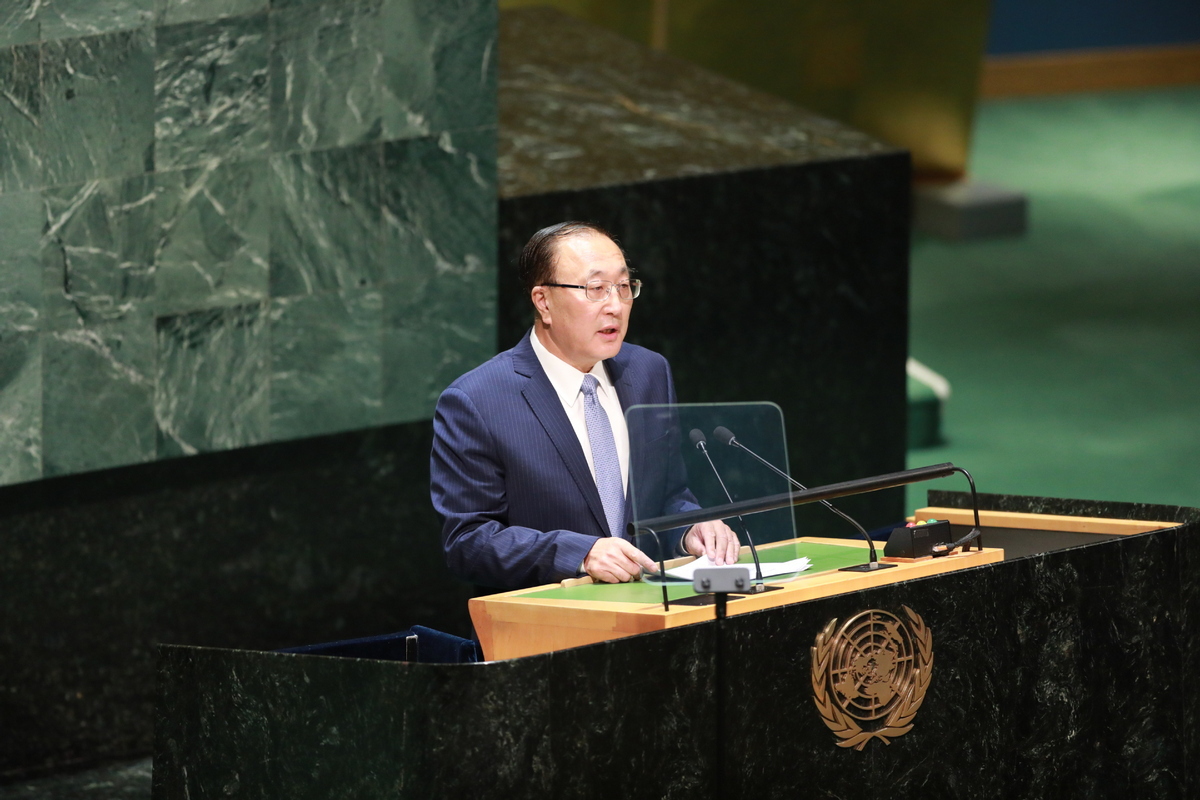
A Chinese ambassador to the United Nations on Wednesday urged the international community to uphold true multilateralism, instead of imposing rules unilaterally formulated by a few countries.
The challenges facing the world today are not because the purposes and principles of the UN Charter are outdated, but because those principles have not been effectively implemented; not because multilateralism itself has problems, but because the essence of multilateralism has not been truly practiced, Zhang Jun, China's permanent representative to the UN, told a Security Council meeting on Wednesday.
True multilateralism means adhering to the belief that the world is one family, and the destiny of mankind is shared, said Zhang. All countries should strengthen unity under the banner of the UN to achieve common development, maintain common security and create a common future, he continued.
"Decoupling is neither feasible nor reasonable," said Zhang, adding that drawing lines based on ideology and creating camps and exclusive cliques targeting specific countries "run counter to the spirit of multilateralism and will only push the world into division and confrontation".
True multilateralism means upholding the international system with the UN at its core, the international order underpinned by international law, and the basic norms of international relations based on the purposes and principles of the UN Charter, said Zhang.
The envoy emphasized that international rules should be based on international law and formulated by everyone, instead of imposing on the international community rules that were unilaterally formulated by a few countries, let alone engaging in exceptionalism and double standards.
True multilateralism means working together to achieve win-win cooperation, Zhang said.
"The UN should start from addressing common challenges, giving priority to promoting the implementation of the 2030 Agenda for Sustainable Development, and ensure that all countries, especially developing countries, benefit equitably from multilateral cooperation," he said.
The UN should be a platform for dialogue and cooperation, said Zhang. "No country should pursue monopoly advantages on the condition of harming the interests of other countries."
The Security Council is the core of the United Nations collective security system and an important platform for putting the concept of multilateralism into action, Zhang pointed out.
Under the current circumstances, it is the common expectation of the majority of member states to promote the Security Council to better perform the duties entrusted by the UN Charter, he said.
"No matter how different they are, members of the Security Council should respect each other, adhere to dialogue and consultation, accommodate each other's concerns to the greatest extent, and avoid creating divisions and confrontations," Zhang said, adding that despite the complexity of the challenges, it is always "our greatest responsibility to unite and cooperate to maintain international peace and security".
The international community's attempts to push the Security Council to resort to coercive measures such as sanctions often fail to achieve the desired effect, Zhang noted.
Existing sanctions should be reviewed, adjusted or canceled in a timely manner according to the development of the situation in the country concerned, Zhang said.
The Security Council should constantly improve its working methods, said Zhang. The most prominent and urgent thing in that regard is to systematically adjust the penholder system to change the unfair and unreasonable situation in which most issue penholder countries are dominated by a small number of permanent members or political groups for a long time, Zhang said.
"The voice of small and medium-sized countries on the agenda of the Security Council should be expanded by setting up co-pencil countries, co-chairing of permanent and non-permanent members, and regular rotation," said Zhang.
"The problems in the Security Council are the epitome of systemic flaws in global governance," he said. "It is necessary to comprehensively promote the reform of global political security, economy, finance, trade and other governance mechanisms; enhance the representation and voice of developing countries in global affairs; and promote the development of the global governance system in a more just and reasonable direction," he said.
"China supports reasonable and necessary reforms of the Security Council. The priority is to allow more developing countries and independent countries, including small and medium-sized countries, to join the Security Council, so as to completely reverse the imbalance in the composition of the Security Council," said Zhang.