Tanshishan relics prove pluralistic origin of Chinese civilization







CNS: How was it discovered? What achievements have been made in the archaeological excavations?
Dong Ping: The Tanshishan site is on the eastern coast of Fujian province, on the northwest side of a hill, in Tanshishan Village, Minhou County, Fuzhou City, adjacent to Minhou County, about 20 kilometers from Fuzhou on the east.
In January 1954, int the seventh district of Hengxin Township in Tanshi Village (now Danshi Village, on Ganzhe Street), villagers building a dam across the Minjiang River inadvertently dug up a pile of an ancient, peculiar style of pottery, stone tools and bone tools, as well as a thick pile of white shells. That April, the East China Cultural Relics Work Team assigned experts to investigate and found that the site contained rich relics and was an important cultural heritage of the Late Neolithic period. So in-depth excavation was needed, and thus it was named the Tanshishan Site.
After 10 archaeological excavations, the total excavation area reached more than 2,000 square meters. And a large number of relics such as trenches, ash pits, sacrificial pits, pottery kilns, stoves, pillar holes, etc. were found. More than 80 burials and a rich variety of cultural relics, including tools made of stone, bone, horns, teeth, shells pottery andjade, as well as primitive porcelain, were excavated.
These cultural relics and other archaeological materials reflect the rich cultural connotation and distinctive regional maritime cultural characteristics of the Tanshishan site, which has high archaeological research value. The previously unknown Min culture has also been gradually uncovered.
CNS: Why do we say that Fujian marine culture started from the Tanshishan site?
Dong Ping: During the Neolithic period, the role of mankind gradually underwent a major transformation from mere natural parasites to transformers, and people began to rely less on nature. During this period, the ancestors of Tanshishan culture also made creations with great maritime cultural characteristics.
Some of the artifacts excavated at the Tanshishan site, such as shellware and pottery kettles, have distinctive characteristics of marine culture and are the earliest, most representative and most systematic in Fujian.
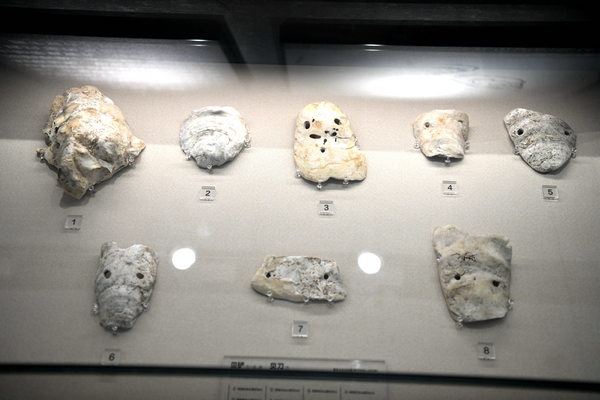
Shellware is a distinctive marine cultural artifact of Tanshishan culture, and the use of oyster shells to make various production tools is a unique cultural phenomenon. From the archaeological material, this shellware has four types: shovels, knives, chisels and adze-type ware, of which a majority of are shovels, and knives.
The shell shovel of Tanshishan culture is made of shell from the long oyster. Long oysters are one of the larger oysters in their family and are found mainly in the intertidal zone and shallow reefs of the sea. Most of the shellware was made of thin, flat right shells. The production of stone tools was more developed in this period, so the techniques for making stone tools, such as drilling, cutting and grinding, were also applied to the processing of shellware. The holes in the shellware were all formed by double-sided drilling, and the method used was not only chisel drilling but also cone drilling.
In the environment of the mountains and the sea at that time, it was especially important to discuss the sea economy. As a production tool, shells played an important role: a shell shovel can be used to dig all kinds of seafood in the mudflats; a shellfish knife can scrape animal fur, scales off seafood, etc.
Pottery kettles are the most typical and the most excavated pottery at the Tanshishan site. As the saying goes, “An empty sack cannot stand upright.” In the process of human civilization's development, cooked food improved human hygiene and promote physical and brain development, and pottery was the most suitable container. At the end of 1996, archaeologists found 18 pieces of pottery kettles, large and small, in the same tomb at the Tanshishan site, and the number is extremely rare. Many of these kettles have traces of fire at the bottom, and it is presumed that they were cooking utensils. The number of burial goods unearthed from different tombs showsthe social differentiation between the rich and poor and the hierarchical differentiation of the people of Tanshishan at that time. It can also be seen that thousands of years ago, at the confluence of the river and the sea, the ancestors of Tanshishan have begun to pay attention to delicacy: they cooked river food and seafood separately, refining the cooking.
The pottery kettle has carried the unique food culture of the Min people for thousands of years, so the dietary characteristics of the Tanshishan people, who sought food from the river and sea and love to drink soup, are fully reflected in the pottery kettle. This is also one of the distinctive features that distinguish the Tanshishan culture from the cultural remains of the Yellow River and the Yangtze River basin at the same time, with distinctive marine characteristics.