Clean initiative








China has been building communication platforms to push for global low-carbon energy transitions and green recovery to realize the UN 2030 Agenda for Sustainable Development
As the world faces cascading crises including accelerating climate change, surging energy prices and sluggish growth of economy, the aspirations set out in the United Nations' 2030 Agenda for Sustainable Development are in jeopardy. Amid intensifying major-country competition, the global clean energy transition is faced with new development trends as well as multiple challenges. China is playing a significant role in the global clean energy transition and gradually becoming a key driving force in advancing the transition.
Over the past few years, with accelerated technological innovation, constantly falling prices and ever-expanding application scenarios, clean energy has displayed growing potential in solving the climate crisis, ensuring energy security, improving access to modern energy services, and stimulating green recovery. Wind and solar generated a record amount of global power in 2022, accounting for 12 percent of global electricity generation, up 2 percentage points from 2021, according to the Global Electricity Review published by the independent climate think tank Ember.
Despite the growing global consensus on clean energy transition, hurdles are emerging on the path to clean energy. Aside from addressing uncertainties associated with breakthrough green technologies and project implementation, we have to navigate several major challenges to realize the energy transition.
To start with, the growth in clean energy generation falls well short of what is needed to meet the carbon neutrality goal.
To ensure short-term energy supplies and rein in energy prices, countries around the world have been accelerating the clean energy transition and at the same time, investing in and subsidizing fossil fuels, thus resulting in a rapid rebound in carbon emissions in the post-pandemic era. Furthermore, the share of clean energy use is much lower in the traditional industrial sector than in the power generation sector. Obstacles to green recovery are stark because of carbon lock-in and path-dependence amid green energy transitions. Currently, the nationally determined contributions are not on track to meet global climate goals. To solve the problem within eight years, all countries must increase their levels of ambition to reduce emissions, which is a grave challenge for all.
Second, the global North-South divide over clean energy development and divergences on the transition have been growing.
Lower-latitude countries tend to feel heavier effects of global warming. However, these "Global South "nations plagued by poverty are in a disadvantageous position in global clean energy transitions. They also lag far behind developed nations in capital input, the scale of development, technological innovation and business models, among others. Furthermore, the North-South divide over how to advance clean energy transitions has been expanding, in particular in such areas as priority issues in transitions (mitigation or adaptation), development pathways and transitional schemes, emissions reduction responsibilities and technology transfers.
Third, the geopolitical rivalry over global clean energy transitions has been intensifying.
In the development process of global clean energy industries, clean energy technologies and key mineral resources have become increasingly important, and acquiring these resources might result in new dependency on countries that produce them, thus creating new geopolitical conflicts. Over the past few years, European countries and the United States have been viewing China as a key competitor in clean energy development.
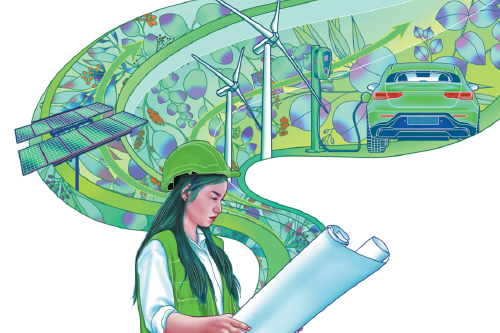
China has been playing an important role in global clean energy transitions and is expected to become a leader in international green energy systems and a defender of global energy security and sustainability.
To start with, by virtue of its structural advantages in green development, China is gradually becoming a backbone of global clean energy transitions, taking up leadership roles in such areas as clean energy technological innovation, equipment manufacturing, and value chain optimization.
To date, Chinese startups have attracted over one-third of global early-stage venture capital investment in the energy sector and China is increasingly playing an irreplaceable and important role in global clean energy technology value chains. China has noticeable advantages in the production of wind turbines, solar panels and electric vehicle batteries, etc. For instance, China takes up seven spots among the world's top 10 wind turbine manufacturers for wind power. China's photovoltaic industry has taken a lead in the world, accounting for around 70 percent of the global output. The country has been instrumental in bringing down costs worldwide for solar PV. China is also home to 70 percent of the global production capacity for cathodes; CATL and BYD collectively account for over 50 percent of the global power battery market.
Second, according to data from China's National Energy Administration, China's investment in renewable energy projects in Belt and Road Initiative partner countries has been growing in recent years, and has remained at more than $2 billion annually.
In 2022, Chinese companies completed power generation projects in 87 countries and regions. As a result, the new energy power generation industry (solar PV, wind power, biomass and energy storage) maintained a growth momentum, and 195 projects with a total contract value of $19.22 billion were signed, increasing by 9.9 percent year-on-year and accounting for 56.5 percent of the total energy project contract value.
Currently, Chinese clean energy companies and green investment projects are making great efforts to go global. The foundation for international cooperation on clean energy has been constantly consolidated. The key projects include the China-Pakistan Economic Corridor, the Bangladesh-China-India-Myanmar Economic Corridor, the China-Indochina Peninsula Economic Corridor, the China-Central Asia-West Asia Economic Corridor, the New Eurasian Land Bridge, the China-Mongolia-Russia Economic Corridor and the Sino-African cooperation, among others.
In the meantime, China has been advancing the integration between the green development of the Belt and Road and South-South cooperation on climate change. Since 2020, China has signed memorandums of understanding with Laos, Cambodia and Seychelles on low-carbon demonstration zones for addressing climate change. These cooperation schemes will help countries involved in the Belt and Road Initiative to improve their climate resilience and capacity for green transitions from both software and hardware. China has not only provided clean-energy materials, including solar PV, wind power equipment and electric vehicles, but also jointly mapped out low-carbon development plans in collaboration with the recipient countries and strengthened assessment of clean energy development potential and low-carbon talent training.
Last, China has been advocating open, win-win international multilateral cooperation to share development opportunities with the rest of the world, building communication platforms to promote global low-carbon energy transitions and green recovery and to realize the UN 2030 Agenda for Sustainable Development, and constantly pushing the establishment of a new governance order concerning climate change and new energy development.
The global clean energy partnership is an important platform and channel for China to carry out global climate governance, which helps promote relevant governance mechanisms by making them more fair, reasonable and efficient and provides a feasible pathway toward better governance of global clean energy.
The author is a research fellow with the Institute of Contemporary Socialism and a professor in the School of Political Science and Public Administration at Shandong University. The author contributed this article to China Watch, a think tank powered by China Daily. The views do not necessarily reflect those of China Daily.
Contact the editor at editor@chinawatch.cn.