Xi'an Declaration: A boon for cooperation







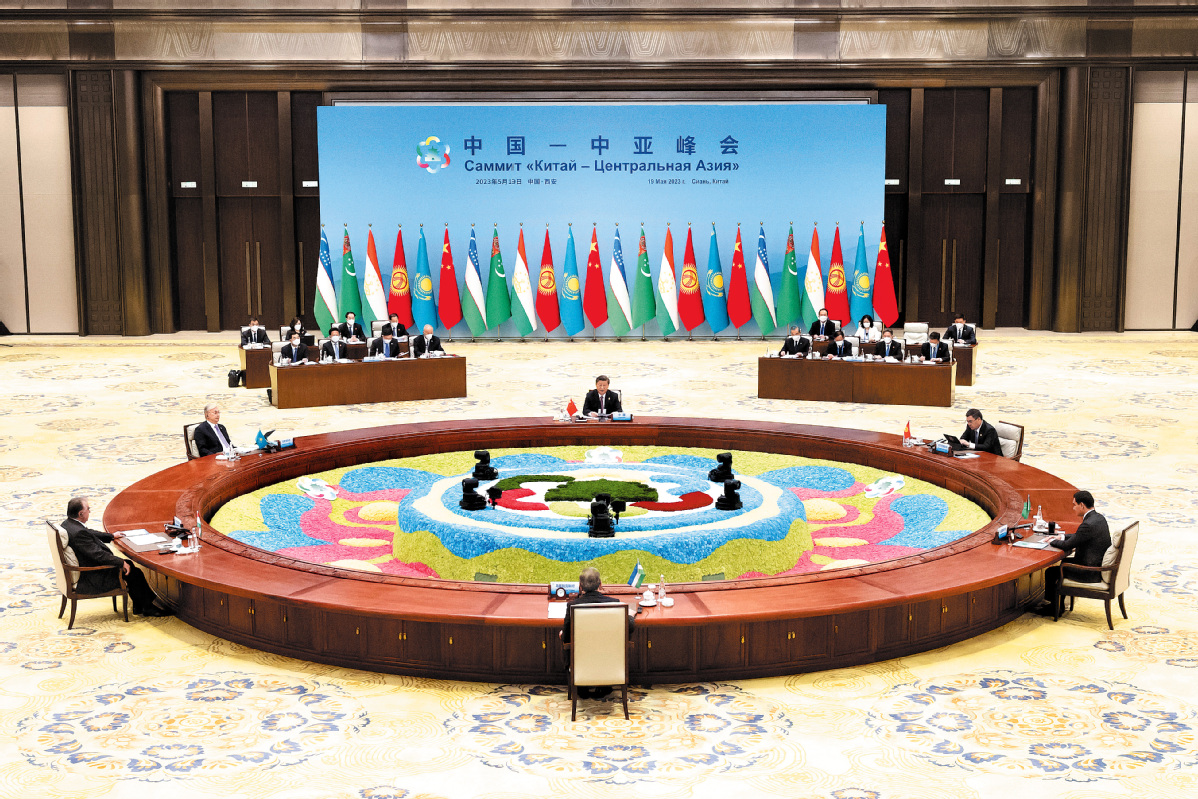
The China-Central Asia summit has concluded. It opened new avenues of cooperation between China and Central Asian nations while elevating regional collaboration to the next level. Leaders have agreed to make the Belt and Road Initiative a major platform to coordinate their respective development strategies. By further cementing their bond, through the Xi'an Declaration announced at the summit the leaders of six countries have stressed building “a closer community with a shared future” between China and Central Asia. As connectivity and regional integration are necessary to enhance economic development, neighboring South Asia must find inspiration and new methods of cooperation with China under the BRI in the wake of the initiative’s 10th anniversary.
During the summit, leaders from Kazakhstan, Kyrgyzstan, Tajikistan, Turkmenistan and Uzbekistan not only reaffirmed the importance of the BRI in regional development but also agreed to increase trade, boost connectivity via railways, roads and air routes. Construction of a cross-border railway between China, Kyrgyzstan and Uzbekistan was agreed to, with a promise of exploring further agricultural cooperation. According to the Xi'an Declaration, China and Central Asian countries have agreed to improve "hard connectivity" through infrastructure and "soft connectivity" through rules and standards under the BRI framework. Apart from infrastructure development, the leaders emphasized people-to-people exchanges, friendship and good neighborliness.
During the press briefing after the summit, Chinese President Xi Jinping said the six countries have agreed to support each other on issues concerning core interests such as sovereignty, independence, security and territorial integrity, respect the development path chosen based on each other's national conditions, and firmly oppose interference in internal affairs by any force or under any pretext. In a noteworthy development, the six countries have officially inaugurated the China-Central Asia Summit mechanism, with China and Central Asian countries taking turns hosting a biennial meeting. The next is scheduled to be hosted by Kazakhstan in 2025.
As neighboring regions, Central and South Asia are important to China, but the south has not been able to realize benefits from Chinese modernization and its economic progress like Central Asia has. Central Asian countries have been actively participating in the BRI, but South Asia is lagging due to the lack of a collective approach. Ten years into the BRI, China and Central Asian countries have made many historic achievements, whereas some South Asian nations are still undecided.
South Asia, the region that lies strategically in the heart of the Indian Ocean, offers unique significance for the BRI. This region is the home of populous countries like India, Pakistan, Bangladesh and Nepal and offers a strategic overland gateway. The region hosts several high-density projects including the China-Pakistan Economic Corridor, the Bangladesh-China-India-Myanmar Economic Corridor and the Trans-Himalaya Corridor. China’s cooperation with Bangladesh, Sri Lanka and the Maldives under the 21st century Maritime Silk Road has already taken shape.
If we look around the world, trade develops faster where there are more and better facilities, especially infrastructure such as roads, railways or ports. Thus, South Asia needs a collaborative effort to speed up the construction of new infrastructure to enable the shared prosperity of the region. One theorized reason for South Asia falling behind other regions in terms of prosperity and connectivity is nations in the region have followed diverse pathways of development while dealing with identical challenges. If connectivity and integration in the region were enhanced it could also deliver large benefits to its poorer population and offer sub-regional links to its neighbors.
The central philosophy of China's foreign policy is to achieve common development and prosperity through unity. Mutual respect for sovereignty, independence, territorial integrity and national dignity have been major characteristics of the Chinese approach. South Asian leaders should realize the region suffers from acute deficits in infrastructure financing, and sub-regional integration a deferred dream. This gap could be addressed by financing China is willing to offer. Since the 21st century is being termed the “Asian Century”, unfolding opportunities within a complex and rapidly changing global order demands South Asia and China collaborate more and make the BRI a venue for regional integration.
Saroj Gautam is a journalist from Nepal. He is pursuing his Ph.D. in international relations at China Foreign Affairs University in Beijing.
The opinions expressed here are those of the writer and do not necessarily represent the views of China Daily and China Daily website.
If you have a specific expertise, or would like to share your thought about our stories, then send us your writings at opinion@chinadaily.com.cn, and comment@chinadaily.com.cn.