Cheap tobacco, fat profits hazardous for smoking control







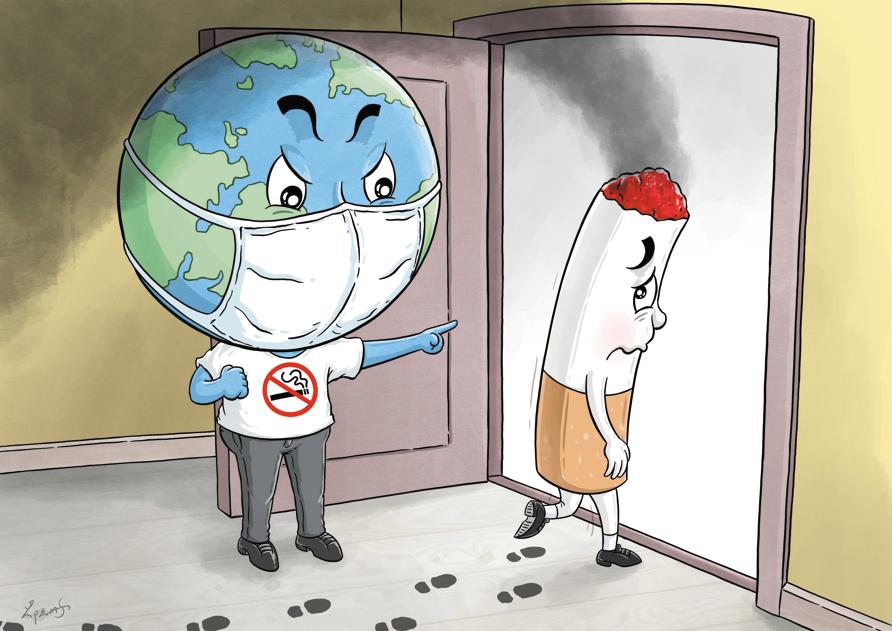
Editor's note: The World No Tobacco Day is highlighting the health and risks associated with tobacco use. The harmful impact of the tobacco industry on the environment is vast and adding unnecessary pressure on our planet's resources, writes a veteran journalist with China Daily.
The 36th World No Tobacco Day on May 31 passed here in China as normal like any other day. Unlike a few years ago when all the publicity organs were mobilized and millions of volunteers went on the streets to inform the public of the dangers of tobacco, few events were organized this year to mark the day.
The "quietness" of the day this year is against a background that despite great efforts made by the government and society in the past decade or so, China's smoking population is showing no remarkable decline and the tobacco industry is booming. Tobacco was introduced into China some 400 years ago by the Europeans who leaned smoking from the locals when they landed in South America. The Chinese picked it up quickly, smoking not only tobacco but also opium. Realizing that the popular opium smoking could eventually ruin the country, the then Chinese rulers attempted to ban the drug nearly 200 years ago.
The banning efforts triggered the Opium War (1840-42) when the United Kingdom, claiming that its interests were affected by the ban, sent dozens of warships to China. China lost the war and thus began its semi-colonial misery for nearly a century.
So, to the Chinese people, smoking is not only hazardous to personal health but also disastrous to the fortunes of the nation.
While opium smoking has been strictly and effectively abolished in China following the establishment of the People's Republic in 1949, tobacco smoking survived because of its popularity as well as the fact that its harms were not fully realized at that time.
With more and more smoking-led hazards discovered by scientists in the past decades, China has joined the global efforts to control smoking. A few years ago, cities such as Beijing and Shenzhen published local regulations banning smoking in public venues. There were reports of offenders, be they smokers or public venues that tolerated the smokers, being caught and severely punished.
But continuous implementation of such regulations is costly and with the passing of time, smokers are gaining their lost ground. Tobacco addicts are found smoking in corridors of their apartment buildings, claiming they have the right; diners are lighting up in restaurants with the owners turning a blind eye.
It is estimated that there are more than 300 million smokers in China. Since nearly 100 percent of the smokers are male, that means of every two Chinese men, one is a smoker.
While the health workers are working hard to persuade smokers to quit, a more dangerous enemy — electric cigarettes — has become popular in China. Claimed to be less harmful to health and environmentally friendly, e-cigarettes are gaining popularity among the young, including high school students.
Analysts do not hesitate to point out that money is behind the great difficulty in reducing the use of tobacco in China. The country is not only the world's No 1 in smoking population but also the biggest producer and consuming market. Even with the tobacco control efforts, there are still about 100 cigarette factories, making hundreds of millions of yuan in profits per day. That's a tax windfall for many local governments.
When a big portion of some local government revenues come from the tobacco industry, it is only understandable that they should be less than fully committed to implementing measures to control tobacco. Such regions will need to be encouraged to set up other pillar industries before they can be prompted to make more dedicated efforts to control tobacco.
Other analysts have suggested that the price of cigarettes be raised yet again to make it more difficult for smokers to have access to tobacco. The last time the price was raised was about 10 years ago and the price has since then been stable. As a result, what used to be expensive a decade ago has now become easily accessible to the public because of the increase in incomes, which have more than doubled on average during that period. The average price of a pack of cigarettes is only 16 yuan ($2.3) in China.
The unsatisfactory situation in China indicates that the road of tobacco control is going to be bumpy and zigzag. Though we may need another 36 years to achieve significant results, neither the governments nor the public can sit idle if we are to reach our destination.
The author is former deputy editor-in-chief of China Daily.