Quad cannot prevent China's rise







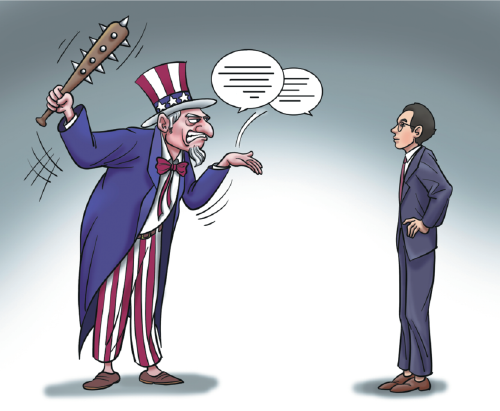
At their third in-person Quadrilateral Security Dialogue on the sidelines of the G7 Summit in Hiroshima, Japan, on May 20, the United States, Japan, India and Australia reaffirmed their commitment to a "free, open, inclusive, and resilient Indo-Pacific" region. But no matter how they package it, the "Quad" is nothing more than a typical example of Washington's "clique diplomacy" to contain China and maintain its global hegemony.
The US revived the Quad in 2017 to serve its global strategy, especially its "Indo-Pacific" strategy. In fact, the US launched the "Indo-Pacific" strategy in 2017 with the core objective of containing China by strengthening cooperation with partner countries, shaping a favorable "Indo-Pacific" order, and maintaining its hegemony. In recent years, the Quad's efforts to contain China have become increasingly pronounced.
After the Joe Biden administration took office, the Quad was elevated from the ministerial level to the summit level, and its first (online) Quad Leaders' Summit was held in March 2021.The scope of cooperation within the Quad has expanded from military security to include fields such as the economy, science and technology, and biosecurity.
While its joint statement this year did not directly mention China by name, it was subtly targeted at China. It opposed any attempts to change the region's status quo by force, undermine its stability, or engage in unilateral actions in the Asia-Pacific region. Expressing "serious concern" over the militarization of disputed islets, the dangerous use of coast guard vessels, and actions that could disrupt other countries' maritime resource development activities, the Quad vowed to intensify its countermeasures against China's infrastructure development in the region.
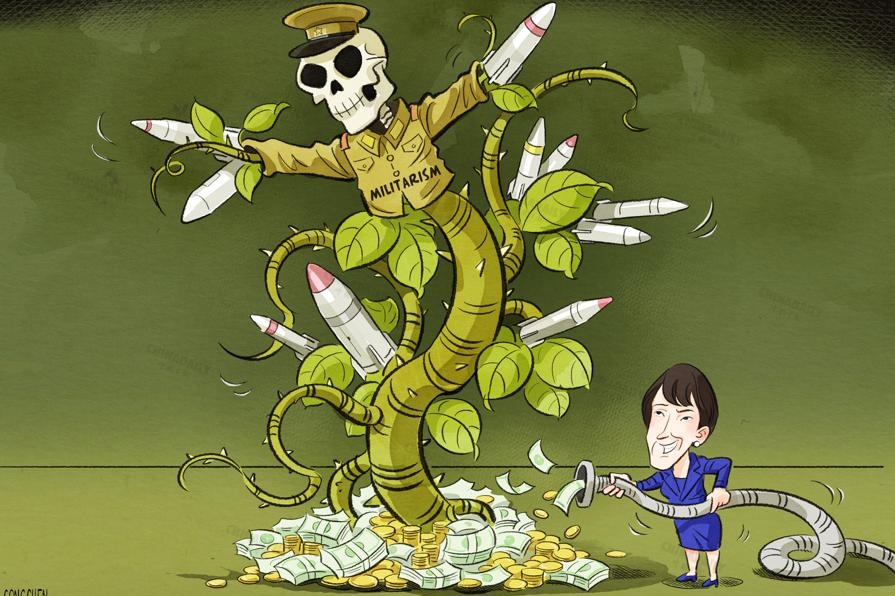
Despite repeated denials from the four countries, the Quad still exhibits a strong "Cold War" undertone. As the leader of the Quad, the US' main goal is to rally allies and partner countries in the anti-China camp, and seek regional advantages through alliances and partnerships.
Similar to the Cold War, military and technology are the two important areas where the US uses the Quad to contain China. Since the revival of the Quad, military and security cooperation among the four countries has been steadily strengthening. For instance, the Malabar naval exercise has evolved from a bilateral military drill between the US and India to a trilateral exercise among the US, India and Japan and a quadrilateral naval exercise with the inclusion of Australia in 2020.
And in 2022, the Quad launched a new maritime security initiative called the "Indo-Pacific Partnership for Maritime Domain Awareness", which currently is in pilot phase.
In the field of technology, the Quad has intensified its efforts to check China's technological advancement, by establishing a "Critical and Emerging Technology Working Group" and launching the "Semiconductor Supply Chain Initiative".The joint statement of the Quad also mentions critical and emerging technologies, meaning the grouping intends to become the leader in innovations and strengthen "supply chain resilience".
Apart from causing disruptions in the "Indo-Pacific" region, the Quad engages with countries outside the grouping in an attempt to lure them into its fold to contain China, thereby creating divisions in the region. The joint statement specifically mentions ASEAN, the South Pacific and the countries around the Indian Ocean, emphasizing the importance of the regional leadership of the Association of Southeast Asian Nations and pledging to further consolidate the Quad's relationship with ASEAN and expand cooperation.
The statement also promises to expand cooperation with Pacific island countries and the Indian Ocean Rim Association, as well as to increase investment and infrastructure construction, particularly laying submarine cables, in the Asia-Pacific region. Besides, it has announced initiatives such as the Quad Infrastructure Fellowships Program and Quad Partnership for Cable Connectivity and Resilience.
Recent years have also seen the US and Australia repeatedly undermine and disrupt underwater cable cooperation between China and other countries, while the Quad has said it will take measures to counter the China-proposed Belt and Road Initiative and pressure regional countries into making a "binary choice".
The Quad has been trying to create divisions and raise tensions in the region, posing a serious challenge to the regional order and security. Particularly concerning is the potential escalation of maritime tensions and increased risks of naval clashes due to the US' aggressive military activities in the region. In recent years, Quad member states have conducted frequent military drills and other activities in the South China Sea, with the US carrying out illegal air and naval reconnaissance and patrols.
The Quad has also conducted military activities with some ASEAN members and non-regional countries such as the United Kingdom and France in the South China Sea. These activities are likely to boost the military confidence of the countries that have disputes with China in the South China Sea, increasing the risk of maritime confrontations and undermining the relatively stable security environment in the region.
The establishment of the Quad Infrastructure Fellowships Program and the Quad's intensified efforts to disrupt supply chains and infrastructure projects targeting China make it even more difficult to develop a free, open and prosperous Asia-Pacific region.
And yet the US says it wants to improve relations with China and has no intention of challenging China. This is nothing but an effort to create a smokescreen which it believes will allow it to continue its anti-China activities without being noticed. The US is wrong, because even the dumbest person knows that it is not possible for the US to improve its relations with China while it strengthens its military presence in the region to counter China.
The Quad cannot prevent China's rise. While the four countries share the common goal of containing China, their specific interests and preferences vary greatly. In particular, India lacks the strong motivation needed to contain China and its position is different from the other three countries' on issues such as the Russia-Ukraine conflict. So it is unlikely that the Quad will turn into a solid US-led alliance.
Moreover, the majority of countries in the region are unwilling to take sides between China and the US. While Washington may have grand ambitions of containing China by using the Quad, it is likely to fall short of its objectives.
Therefore, the Joe Biden administration should seize the opportunity of Secretary of State Antony Blinken's visit to China on Sunday and Monday to change its short-sighted China policy, and commit to concrete actions that match the US president's statements that the US desires to cooperate with China for global good.
The author is vice-president of the China Institutes of Contemporary International Relations.
The views don't necessarily reflect those of China Daily.