Vision into action
Belt and Road Initiative promotes the emergence of a more equitable and peaceful international order







Belt and Road Initiative promotes the emergence of a more equitable and peaceful international order

As is well-known, Chinese President Xi Jinping proposed building the Silk Road Economic Belt in Kazakhstan in September 2013 and the 21st Century Maritime Silk Road in Indonesia the following month. In March 2015 the Vision and Actions on Jointly Building Silk Road Economic Belt and 21st Century Maritime Silk Road was published by the Chinese government. In May 2017 and April 2019, the first and second Belt and Road Forums for International Cooperation were held with a third planned for 2023.
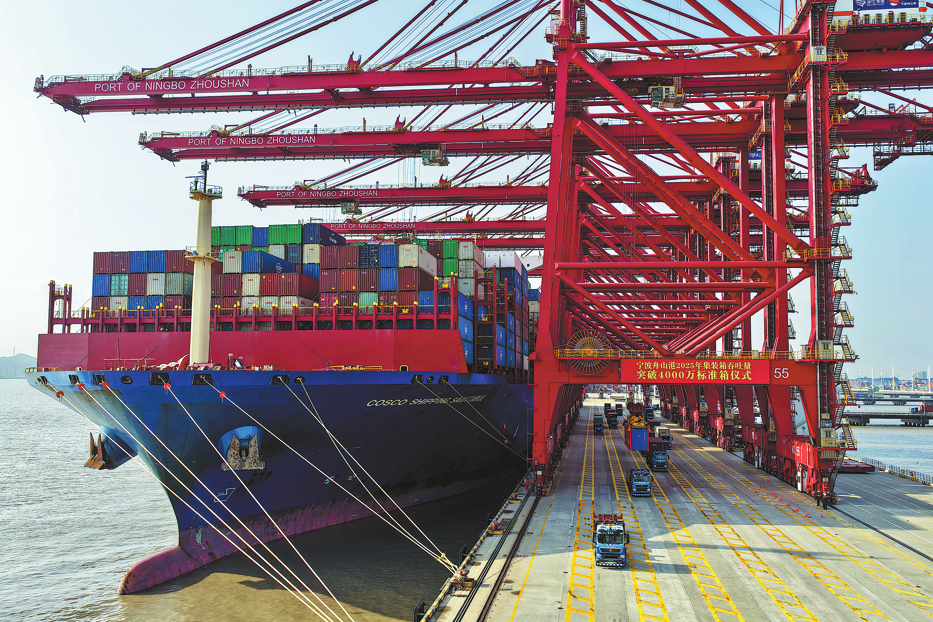
Essentially, the Belt and Road Initiative, as they are now collectively known, comprises a set of bilateral and multilateral deals between China and other countries designed to increase connectivity, trade, investment, people-to-people relations, financial integration, policy coordination and industrial development. Since the Ministry of Commerce started to report data on China's non-financial direct investment in Belt and Road countries, it has risen almost constantly despite the economic turbulence of the past few years, from $14.83 billion in 2015 to $20.97 billion in 2022. The value of new foreign construction projects increased from $92.64 billion in 2015 to $154.9 billion in 2019. In 2022 in spite of the continuing COVID-19 pandemic it stood at $129.6 billion.
The Belt and Road Initiative is a multilevel infrastructure framework centered on energy and power, railways, roads, shipping, aviation, pipelines, cross-border fiber optic cables and integrated space information networks designed to reduce transport and transaction costs and share information, along with economic development zones, energy, water and social infrastructure. Initially embracing Asia, Europe and Africa, it has been extended to the Pacific and Latin America, and it is aimed at peaceful economic cooperation and development.
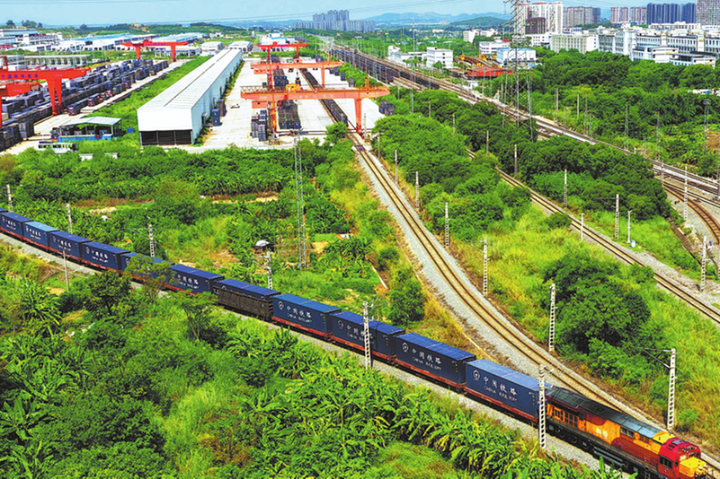
A striking example of this is the China-Europe Railway Express. From 2011 to 2022, trains completed over 65,000 trips and shipped freight worth $300 billion. A network of 82 service lines traverses Eurasia connecting over 200 cities. In China there are five gateways/ports including Horgos and Alashankou Port in the Xinjiang Uygur autonomous region, Manzhouli in the Inner Mongolia autonomous region, Suifenhe in Heilongjiang and Erenhot Port in the Inner Mongolia autonomous region. As these cases show, the goals are to drive development with an increasing emphasis on projects that are high-quality, equitable and green.
The Belt and Road Initiative is a project that all countries can join. As China repeatedly insists Belt and Road projects are win-win which means that they do involve gains for China but these gains coexist with gains for China's partners. Negotiated and managed economic integration (centered on equality, mutual respect and self-reliance) can generate win-win outcomes in which the results of increased productivity as a result of economies of scale and increased market size, reductions in uncertainty and risk, technological spillovers, reductions in social overhead costs and increased efficiency of value chains are shared. Within each country these gains can be widely distributed given appropriate national and local policies.
From the outset, the Belt and Road Initiative has been centered on the Five Principles of Peaceful Coexistence: mutual respect for each country's sovereignty and territorial integrity and the diversity of civilizations, mutual non-aggression, mutual non-interference in a country's internal affairs, equality and mutual benefit (win-win cooperation and fairness and justice), and peaceful coexistence. On its launch, President Xi pointed out that the historical Silk Roads had shown that "countries of different races, beliefs and cultural backgrounds are fully capable of sharing peace and development". More recently the Belt and Road Initiative has assumed a role in China's aim to help construct a global community with a shared future for mankind.
In fact, the Belt and Road Initiative is one of a number of striking Chinese initiatives whose goal is to address global issues. In 2017, President Xi said that the initiative is a Chinese contribution to answer two questions: what is wrong with the world and what should we do? What is wrong is the existence of three deficits: a peace deficit, a development deficit and a global governance deficit. The last includes the need to rescue the United Nations Charter whose first two articles call for the maintenance of international peace and security and the sovereign equality of all members. The governance deficit also involves the need to act collectively to deal with conflict, security, development differentials, refugee movements, climate change, the environmental and biodiversity crises and health issues. More recently, China pointed to a security deficit and the importance of the principle of indivisible security.
The Belt and Road Initiative and the subsequent initiatives reflect distinctive values and principles deriving from several sources. Alongside the Five Principles of Peaceful Coexistence, distinct Chinese civilizational values and hybrid Chinese characteristics resulting from its international engagement have led to a distinct Asian vision of an international order that Western civilization finds it difficult to understand. In the past (until 1894) the East Asian world system (setting aside Western interventions) was much more peaceful than Western civilization. Chinese thought draws on a traditional distinction between a king who rules by benevolence and righteousness and a hegemon who rules by power. Chinese civilization rejects the principle of hegemony.
China's vision is a harmonious international order rooted in Chinese concepts of "all under heaven", relationality and symbiosis. In this light, the Belt and Road Initiative can be described as a vision of the world in which the success of one country can only be guaranteed by the success of all. The Belt and Road Initiative is only a success if all its member states develop and prosper in tandem.
This vision of a more equitable and harmonious multipolar world is reflected not just in the Belt and Road Initiative but also in other Chinese initiatives: the Global Development Initiative to help "other developing countries to pursue the UN 2030 Agenda for Sustainable Development", jointly address "global humanitarian challenges" and support "endogenous growth"; and the Global Security Initiative and Global Civilization Initiative; as well as the concept of building a community with a shared future for mankind.
In short, while watching the progress of concrete Belt and Road Initiative projects and the new financial and governance architecture associated with them, one should always keep in mind the way the initiative seeks to contribute to the development of a more equitable and democratic global order that has no need for a global Leviathan.
The author is emeritus professor of the University of Sussex and a visiting professor at the Institute of Geographical Sciences and Natural Resources Research at the Chinese Academy of Sciences. The author contributed this article to China Watch, a think tank powered by China Daily.
Contact the editor at editor@chinawatch.cn.