'De-risking' another term for decoupling







Expert says US using new word with a negative connotation toward China
No one believes the US and China will decouple, so the US shifted to the term "de-risking" instead of decoupling, according to a foreign policy and military expert.
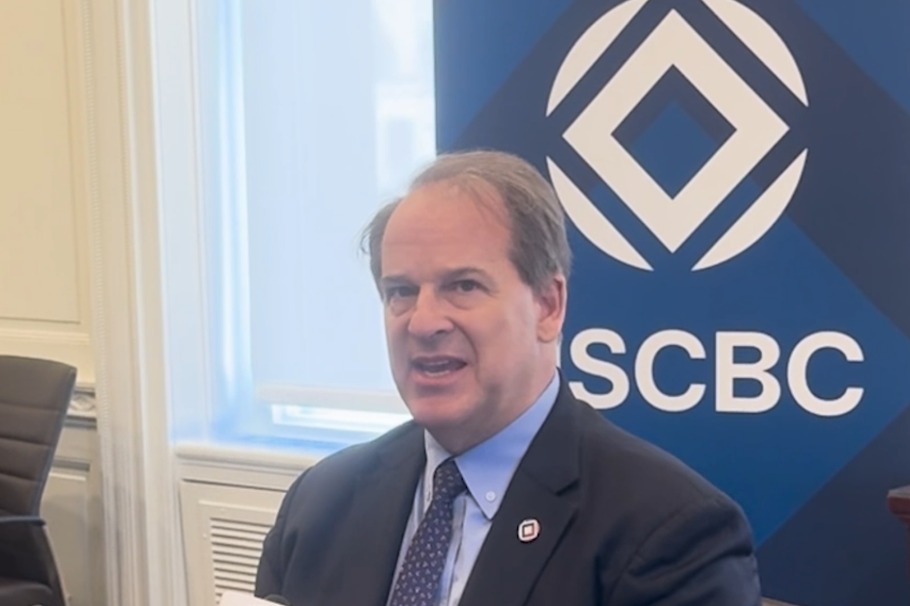
"The two terms are exactly the same in practice," Jack Midgley, the principal of global consultancy Midgley & Co, told China Daily.
De-risking is not a new term, Midgley said. As an old term from the financial services industry, de-risking, for example, is when a bank decides to stop doing business with a type or category of customers to avoid money laundering problems or other penalties.
"It has a very negative connotation," said Midgley.
In the past two or three months, more US high-level officials are using de-risking as a fashionable term to describe the US strategy toward China.
"We are for de-risking, not for decoupling," said Jake Sullivan, the US national security adviser, in a speech on April 27. "De-risking fundamentally means having resilient, effective supply chains and ensuring we cannot be subjected to the coercion of any other country," he said.
Antony Blinken, the US secretary of state, said his country was seeking to "de-risk and diversify", not decouple from China, in remarks at the end of a visit to Beijing.
US imports of goods from China totaled $536.8 billion in 2022, according to data released by the US Department of Commerce earlier this year. US exports to China rose 1.6 percent to $153.8 billion last year.
"That's a huge part of the American economy. And a huge part of the Chinese economy," said Midgley. "The idea of decoupling the US and the Chinese economies is something that no one believes."
Midgley said the US has "militarized" its relationship with China. "The US side needed a different word to say the same thing. And so, they used the word 'de-risking,'" he said.
US President Joe Biden, after the G7 summit in May, told the media that de-risking means "resisting economic coercion together and countering harmful practices that hurt our workers "and "protecting a narrow set of advanced technologies critical for our national security".
At the summit, the leaders agreed on a shared strategy to "de-risk, not decouple" their nations' economic engagement with China.
"So, de-risking is about the security relationship," Midgley said.
"When we, the Americans, actually implement de-risking, what do they do? They (US officials) apply export controls or tariffs."
Midgley said the US Commerce Department uses export controls or even sanctions on technology that will improve the speed or accuracy of decision-making, which covers "almost any IT, any computing technology, any analytical technology".
"Well, that's the American idea of de-risking. But what is actually happening is we're shutting down trade on these sensitive technologies, and it's even broader than that," he said.
"De-risking means taking any action that the US government wants to take to limit trade with China," Midgley said. "The de-risking and the decoupling are exactly the same in practice."
Euphemism, repackaging
China considers de-risking a euphemism for decoupling.
Yang Tao, the director-general of the Chinese Foreign Ministry's Department of North American and Oceanian Affairs, said in a June 23 interview that de-risking is no different from decoupling, as both policies focus on de-Sinicization.
"Our question is whether de-risking is just a repackaging of decoupling," he said.
The so-called de-risking of relations with China drew attention when the European Commission President Ursula von der Leyen explained why she would visit Beijing in April and why Europe would not follow calls for decoupling, in her March 30 speech.
On June 20, the European Commission unveiled its economic security plan, aiming to persuade all 27 member states of the bloc to enforce stricter regulations on the export and outflow of technologies that could potentially be used for military purposes by rivals using the term de-risking without naming China.
"The Europeans say any outbound investment that we make, whether that's in China or anywhere, we want to make sure that it's not used for military applications," said Midgley. "I think we can say that European policies are narrower. They don't cover as much as the US policy."
Frances Burwell, a fellow at the Atlantic Council's Europe Center, sees de-risking as "an alternative to decoupling". But she suggested differentiating "those parts of our economic interaction with China that do pose a real national security risk".
"I would actually argue that some of the focus on chips is misdirected, or at least the responses that we've seen are misdirected because there are lots of chips that are pretty boring, mundane, used in everyday applications," Burwell said at a June 23 Atlantic Council event titled "Competition or Cooperation: Debating a Transatlantic De-Risking Strategy on China".
At the same event, Alicia Garcia Herrero, the chief economist for Asia-Pacific at Natixis, a French investment bank, said the needs of Europe and the US are different.
"The whole idea of having a unified, monolithic view about China is also very dangerous because it can be the wrong view," she added.
The de-risking from Europe and the US toward China, Midgley added, is not "aligned".
yifanxu@chinadailyusa.com