Greater division for East Asia
Japan's security diplomacy will weaken trust with regional neighbors, potentially resulting in isolation and opposition








Japan's security diplomacy will weaken trust with regional neighbors, potentially resulting in isolation and opposition
In the great power competition, the Joe Biden administration views China as the "most important geopolitical challenge to the United States". With its own relative decline in power, the US is leveraging Japan as a force multiplier in its strategic competition against China. To maintain US hegemony, the Japanese government closely aligns its China policy with that of the US with a focus on countering China.
Thirty-one out of 500 pages in the latest version of the Defense of Japan annual white paper released on July 28 mention China. This is the first defense white paper since the release of three other documents — the National Security Strategy, National Defense Strategy and Defense Buildup Program — at the end of 2022.
The white paper questions the increase in China's defense budget, accuses China of increasing military activities around Japan, and extensively discusses China's Taiwan, sensationalizing the so-called military threat from the Chinese mainland. The white paper sensationalizes the security environment and the "China threat" as the drive for Japan to alter its security policy since the end of World War II.
Guided by the Yoshida Doctrine, Japan minimized its own defense efforts and focused on economic growth after World War II. It grew to become a major economic power and exerted its influence in the international community through economic means.
However, post-Cold War Japan slid into a prolonged recession as its economic bubble burst. By 2010, it was overtaken by China as the world's second-largest economy. No longer an economic powerhouse, Japan has sought to shift to being a military power through "proactive pacifism", aiming to establish military deterrence over its neighbors.
A research report from Japan's National Institute for Defense Studies, a policy research arm of the Ministry of Defense, explicitly states that Japan is not a third party but a direct participant in the great power competition and takes the same strategic stance as the US across various fields. To uphold the US-dominated international order, Japan is deepening the "Indo-Pacific strategy", portraying China as "dangerous".
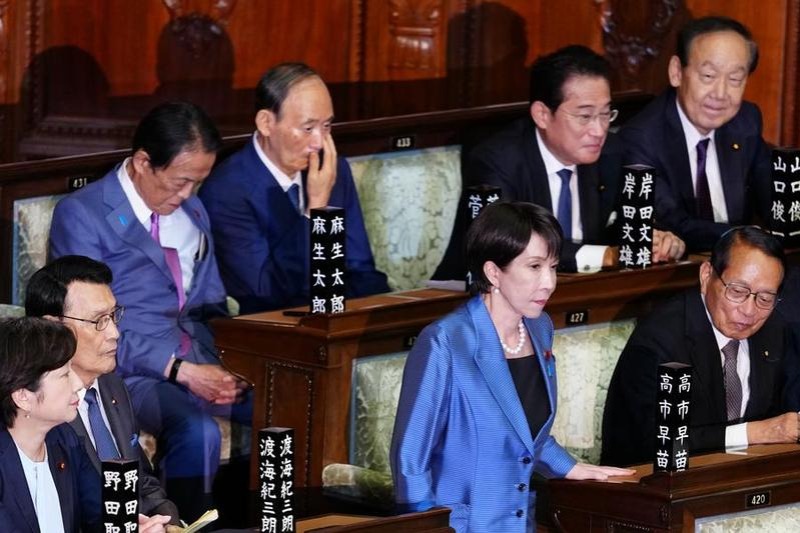
It is worth noting that the "modernized alliance" promoted by the Japanese government and the US no longer puts emphasis on the US obligation to protect Japan. Instead, it advocates for Japan to shoulder more responsibilities and play a greater role in the alliance. The intention is to keep the relatively weakened US engaged in Asia, so Japan, without a standing army, can continue to leverage the security guarantee of the US and reap the benefits of the "American order" during the "new era of crisis". In multiple meetings between the leaders of Japan and the US, Japanese Prime Minister Fumio Kishida made it clear to Biden that Japan needs to fundamentally strengthen its defense capabilities.
Sticking to the Cold War mentality of aligning with the US and countering China, Japan expresses its concern about China's normal military development in its white paper, while dramatically increasing its own defense budget, allocating 43.5 trillion yen ($303.22 billion) for defense expenditures over the next five years.
Japan's new Cold War thinking is detrimental to the security situation in East Asia. On the one hand, the escalation of the "China threat" narrative and criticism of the legitimacy of China's rise will undoubtedly stir up regional tensions, increase contradictions and opposition between nations, and undermine the stable security environment required for the peaceful development in East Asia.
On the other hand, Japan's efforts to build counter capabilities and increase security assistance to regional countries will lead to security confrontations and arms races in the region. With a history of militaristic aggression, Japan is breaking from its past exclusively defense-oriented policy which will trigger concerns and strong backlash from regional countries, leading to new security issues and even conflicts.
Since the modern era, East Asia has been divided. Countries have taken different paths, joined different blocs, and written different histories. Upholding the oriental value of "harmony in diversity", East Asia has achieved stable and rapid postwar development, by respecting diversity and co-building peace.
The Kishida administration's "realism diplomacy in a new era" and the "Indo-Pacific Strategy", however, take the "democratic values" as the primary pillar. The new defense white paper judges the surrounding security environment based on so-called democratic values, viewing countries that "do not share universal values nor political and economic systems based on these values" as threats and denying the legitimacy of China's rise.
Japan's National Security Strategy emphasizes the need to create a favorable security environment for Japan, but its security diplomacy is undeniably a new form of "leaving Asia for the US".This will inevitably weaken mutual trust between Japan and its neighboring countries, let alone build a beneficial security environment for Japan and East Asia. Japan's manipulation of "values" will lead to greater division in the East Asian region, potentially resulting in isolation and opposition. This is a matter of concern.
The author is a researcher at the Institute of Japanese Studies at the Chinese Academy of Social Sciences. The author contributed this article to China Watch, a think tank powered by China Daily. The views do not necessarily reflect those of China Daily.
Contact the editor at editor@chinawatch.cn.