Camp David summit does not bode well for the Asia-Pacific region







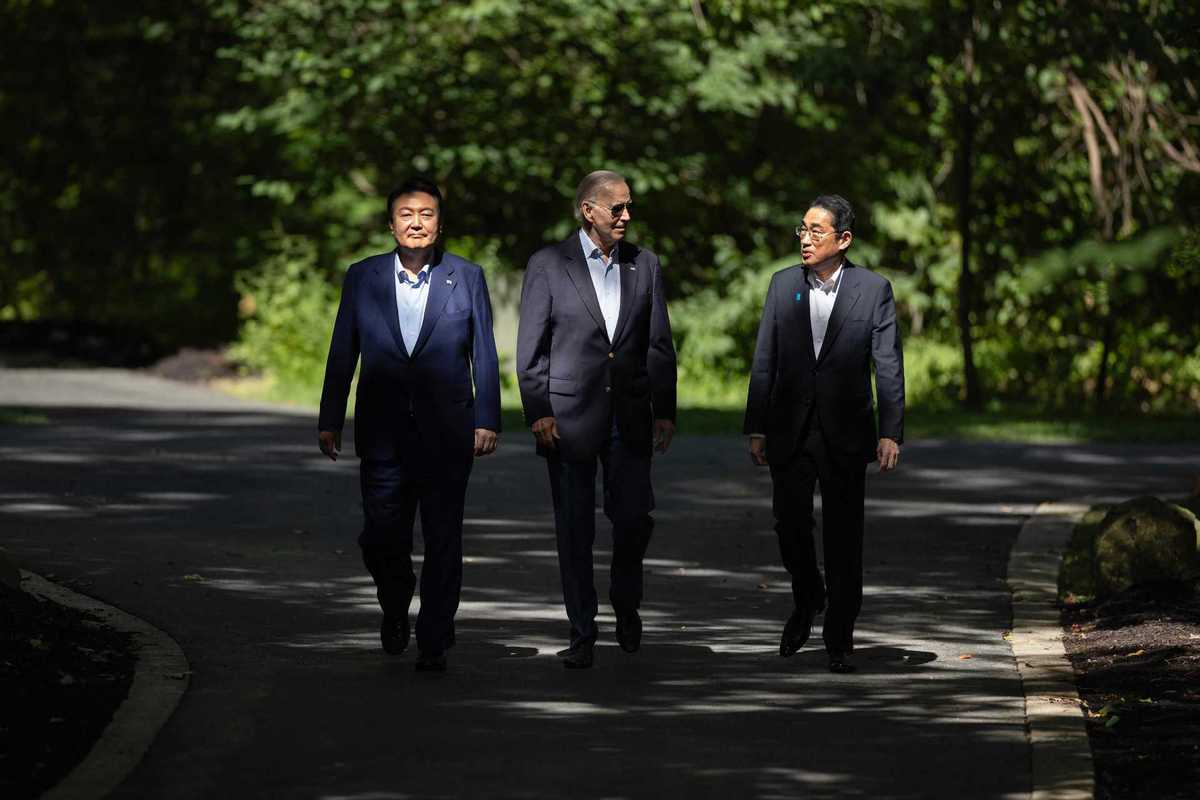
It seems that Camp David, the US presidential retreat, has become the epicenter of a new Cold War and an instrument for covert formation of a mini-NATO in the Asia-Pacific region, after the recent trilateral meeting of the leaders of the United States, Japan and South Korea.
The meeting on Aug 18 was the first time that the nations held a trilateral summit on an occasion other than at an international conference, and also was the first time that US President Joe Biden hosted foreign leaders at Camp David since taking office in 2021. This vividly reflects the meeting's geopolitical and geostrategic importance.
Despite US officials' denial that the US-Japan-South Korea summit was against China, their statements and agreements run counter to their claim.
The agreements mainly focus on military alliance moves, and their statements not only contain premeditated inclusion of the Taiwan Strait and the South China Sea, but also have strong wording about so-called dangerous and aggressive behavior by China, not the US, in the South China Sea.
Such ill designs and grand policies of a zero-sum game on the pretext of peace and stability, just to justify their containment of China, elucidate the chronic schemes of these three allies against China, making their officials blatantly hypocritical, with Camp David standing out as part of the anti-China syndrome.
Instead of any dovish endeavor for regional peace, Biden's holding of the summit with South Korean President Yoon Suk-yeol and Japanese Prime Minister Fumio Kishida brought new military commitments, followed by the holding of joint military drills, a strengthening of China-excluded semiconductor supply chains, cybersecurity and artificial intelligence, and moving jointly toward encircling China to further consolidate US hegemonic designs.
Furthermore, the trilateral agreement to pilot a supply chain early warning system to guard against disruptions of certain products, including critical minerals used in electric vehicle batteries, smacks of economic coercion.
The three countries are moving toward an interlinked security environment and a mini-NATO mechanism. It is seriously concerning that such plans, which serve the US' strategic competition with China and weaken China's development prospects, are being chalked out. The trilateral framework could be gradually institutionalized in these countries in coming years, creating further uncertainty and instability in the region.
In addition, the three countries have actually tried to forge their image as defenders of peace and stability in the so-called Indo-Pacific region, rather that troublemakers and creators of camp confrontation.
Wang Wenbin, a spokesman for China's Foreign Ministry, rightly urged the three countries to uphold true multilateralism amid a complex international security situation.
However, although both Seoul and Tokyo are bent by US military bases and politics, conflicting realities on the ground indicate a declining political grip by and acceptability of South Korean President Yoon, as his pro-US policies and olive branch offering to Japan have been labeled by some as a national disgrace. Neither is Kishida's approval rating at home satisfactory.
The current policies of the leaders of Japan and South Korea reflect a lack of independence, making their diplomatic approach unbalanced, which will surely affect these leaders domestically.
The Camp David summit has turned out to be another deliberate extension of the US containment of China, the US military industrial complex, Biden's executive order restricting US investment in China, and sanctions against Beijing, by involving South Korea and Japan. It may be appropriate to say that the trilateral summit was the first shot in a new Cold War.
However, this might not be a good omen for South Korea or Japan, because China is their huge trade partner and close neighbor. Their business communities already are feeling the chill from the Camp David results.
Ultimately, the implementation of the Camp David agreements will create economic imbalance, industrial supply chain disruption and security paradoxes in the days to come, which will hurt both Japan and South Korea, at least.
The author is executive director of the Center for South Asia & International Studies in Islamabad, Pakistan.