China's manufacturing speeds up for digitalization







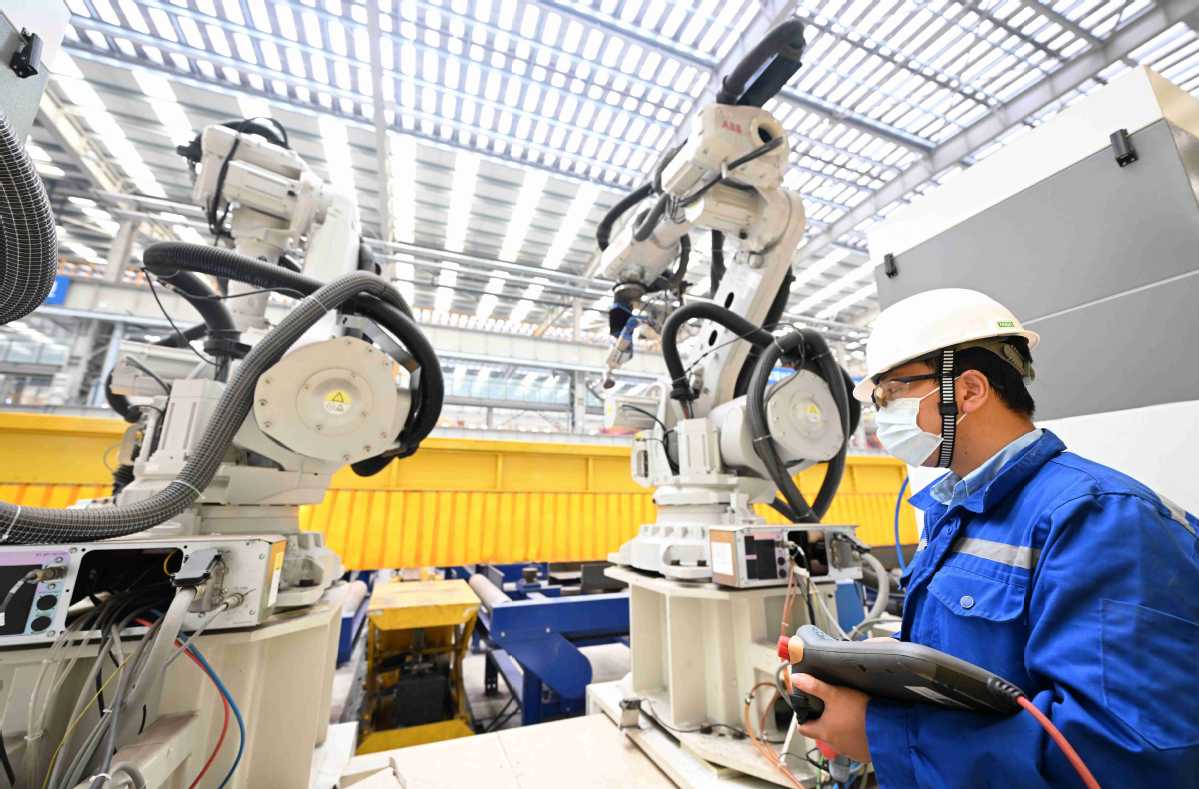
The Chinese manufacturing industry is embracing digitalization at an accelerated speed, experts and industry veterans said, calling on the government to provide more support for small and medium-sized enterprises in their "going smart" drive.
"Intelligent manufacturing is showing a trend of accelerated development in China and strong businesses are becoming even stronger in the field," said Qin Shuo, an influential opinion leader in business and finance.
Leading and major enterprises in the manufacturing industry that have embarked on digitalization have made favorable achievements from the move, and this, in turn, encourages them to devote more resources to it, he said at a forum during the Tencent Global Digital Ecosystem Summit, which is being held in Shenzhen from Thursday to Friday.
According to the statistics from the Ministry of Industry and Information Technology released in July, the number of digitalized workshops and intelligent factories in the country had reached nearly 8,000.
Of them, over 2,500 had basically completed the process of digital transformation and 209 had become demonstration factories with world-class intelligent manufacturing capability.
With the help of advanced technologies, the average period of product R&D among those model plants has reduced by 20.7 percent and production efficiency has been enhanced by 34.8 percent. The rate of defective products, meanwhile has declined by 27.4 percent on average. The transformation has also cut average carbon dioxide emissions in those factories by 21.2 percent.
Qin said local governments should play an active role in promoting digitalization among businesses, especially SMEs, by providing them with financial support.
Some district-level government departments in Shenzhen, Guangdong province, have already started to subsidize SMEs for their consumption of computing power, which Qin said is "a highly correct move".
"It may not be a problem for large enterprises. But for SMEs, they would consider whether it is cost-effective to consume a large amount of computing power. It is essential that the government could provide a driving force for them," he said.
Huang Jinjie, senior advisor of electric vehicle battery maker Sunwoda Electronic, said the company has relied on digital transformation to deal with external uncertainties. "Digitalization is not a choice, but a must," he noted.
"In the past, 80 to 90 workers were needed to work on a 100-meter production line in our factory. By leveraging digital solutions, we now only need three to five workers there, with efficiency significantly being enhanced."
He added that the company has set up an intelligent manufacturing unit, which focuses on exporting its experience in digital transformation to other enterprises in the upstream and downstream so that synergies could be created in the whole industry chain.
According to a white paper on industrial digitalization and intellectualization, jointly published by Huawei Technologies, China Academy of Information and Communications Technology, and Roland Berger, the rate of digitalized equipment in the country is expected to reach 65 percent by 2025, up from 51.5 percent in 2021.
Sharing his thoughts on the trend of the manufacturing industry in the next three to five years, Cao Lei, vice-president of Tencent Cloud, the cloud-computing arm of internet giant Tencent Holdings, believes "going global" should be a vital strategy for Chinese manufacturing enterprises to adopt.
He took engineering machinery as an example, saying that despite the overall downturn across the wider industry in the first half of the year, this segment still posted double-digit growth in overseas revenue.
"Meanwhile, decarbonization should not be considered as an extra cost for manufacturing businesses. Instead, the application of green technologies to achieve carbon neutrality will help them enhance production efficiency further," Cao added.
sally@chinadailyhk.com