Curbing food waste should always stay to create a better future







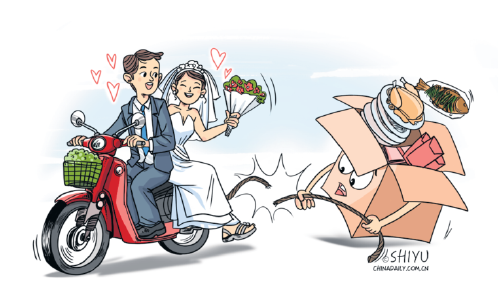
Many people have reserved banquet halls in hotels and big restaurants during the eight-day Mid-Autumn Festival and National Day holiday to hold wedding ceremonies or family get-togethers with special and exquisite dishes to serve the guests.
Food plays one of the most important roles on special occasions for the Chinese people. While people in the West tend to believe "you are what you eat", the Chinese people believe "to the people, food is heaven". Few cultures are as food-oriented as the Chinese. For the Chinese people, food has a meaning far beyond its importance as fuel for life.
Food has held the pride of place in fertility rituals in many societies. Food signifies prosperity, a good marriage and afterlife. Food has also been used to showcase the power and wealth of a state, family or person. Different foods carry different meanings for diners; they indicate the closeness of relations with the people who are served those foods.
In Chinese culture, serving expensive and rare dishes is a way of showing respect for the guests. Hence, it is common for hosts to order or prepare more dishes than their guests can possibly eat. This, however, results in waste of food at banquets.
Ordering excess food became a big problem in China after the country achieved rapid economic growth. To curb food waste, therefore, the country launched the nationwide "Clear Your Plate" campaign in 2013, and the top legislature passed an anti-food waste law in 2021. Yet the problem persists, not least because of rising incomes and purchasing power.
According to a 2020 survey by the Standing Committee of the National People's Congress, at least 34 million tons of food are wasted in restaurants in Chinese cities every year. At banquets and other group events, between 30 and 40 percent of the food on the table is not eaten, according to a study by the Chinese Academy of Social Sciences.
At wedding ceremonies and family reunions during holidays, food waste is common. So what's the reason for food waste on such a massive scale?
First, many people are not fully aware of the importance of not wasting food. The fact that people see food waste at banquets, particularly at wedding banquets because the couple's families fear "losing face" if the dishes are not expensive or excess food is not ordered for the guests, prompts them to accept it as "normal". For some, extravagant wedding banquets are a way of displaying their wealth and social status.
Second, some restaurants tend to encourage diners to order more expensive dishes by setting a minimum consumption amount for reserving banquet halls, while consumers who believe that flamboyance is a way of life, especially to boast of in front of friends, turn a blind eye to food waste regulations and advice from restaurant staff. They also are reluctant to pack leftovers for fear of being seen as stingy.
Third, weak supervision of food waste in restaurants makes it difficult to end this social evil. There were more than 8 million catering enterprises in China in 2021. And the huge number of banquets held every day and the shortage of supervisors make it almost impossible to keep a tab on every banquet.
Fortunately, the central government, the catering industry and society are working together to combat food waste. A recently released guideline for curbing food waste is the latest in a series of government measures to promote a more sustainable approach to food consumption and encourage responsible practices in the restaurant industry.
The notice requires restaurants to clearly mark the price of each dish in banquet packages along with information on discount, if any, while caterers are required to include policies aimed at reducing food waste in their contracts for banquets. Restaurants also need to do away with minimum spending requirements, indicate the number of diners each package is designed for, and provide free containers for packing leftovers.
Thanks to media outlets, government agencies, social organizations and internet celebrities' joint online streaming of messages criticizing the waste of food, an increasing number of people have started ordering the right amount of food and taking the leftovers home.
In fact, almost all Chinese people must have been made to memorize the traditional proverb "when eating a mouthful of congee or rice, one should bear in mind that its production is not easy" in primary school. This means Chinese children are made aware of the importance of not wasting food since childhood. But the social environment affects people's way of thinking when they grow up. As such, family members, friends and colleagues all need to remind each other of the importance of saving food in order to create a better future for the country.
The author is a writer with China Daily.