Sea goddess helps build cross-Strait ties







Shared beliefs a driver of exchange activities between Taiwan and Fujian
A shared folk belief in Mazu — a revered goddess of the sea worshipped on both sides of the Taiwan Strait — can act as a bridge connecting people of the two sides and promote cross-Strait integration, experts said.
Taiwan representatives from various industries attended the 8th Global Mazu Culture Forum last weekend in Meizhou, a seaside resort in Putian, Fujian province.
Putian was the hometown of Lin Mo, who died more than 1,000 years ago while attempting to rescue people fishing out at sea. She was later worshipped as a goddess protecting those who depended on the sea for a living and belief in Mazu spread around the world as people from Fujian emigrated.
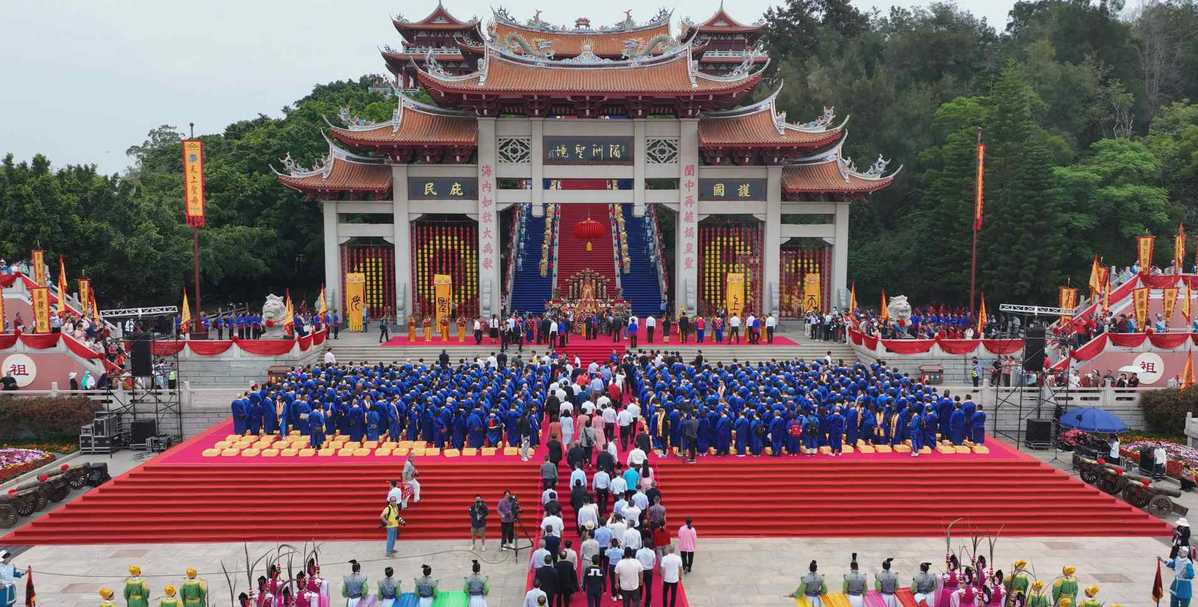
Devotees visit the ancestral temple of Mazu in Meizhou to commemorate her.
Lin Join-sane, former chairman of the Taiwan-based Straits Exchange Foundation, said at the forum that worship of Mazu was prevalent in Taiwan, with over two-thirds of the population venerating her.
"Mazu culture is a deep-rooted homeland memory that will forever connect the people on both sides of the Taiwan Strait," he said.
Lai Seh-jen, chairwoman of the Taiwan Tourism Interchange Association, said belief in Mazu had become a cultural symbol used by Taiwan people to trace their origins, and Mazu temples around Taiwan organized believers to participate in exchanges with mainland temples.
She said the shared belief had promoted grassroots exchanges between people on both sides of the Strait at different times.
The first direct sea trip between the two sides of the Strait since the founding of New China was initiated by fishermen from Yilan in Taiwan in 1989, when they escorted a Mazu statue in Taiwan back to Meizhou before the official commencement of direct cross-Strait sea routes.
In 1997, another statue of Mazu from Meizhou went on a 102-day tour of Taiwan, where more than 10 million people paid homage and worshipped it.
In September, a 10-day Mazu statue pilgrimage ritual in Putian attracted over 500 Taiwan compatriots from 18 counties and cities in Taiwan.
Lin Jinzan, chairman of the Mazu Ancestral Temple's board of directors in Meizhou, said an increasing number of Taiwan compatriots are crossing the sea on pilgrimages to pay their respects to the Mazu ancestral temple and trace their roots and ancestors, and various activities are held for them.
Zhu Fenglian, a spokeswoman for the State Council's Taiwan Affairs Office, said that when the Mazu statue from Meizhou was taken to Taiwan it received a warm welcome from believers on the island, and authorities are trying to promote another visit.
The common faith in Mazu can play a role in promoting cross-Strait integration, according to a policy document issued by central authorities in September that supported Fujian building a demonstration zone for integrated development across the Strait to advance peaceful reunification.
It said various forms of exchanges based on the shared belief in Mazu and other folk beliefs will be encouraged, and it suggested that Fujian and Taiwan jointly apply for the listing of Mazu cultural relics as World Cultural Heritage.
Lai, from the Taiwan Tourism Interchange Association, said that in an uncertain global environment people needed the power of peace to calm their hearts, and the shared Mazu culture across the Strait could play a significant role in promoting tourism.
She suggested incorporating Mazu content in activities for young Taiwan people visiting the mainland to help more young people understand the profound spirit of love and peace embedded in it.
Cultural products related to Mazu could be developed to attract young people, and the two sides could work together to preserve the shared cultural heritage of the Mazu pilgrimage rituals, she added.
Such cross-Strait exchanges have already had a positive impact, with over 300,000 Taiwan compatriots visiting Meizhou for pilgrimages and sightseeing each year. Those exchanges have led 16 teams from Taiwan to establish startup businesses in Meizhou, including homestays and restaurants, according to local authorities.
Deng Jiahui contributed to this story.



- National Games vibe is everywhere in Guangzhou
- Forum unites global experts to enhance city image communication
- Miao New Year celebrations get underway in Guizhou's Leishan county
- Mainland spokesman reiterates stand on Taiwan
- Fujian county's rural development becomes a big draw for Taiwan investors
- Nobel laureate in chemistry: Give young scientists more independence