Experts' takes on Chinese economy in 2023







Techno-industrial upgrade fuels development
About a century ago, Sun Yat-sen, a Chinese national hero and a forerunner of China's democratic revolution, penned a prescient letter to Henry Ford, the founding father of the so-called second industrial revolution.
Sun implored Ford to visit China, go to the south of the country, and support China's industrialization. Sun prophetically argued that if China remained economically underdeveloped, it would become an object of exploitation and international strife for the Great Powers, possibly precipitating the next world war. Regrettably, Henry Ford rejected Sun's invitation and never shared his formidable expertise in support of China's industrialization. The years that followed validated Sun's foresight as Chinese weakness invited Imperial Japan's aggression.
Fast forward to 2018. Elon Musk, arguably one of the world's leading entrepreneurs and the founding father of the electric vehicles revolution, is feeling confident about China. Unlike Henry Ford, who saw no future in China in the 1920s, Musk has repeatedly expressed his confidence that the wave of the future may indeed be found in China.
Musk is not an amateur prognosticator. He has witnessed the dynamism of Chinese mobilization and industrialization from up close. His Shanghai Gigafactory began operating from scratch in just 9 months (Tesla's Berlin Gigafactory took 3 years), helping Tesla produce its flagship Model 3 during a period of international trepidation over the company's negative cash flow. With the Shanghai Gigafactory unleashing its productive might, Tesla not only demonstrated profitability but also ascended to become the world's most valuable automobile company.
But what changed between the China of the 1920s and China today, or between Sun's failed plea to Henry Ford and Musk's unbending attraction for China? The first catalyst has been national unity established in 1949. Sun, the great patriot, however much he struggled, never managed to fully neuter the influence of centrifugal forces and foreign coercion. But in 1949, for the first time since the late Qing Dynasty (1644-1911), the Chinese people stood up as one.
The second catalyst has been the visionary reformist leadership that opened up China to the world. Under the leadership of Deng Xiaoping, the Third Plenum of the 11th Central Committee of the Communist Party of China in December 1978 espoused openness and set the foundations for the most significant transformation of any modern nation since the advent of the industrial revolution.
Deng's adage, "It doesn't matter if the cat is black or white as long as she catches mice," encapsulates the essence of pragmatic reform and opening-up. Over the next 40 years, China witnessed a miracle economic growth, with GDP soaring by an average of 9.8 percent annually.
Yet, more substantial perhaps is China's qualitative shift from a low-end manufacturing economy to a high-tech industrial behemoth. A decade ago, my Chinese classmates at Tsinghua University dreamed that China should not only produce low-end iPhone components but contribute to the design and high-value segments. China then accounted for about 3.6 percent to an iPhone's value. Chinese suppliers today contribute more than 25 percent to an iPhone's value. Moreover, with Huawei, Xiaomi, Oppo and Vivo, China has created its own mobile hardware/software ecosystem that no other economy can match.
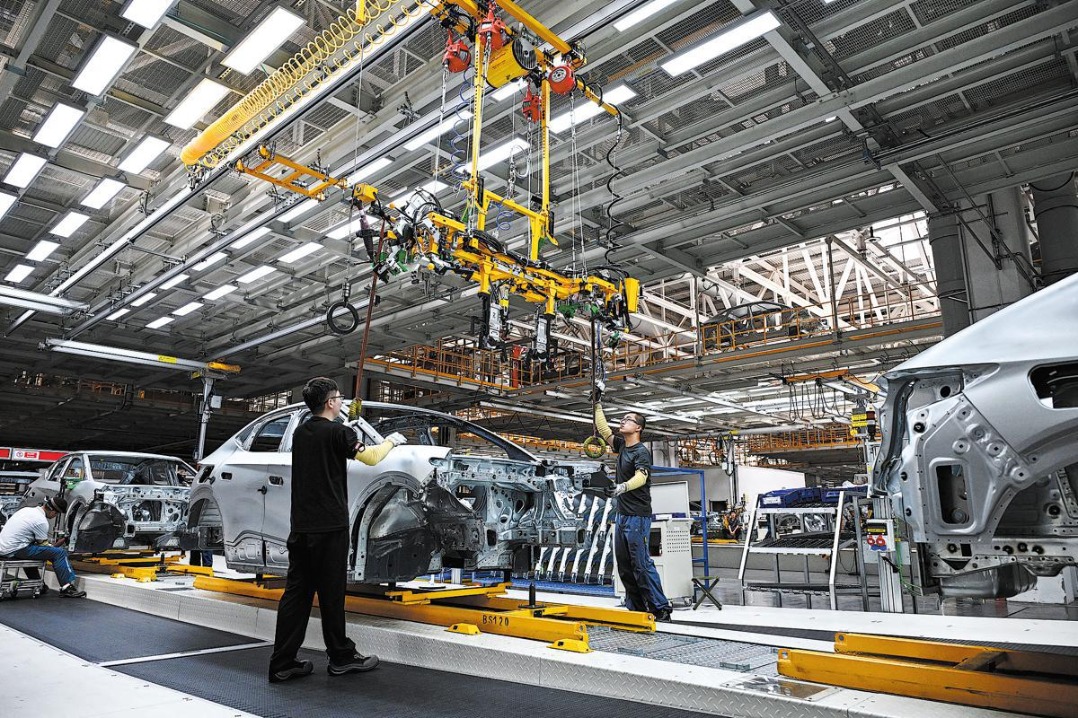
The automobile sector further attests to China's qualitative transformation. Just five years ago, Chinese cars stood no chance against their European rivals. Now, Chinese EVs are becoming increasingly competitive in the global market. In 2023 China is projected to surpass Japan and become the world's largest automobile exporter. Meanwhile, China's industrial success across the renewable sector is unambiguous. From batteries to solar panels to wind turbines, the country is leading by a large margin.
China's industrial prowess becomes evident in the United States' struggles to effectively disentangle its supply chains through either near-shoring or friend-shoring strategies. Insights from the Bank of International Settlements underscore that the new extended supply chains have incorporated intermediary nations but have failed to diminish reliance on China. Simply put, China's industrial competitiveness is unmatched.
Nobel laureate economist Paul Krugman once declared that China would find it hard to shift from "perspiration to inspiration." Its low-wage, labor-intensive economic model would make China a world factory, but Western capitalists would reap the lion's share of profits. According to this argument China was doomed to be a laggard in industry and innovation only reproducing designs and ideas sourced in Western Europe and the United States.
Krugman got it wrong. Recent qualitative developments in the Chinese economy may signal the dawn of an era of inspiration. However, as China climbs the value chain, the "geopolitical contract" may have been shaken. In a key official document, Chinese thinkers have echoed Sun's century-old contention that the basis of national strength is technological innovation capacity, and a nation with weak innovation is at peril.
The authors of the 2015 innovation-driven strategy proclaimed that the main reason China was weak and preyed upon in the modern era was because China had missed out on successive technological revolutions. No wonder the top Chinese leader has reiterated the importance of breaking the technological bottlenecks and advocated for innovation-driven development.
Forty-five years since Deng's reform and opening-up, the meteoric ascent of Chinese industry and technology has agitated old industrial powerhouses. Paradoxically, however, this unease might serve as an opportunity for these nations to mirror China's strategic response in 1978. Rather than succumbing to protectionism and insularity they can opt for reform and opening-up.