High stakes summit
The EU and China should seek to agree on meaningful deliverables that help build a systemic partnership








The EU and China should seek to agree on meaningful deliverables that help build a systemic partnership
The recent announcement that China will roll out visa-free policies to Spain, France, Germany, Italy, the Netherlands and Malaysia on a trial basis from Dec 1 to Nov 30, 2024, is one of the most positive moves this year. That five of the countries are members of the European Union means the move is a milestone in EU-China relations since people-to-people exchanges are one of its pillars.
The EU and China are holding a summit in Beijing, the first in four years, and the stakes are high. After the handshakes and candid exchanges, the global audience will expect to see positive outcomes amid the international scenario pervaded by multiple crises.
Viewing it through a realistic and pragmatic macro-lens, the EU should consider the San Francisco summit between Chinese and US leaders as not only contributing to the stabilizing of China-US ties and a new chapter for Asia-Pacific cooperation, but also as a window of opportunity for China and the EU to find common ground on connectivity issues.
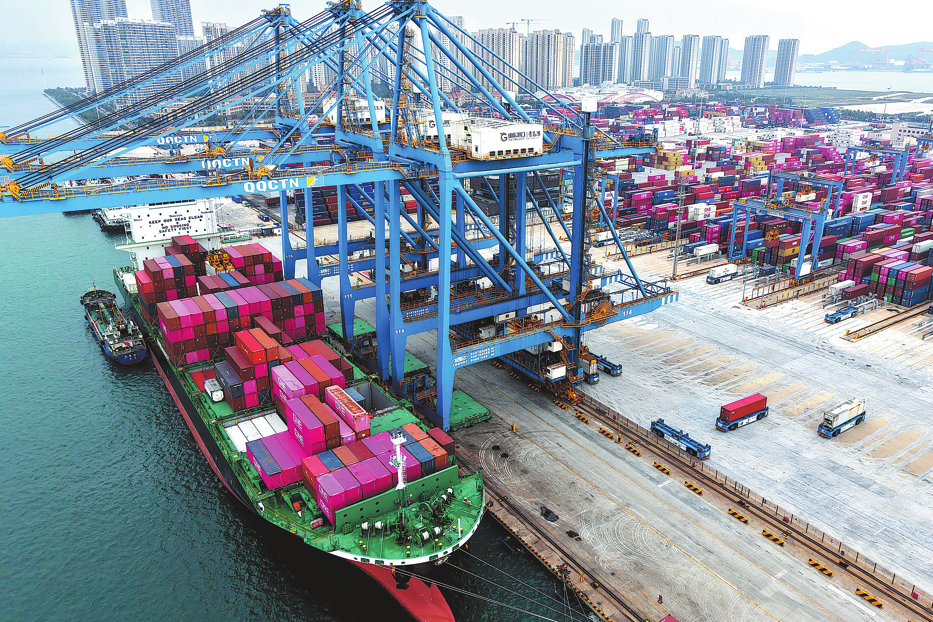
Several years before the pandemic, I remember that Eurocrats in Brussels often suggested that — aside from the 18 EU countries which have signed a memorandum of understanding on the Belt and Road Initiative — not signing the memorandum did not mean that the bloc as a whole ruled out cooperating in other continents, regions or markets. Back then concerted action had not been taken. That relative inertia could be understood because there was no single unified European plan. Since the EU launched the Global Gateway in 2021 with its own infrastructure investment program, aimed at mobilizing 300 billion euros ($329 billion) for sustainable and high-quality projects before 2027, there are a number of reasons to explore innovative joint-ventures.
Let's remember when it was announced: in the middle of a restrictive pandemic. Now there is margin for action, but there is a new challenge: the conflict between Israel and Hamas and the looming prospect of it spilling over into the Middle East overlapping with other potential crisis in neighboring Africa and elsewhere.
Some analysts have seen the Global Gateway as the EU's reaction and sustainable alternative to China's BRI. But looking at the situation from a purely pragmatic perspective, considering international relations as they are, encompassing trade, investment, innovation, diplomacy and strategic considerations, is an art.
But the Global Gateway — saluted by Brussels and by each influential European capital for its scale and ambition — considers beneficiary countries' lasting benefits for their local communities. An objective view tells us that the moment seems ripe. Both sides, China, and now the EU, coincide in the sense of mega projects which offer people a better life in tune with the United Nations' 2030 Agenda for Sustainable Development and its Sustainable Development Goals and the Paris Agreement.
First of all, China, having been engaged worldwide for a decade with an initiative that now encompasses more than 150 countries, has unique experience. By the same token, in the context of the Global Gateway, European agencies have been engaged in preliminary projects in the Western Balkans, Eastern Europe, Central Asia, the "Indo-Pacific" region and Africa. If the Global Gateway does not minimize the potential waste, dispersion of human resources and raw materials which will entail by acting separately, it will fail to fulfill its potential. Both the BRI and the Global Gateway cover countries and territories exposed to or near various conflicts, the most conspicuous of which currently involves Hamas and Israel and their respective partners or allies in a wider geostrategic space.
Two weeks ago, in the wake of the EU's top diplomat Josep Borrell's visit to the Middle East to support peace talks in order to contribute to a peace settlement, an Arab-Muslim delegation went to Beijing to request Chinese diplomatic engagement in the region. We should not forget China's key role in normalizing diplomatic relations between Iran and Saudi Arabia this spring, and its potential to act as a peace broker and mediator elsewhere. The EU and China can engage in dialogue and cooperation in promoting peace in the Middle East.
It is time for diplomacy, but also to think about investment, infrastructure, construction and future reconstruction of areas and regions that are not involved in any conflict but that are still waiting to emerge from underdevelopment, post-conflict or crises situations, or still slowly reemerging from challenges of the COVID-19 pandemic.
Another possibility that could be explored at the EU-China Summit would be how to revive the EU-China Comprehensive Agreement on Investment, one of the most ambitious documents of its kind ever conceived, which was concluded in December 2020. The incoming US government called for "caution" in 2021 and some European leaders reminded everyone that it had taken eight years to negotiate, not willing to squander the opportunity to seal a historic deal with a titanic market and long-term partner. And an opportunity has been missed. The CAI was supposed to be Brussels' much advocated leveling of the playing field in the Brussels-Beijing relationship.
Both sides should bear in mind that it is an instrument providing an unprecedented level of market access for EU investors, giving European businesses certainty and predictability for their operations, and Chinese companies likewise. As was the case in 2020, in 2023 the CAI has the strong potential to significantly ameliorate rules, thereby offering a more level playing field and fairer treatment when competing in each other's markets.
Of course, the EU-China Summit should focus on economic issues such as the EU's bilateral trade deficit with China and the concerns regarding China's and the EU's industrial policy and the use of subsidies by both sides. And it is important that both partners listen to each other's grievances and seek to manage their differences in the smartest mid- and long-term manner.
But they should also try to hammer out the sensitive issues blocking the EU-China Comprehensive Agreement on Investment, so that it can be implemented in all its dimensions.
Doing something constructive — exploring the potential of coordinating the BRI and Global Gateway and demonstrating the goodwill to resume talks to solve the pending CAI issues — might well be the way to build a systemic partnership, if not in most fields, in the ones we can.
The author is director of the Dialogue with China Project and former global expert in the United Nations Alliance of Civilizations. The author contributed this article to China Watch, a think tank powered by China Daily. The views do not necessarily reflect those of China Daily.
Contact the editor at editor@chinawatch.cn