Sensible about-turn
Rest of the EU should follow Hungary's example and seek to form a cooperative partnership with China rather than a confrontational one








Rest of the EU should follow Hungary's example and seek to form a cooperative partnership with China rather than a confrontational one
The 24th EU-China Summit is being held on Dec 7 and 8. The first summit took place in 1998 and was supported by discussions at ministerial and committee-levels. In its 2006 document entitled "EU-China: Closer Partners, Growing Responsibilities", the European Union changed its tone: rather than a partner in a relationship full of opportunities, China was viewed as a competitor and a challenge.
China's response to the 2008 global economic crisis and the launch of the Belt and Road Initiative led some EU countries to see great potential for cooperation with China, but the EU as a whole still remained distant in its relations with China. Germany, Italy and Hungary pushed for deeper ties with China: Hungary (2015) and then Italy (2019) signed cooperation agreements on the BRI. Germany, Italy and many other European countries joined the Asian Infrastructure Investment Bank as founding members after its establishment in 2015. And after seven years of difficult negotiations, the Comprehensive Agreement on Investment (CAI) was finally concluded by then German Chancellor Angela Merkel on Dec 30, 2020, the last day of the German EU Council presidency.
However, the trade war between the United States and China has left its mark on EU-China relations.
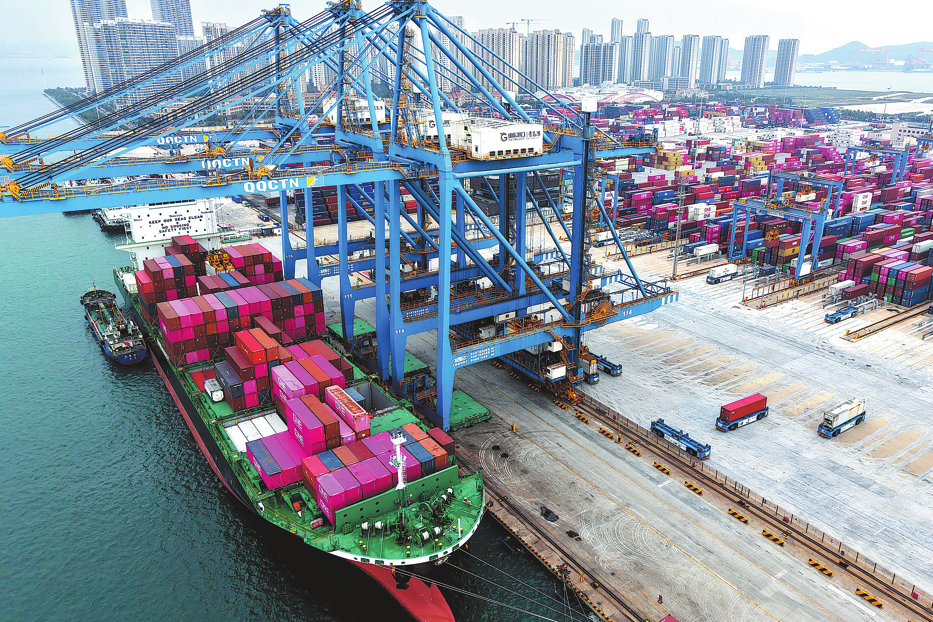
The EU and China are important trading partners: in 2022, the bilateral trade in goods increased by 23 percent year-on-year to a record level of 857 billion euros ($935 billion). EU exports to China rose by 3.1 percent to 230 billion euros ($250 billion), while EU imports from China increased by 32 percent to 626 billion euros ($683 billion).In 2022, the trade volume amounted to more than 2 billion euros per day.
In 2021, five months after the CAI agreement was frozen, European Commission President Ursula von der Leyen announced the Global Gateway strategy, which is strikingly similar to the BRI, but with the European strategy focusing on ideological aspects rather than economic cooperation and development. While China celebrated the 10th anniversary of its initiative in 2023 with the participation of more than 150 countries, the Global Gateway — two years after its birth — is still little known and has little to show. The same applies to the US alternative, the "Build Back Better World" initiative.
The West cannot accept that Asian countries have become economically and politically stronger, that the 500-year Atlantic era with its colonial hegemony has come to an end and that the world beyond the West does not want cooperation based on Western ideology, but rather economic cooperation and joint development based on their national interests. The former is provided by the Global Gateway and Build Back Better World, the latter by the BRI. Not much can be said about the former two, but the latter, as mentioned earlier, has already celebrated its 10th anniversary with great achievements to its name.
In 2023, instead of rethinking its political relations with China in terms of close economic ties and the economic interests of EU countries and initiating new negotiations based on peace, cooperation, mutual respect and mutual benefit, the EU has been stepping up its "de-risking" policy toward China. Meanwhile, China has reacted calmly to the EU's initiative. Chinese Foreign Minister Wang Yi, for example, said at a news conference following the Belt and Road Forum for International Cooperation in October that the BRI and the Global Gateway strategy can be aligned, so as to leverage their respective strengths and form synergy to help developing countries speed up infrastructure development.
Hungary was the only EU country to participate in the Belt and Road Forum for International Cooperation in October. As a timely response to the changing world order, Hungary announced its "Opening to the East" policy in 2010, which aims to diversify international relations and build ever closer political and economic ties with China and other Asian countries in addition to its existing Western relations.
It is hoped that the EU leadership at the EU-China Summit will come to China with a new attitude and approach that will serve the common interests in its negotiations with one of its largest economic partners.
The author is director of Eurasia Center at John von Neumann University in Hungary and former consul general of Hungary in Shanghai. The author contributed this article to China Watch, a think tank powered by China Daily. The views do not necessarily reflect those of China Daily.
Contact the editor at editor@chinawatch.cn