May the force be unbound
Healthy China-EU economic ties do a power of good in promoting global prosperity and stability







Healthy China-EU economic ties do a power of good in promoting global prosperity and stability
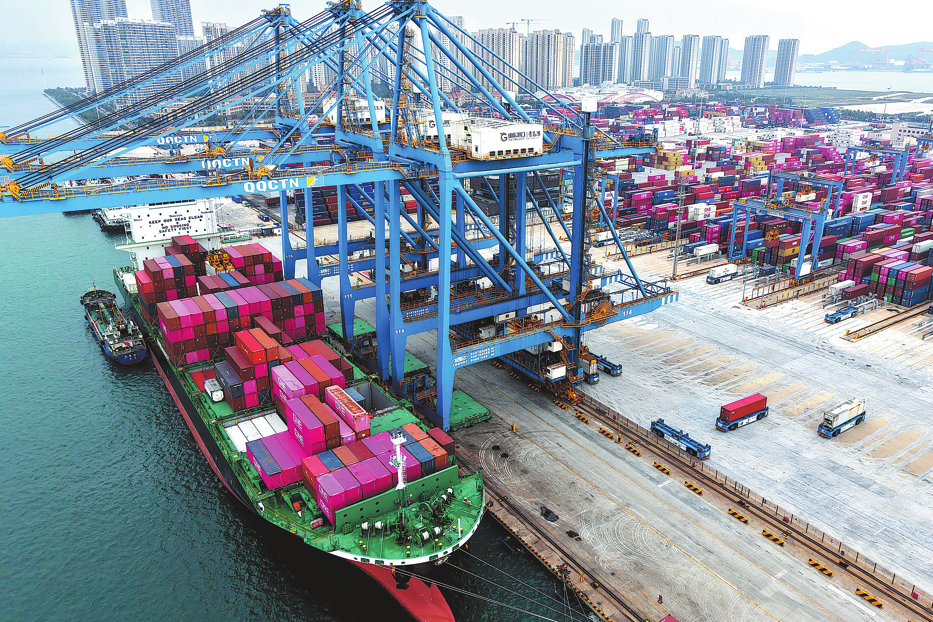
As one of the most important trade partnerships globally, China and the European Union recorded a total trade volume in goods exceeding 800 billion euros ($862.5 billion) last year, encompassing a diverse range of goods flowing in both directions. Undoubtedly, these robust commercial ties not only yield mutual benefits for China and the EU, but also contribute to the collective prosperity of the world.
But despite its strength, the China-EU trade relationship is not without its challenges. Issues such as market access restrictions, intellectual property rights protections, environmental impacts, and cybersecurity concerns have been persistent points of contention. Moreover, geopolitical tensions and differences in values and political systems also create discord and misunderstanding.
The frictions often manifest in China's substantial trade surplus with the EU, reaching nearly 260 billion euros in 2022 according to China's Customs, and approximately 400 billion euros according to Eurostat.
From an economic perspective, trade gaps reflect the deep pattern of the international division of labor and can be viewed as a natural result of market competition rather than something orchestrated by malevolent forces.
Clearly, the trade imbalance needs to be handled wisely. There are constructive solutions to this significant and sensitive issue.
First, as the COVID-19 pandemic subsides, China is demonstrating a renewed commitment to further two-way opening-up. In particular, with the emergence of the country's middle-income group, which may rival the entire population of the EU in size, China enjoys an increasingly significant purchasing power, leading to a growing demand for high-quality European products. A notable example in this regard is the China International Import Expo, which stands as an impressive initiative to rebalance the country's trade with the rest of the world. Indeed, in its sixth year, the intended import amount reached as high as $78.4 billion annually, marking a 6.7 percent increase over the previous session.
Second, the EU's relaxation of trade restrictions on high-tech products would substantially contribute to reducing the trade deficit with China and, even more importantly for itself, would reinforce its specialization in the advanced industries. It is crucial to recognize that the restrictive measures on exports of the high-tech goods or goods of strategic importance, for example, semiconductor equipment, aircraft parts, and electric vehicle, are not driven by market forces but rather by motivations of "de-risking" from China — a disguised form of Cold War mentality. The logic here is straightforward: Economic objectives such as trade rebalancing cannot be achieved if they are undermined by the pursuit of non-economic goals, such as national security concerns, which are often ill-defined.
Third, as has been widely observed, international trade is largely driven by international investment. With its burgeoning economy, China continues to be an attractive hub for foreign capital, brimming with commercial prospects. Unfortunately, due to various restrictive measures, the enormous investment potential of Europe in China has not been fully realized. While there is still large room for improvement in the business environment on the Chinese side, the European side should make more efforts to actively explore mutually beneficial investment facilitation models such as the China-EU Comprehensive Agreement on Investment, for which the negotiation remains pending.
Last, as a major player in the service trade, the EU has a strong presence in various service sectors, including financial services, business services, patents, copyrights, education, and tourism. In contrast to the trade in goods, the EU has maintained a surplus in its service trade with China for quite a long period of time. Although the sizes of the service trade and its surplus remain relatively small (according to Eurostat, 108.3 billion euros and 16.5 billion euros in 2022, respectively), the potential for growth is substantial. For instance, visa facilitation and intellectual property cooperation are important measures to consider. It is noteworthy that increased service trade with the EU would also be beneficial for China, especially in terms of technological diffusion, business development, human capital accumulation, and enjoying diverse lifestyles.
In conclusion, the China-EU trade imbalances are attributable to complex economic and non-economic factors. While there is no single panacea solution to this multifaceted issue, adopting a constructive and open-minded approach is of great importance. After all, balanced and symbiotic economic ties between China and the EU serve as a powerful force for global prosperity and stability. It is especially true as the world faces harsh headwinds of deglobalization, the likes of which we have not witnessed since the end of World War II. Therefore, as this partnership progresses, it is crucial to address the challenges with a spirit of cooperation and a shared commitment to mutual benefit.
The author is researcher of economics at the Institute of Economics at the Chinese Academy of Social Sciences. The author contributed this article to China Watch, a think tank powered by China Daily. The views do not necessarily reflect those of China Daily.
Contact the editor at editor@chinawatch.cn