Pressing need
Against the backdrop of the complex international situation, the incentives for China and the EU to cooperate have been increasing








Against the backdrop of the complex international situation, the incentives for China and the EU to cooperate have been increasing
Stability is becoming a key issue in current China-EU relations. Bilateral economic and trade cooperation is not only the "ballast stone" for their relations, but also an important force for building an open world economy. China and the European Union have already formed a highly interdependent relationship.
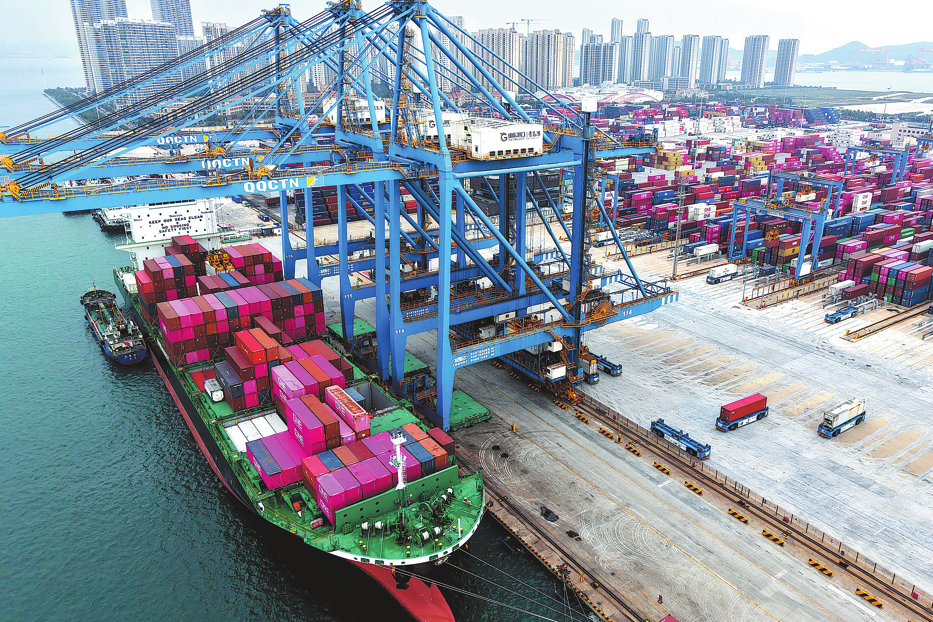
In the past two decades, the volume of trade between China and the EU has increased nearly ninefold, EU investment in China has nearly tripled, and the two-way investment stock has exceeded $230 billion. In 2022, the bilateral trade in goods between China and the EU reached $847.3 billion, an increase of 2.4 percent year-on-year, making China and the EU each other's second-largest trading partner. The number of China-Europe freight trains has also shown a growing trend, providing effective support for economic cooperation between the two sides. In 2022, there were 16,000 China-Europe freight train services, transporting 1.6 million TEUs (twenty-foot equivalent units), an increase of 9 percent and 10 percent respectively.
On Nov 14, the China Chamber of Commerce to the EU released a report on the development of Chinese enterprises in the EU, which shows that the optimism of Chinese companies toward doing business in the EU has been increasing in recent years. According to the survey results of about 180 Chinese companies or institutions in the EU, about 90 percent of the respondents reported an increase in revenue from their EU operations, significantly higher than last year's figure of 70 percent. About 80 percent of the companies covered by the survey have made plans to further increase their investment in Europe and deepen their presence in the European market.
The strategic competition between China and the United States has put growing pressure on cooperation between China and the EU. However, as two crucial forces in the multipolar world that is taking shape, China and the EU have become increasingly prominent in their strategic cooperation and there is tremendous potential for both sides to make efforts to promote their comprehensive strategic partnership established in 2003. President of the European Commission Ursula von der Leyen said at the European China Conference 2023 on Nov 16, the EU sides believes that China's ability to influence the world has grown exponentially in the last ten years.
Therefore, there is a strong need for strategic stability in how the EU deals with China in these turbulent times. In addition to pragmatic economic and trade cooperation, climate change, poverty reduction, pollution prevention and control, and biodiversity conservation are all areas where China and the EU have broad consensus and basis for cooperation.
Still, there are also many unstable factors in China-EU relations. In recent years, the EU has undergone significant changes in its strategic positioning toward China, with greater emphasis on competitiveness as the EU regards China as a "partner, competitor and systemic rival". In 2023, the de-risking strategy proposed by President of the European Commission Ursula von der Leyen captured the main discourse for the EU's China policy, prioritizes de-risking rather than decoupling, while the positioning of China is confusing, leading to a rise in fear and prejudice against China, especially for companies and grassroots, further amplifying the unstable factors in China-EU relations.
At the same time, the downward pressure on the EU economy has increased. On Nov 15, the European Commission released its 2023 Autumn Economic Outlook report, lowering the economic growth forecast for the EU and the eurozone for the next two years. With the relative decline of its economic strength, the EU is expected to adopt a more contractionary foreign policy approach, emphasizing trade protectionism and employing trade defense tools, which have negative impacts on China-EU relations. Nevertheless, China's mega market is the antidote for the economic growth and better livelihoods in Europe.
Moreover, the EU member states pursue different political goals and economic interests, which makes the overall EU policy toward China appear incoherent and inconsistent. Although some politicians and think tanks hope to "keep a distance "from China and even emphasize the risks of China-EU economic and trade relations, some German business representatives pointed out that trade protectionism will cause serious harm to the global economic and trade landscape and market. That is irrational and undesirable. French Economy Minister Bruno Le Maire stressed that it was impractical to sever all economic ties with China.
In view of the growing importance and complexity of the bilateral relationship, the key to a stable path for China-EU relations is to manage competition and avoid trade protectionism, injecting positive momentum into the development of China-EU relations.
First, it is undeniable that in recent years, the complexity and competitiveness of China-EU relations have been on the rise. On the one hand, China and the EU face changes in the global order and the world economic system, as well as common opportunities, challenges and uncertainties at the global and regional levels. On the other hand, there is considerable competition between China and the EU, with competition outweighing cooperation in areas such as rule-making for the digital economy and technology, and normative concepts. However, common interests and conflicting interests between China and the EU may change and transform with the dynamics of their interaction and the international landscape. Therefore, China and the EU need to properly manage the frictions between them and avoid strategic miscalculation.
Second, they should avoid the uncertainties brought about by politicization and securitization, especially the return of protectionism, as this leads to zero-sum games and even adversarial thinking. The rise of extreme populism within the EU has intensified political fragmentation within the bloc, making it difficult to reach consensus and influencing its foreign policy more deeply through the internal political game. The EU should view China's peaceful rise as an opportunity in order to generate more converging interests with China.
Third, China and the EU should enhance their exchanges in policy planning, green industry cooperation, technology transfer and other areas. They should also implement policy planning at the level of local governments and business collaborations, fully tap into the complementary advantages between China and the EU, and promote a trade balance by demand-driven approaches. In addition, China and the EU's aspirations for global governance, particularly the maintenance and development of multilateralism, reflects the vision of both sides to reshape the international order and avoid a "new Cold War".
Seeking common ground while reserving differences is the key to strategic stability. Excessively emphasizing differences will overlook commonalities. The cooperation between China and the EU is much greater than competition, in terms of bilateral cooperation and multilateral governance. They also have a rich history of civilizational exchanges and mutual learning to build on. Cooperation between China and the EU to accelerate the green and digital transformations can be seen as a breakthrough in "constructive cooperation". In addition, the world needs inclusive and effective cooperation between China and the EU in the field of global governance, and even trilateral cooperation among China, the United States and the EU, so as to respond more effectively to the global economic slowdown and drastic changes in the international landscape.
The author is an associate research fellow with the Institute of European Studies at the Chinese Academy of Social Sciences. The author contributed this article to China Watch, a think tank powered by China Daily. The views do not necessarily reflect those of China Daily.
Contact the editor at editor@chinawatch.cn