Fresh perspective
The more emphasis Japan attaches to security, the less secure it will become








The more emphasis Japan attaches to security, the less secure it will become
Japan's secure development is highly dependent on globalization. In recent years, faced with the global upheavals triggered by the relative decline of United States hegemony, Japan's strategic choices have relied overwhelmingly on conservative thinking, but this has undermined its own development foundations. The true solution lies in its return to genuine openness.
Tokyo has emphasized that the Japanese economy must serve its national strategy, and it is seeking to exert tight control over key elements and links in its industry and supply chains. The aim is to establish Japan's "strategic indispensability" in the global industrial structure, maintain its core competitiveness, and explore new indispensable areas. At present, the core strategy involves a global industrial layout centered on the Japan-US alliance. This includes enhancing Japan-US cooperation to construct a "free, fair and open "economic order, the essence of which is to build an alliance-led global industrial structure that reduces its dependence on China. For example, Japanese companies in industries such as semiconductors, components and industrial materials have received official incentives to invest in the Association of Southeast Asian Nations member economies. Tokyo has also encouraged Japanese companies in China to shift toward ASEAN. In 2022, the Japanese government sponsored 17 Japanese companies in two rounds of an initiative known as the "Program for Strengthening Overseas Supply Chains", an indicator of its bid to control overseas industry chains.
The second aspect of Tokyo's measures involves overcoming Japan's economic deficiencies by building up reserves, seeking alternatives, strengthening supply capabilities and enhancing cooperation with allied nations. The Japanese government has underscored that economic and fiscal operations should ensure the supply of crucial materials such as minerals and pharmaceuticals. Tokyo has strengthened financial and fiscal support in this regard, saying that such measures cannot only reduce "asymmetric dependence" on other countries, but also enhance local technological capabilities and increase employment and income for residents. In the energy sector, there is a push to restart nuclear power, flexibly utilize renewable energy, and improve energy self-sufficiency. In terms of food and raw materials, Japan has increased domestic production of feed, wheat, starch and wood, as part of broader efforts to promote the substitution of imported raw materials with domestic alternatives.
The third aspect involves using the Japan-US alliance as the foundation to promote rules-based trade agreements. Japan actively participates in global and regional governance to incorporate its "values" into international rule-making. It has proposed the Data Free Flow with Trust concept for digital trade rules, green transformation rules for industries and goals for high-quality infrastructure development. During the Shinzo Abe administration, Tokyo put forward initiatives such as the Partnership for Quality Infrastructure and G7 Ise-Shima Principles for Promoting Quality Infrastructure Investment. Prime Minister Fumio Kishida has expressed the belief that only by having the right to formulate global infrastructure rules can Japan reverse the decline in Japanese corporate competitiveness and expand its global market share.
The coupling of conservatism in Japan and the US, with both nations in excessive pursuit of conservative values, has led to the stagnation in regional cooperation and the accumulation of trust deficits. The more emphasis the two nations attach to security, the less secure they will become. The greater the efforts they make to achieve decoupling and the severing of industry chains, the less development they will achieve. In the end, their approach will become a key factor that harms Asia's stability and prosperity. The core of Abe's concepts such as Confluence of the Two Seas and "Indo-Pacific" Strategy was freedom and openness, but Japan has never truly achieved openness and inclusiveness. The global landscape is now confronted with changes and instabilities, with risks and challenges continuously emerging. The Ukraine crisis is ongoing, conflicts have erupted again in the Middle East, and the peaceful and stable regional environment in Asia-Pacific is threatened by disruptions. The peace and stability in the Asian region are invaluable and require diligent nurturing.
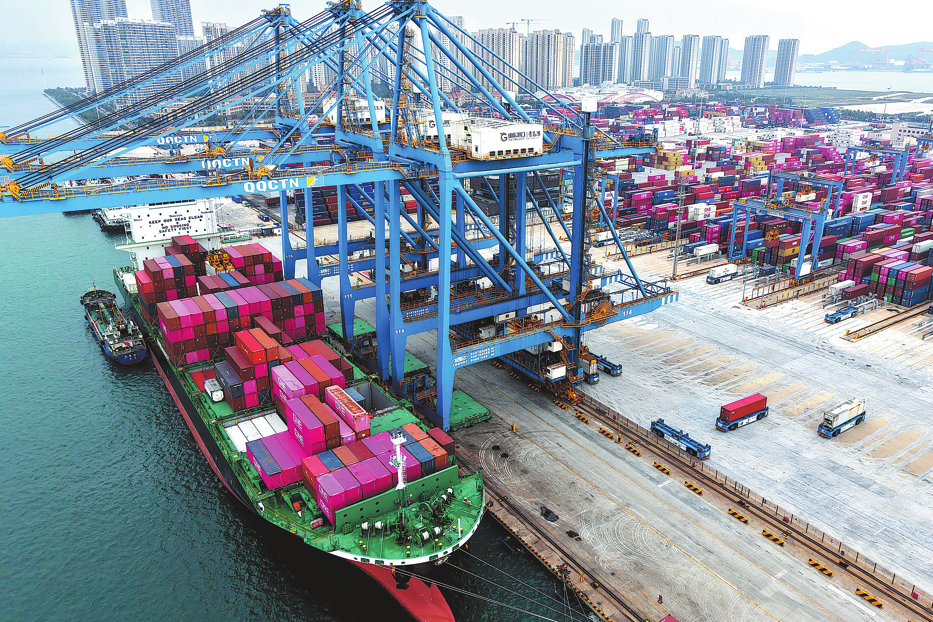
The economies of China and Japan are interdependent, with further expansion of the industry and supply chains in Asia forming the value axis for the secure development of various countries in the region. From 2000 to 2022, the global share of the Asian economies increased from 26.8 percent to 33.1 percent. The region is Japan's most important trading area, accounting for 50.3 percent of its global trade. China surpassed the US in 2007 to become Japan's largest trading partner.
Without the Chinese market, Japan's semiconductor industry faces a "double loss" in technology and market, as China is Japan's most important market for semiconductors and semiconductor manufacturing equipment, with exports to China reaching 26.6 trillion yen ($184.04 billion), or 27.3 percent of its total semiconductor exports, in 2022. Japan's policy of containing China in the semiconductor field will not help achieve its goal of preventing China's technological upgrading. On the contrary, the effectiveness of its export controls policies will be undermined because of China's accelerated independent research, leading to the loss of its key edges in the industry and supply chains.
For Tokyo, a more reasonable approach would be to strengthen technology research and development, produce more high-tech products, and increase its exports to China, and thereby enhance the interconnection between the two countries to gain a win-win result. Japan's secure development cannot be attained without the Chinese market and technology, and deepening cooperation with China is an essential prerequisite for its power in industry, resources and rule-making. Tokyo must rethink whether it should embrace the international order or rebuild an international order subject to its own will.
China and Japan should objectively and rationally view each other's development, establish positive and friendly mutual understanding, and constructively manage conflicts and differences. It is also important for Japan not to overstretch the concept of national security on economic issues, and view the world, Asia and China-Japan relations from a developmental perspective, and recognize the complex diversity of regional production networks, which is not simply an issue of supply chains. Both countries should build a cultural foundation for the development of regional productivity and production relationships, find their own position at the historical crossroads, and attain a common understanding while seeking to reshape regional values.
The author is the executive director of the Communication Center at the China Institutes of Contemporary International Relations. The author contributed this article to China Watch, a think tank powered by China Daily. The views do not necessarily reflect those of China Daily.
Contact the editor at editor@chinawatch.cn