Fitness test and opportunities








WANG XIAOYING/CHINA DAILY
Digitalization and green transformation of economies are long-term developments that offer great scope for China and Germany
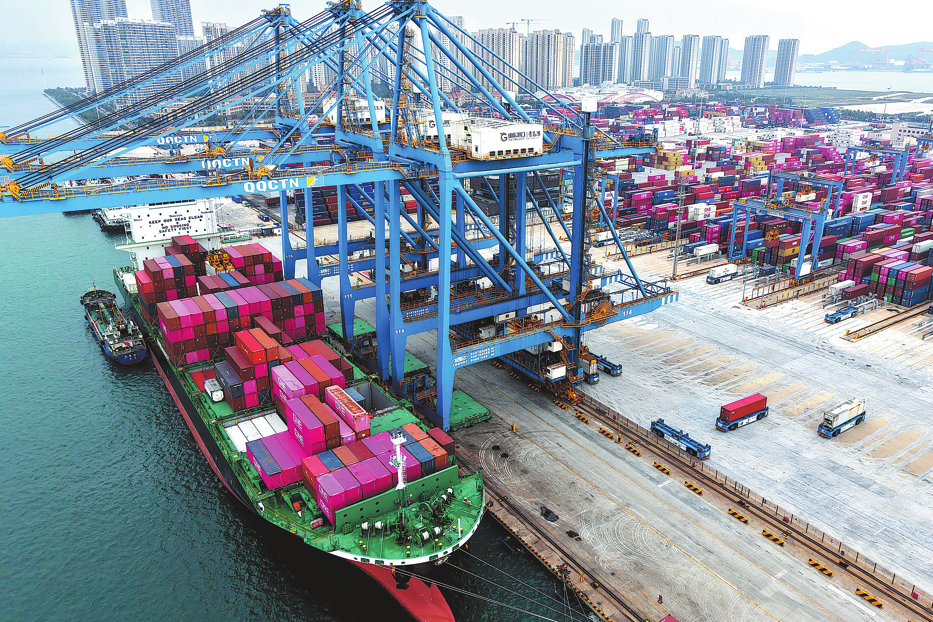
The economic relationship between Germany and China has been mutually beneficial for both countries for many decades. It is a classic win-win situation for the companies and citizens involved. Trade and investment are the driving forces.
Already in 2022, China was Germany's most important trading partner for the seventh consecutive year, although the volume has declined due to the mediocre performance of the global economy and geopolitical tensions. The value of goods traded between Germany and China rose from 25.8 billion euros ($27.8 billion) in 2002 to 64.7 billion euros in the first quarter of 2023.
Around 1 million jobs in Germany depend on exports to China, and imports from China help Germany's domestic economy in two ways: they support lower price levels for consumers and high value-added production for companies. For China, German imports contribute to the development and upgrading of Chinese industry, especially in the manufacturing sector.
German companies in China have been deeply involved in the Chinese market for many decades in terms of investment, production, and sales. According to the data from Deutsche Bundesbank, Germany's central bank, German companies continued investing in China in 2022, with their total investment reaching 11.5 billion euros, with over 5,000 German companies active in China. As an emerging middle-income country with around 400 million well-off citizens, the Chinese market has also become attractive as a sales market and no longer just as a production location for cheap labor.
The Chinese car market is a good example. As the largest market in the world, it has been generating high sales and profits for the leading German car manufacturers for many years. The same applies to other sectors such as electronics, chemicals, sports and software.
The growing innovative power of Chinese companies is also important for the business development of German companies in China. While competition gets tougher, it is also an incentive to become more competitive themselves. In a way, China is a kind of fitness test for German companies. And it pays off. In 2023, for example, German companies sold almost 50 percent more electric cars in China than in the previous year, according to a study by global accounting company PricewaterhouseCoopers.
The case of Volkswagen is instructive for the innovation approach. At the Shanghai auto show last year, the company announced that it would invest around 1 billion euros in an electric car development and business center in Hefei, Anhui province. This was followed by the acquisition of a 4.99 percent stake in Xpeng worth $649 million euros. The two companies have agreed to jointly develop and produce two mid-size electric cars for China.
Such innovative joint ventures are expected to shape the future of Sino-German business cooperation. They also have the advantage of local branding. Seeing the attractiveness of the Chinese market, German companies are increasingly pursuing a localization strategy, not only in terms of supply chain but also in terms of setting up legal entities.
A recent business confidence survey conducted by the German Chamber of Commerce in China showed that more than 90 percent of the companies surveyed have no plans to leave China. On the contrary, 54 percent plan to increase their investment in China over the next two years. This was particularly the case in the automotive and electronics industries, as well as in the business services sector. The majority of German companies see China as an innovative market where they need to be present.
Although geopolitical tensions are still high, the risk of investing in China is actually not that high. Experience shows that most investments pay off within a few years. Moreover, the reputation of German companies and German products and services is still very good in the Chinese market. It seems that the biggest risk for German companies is to not invest in China.
Digitalization and green transition are the most important areas for the future of China-Germany business cooperation. Both German and Chinese manufacturers are in the process of digitalizing and automating their production. In addition, the financial industry is also digitizing its services. The most prominent example is FinTech. The successful third China-Germany High-Level Financial Dialogue held in Frankfurt last autumn underlined the importance of Sino-German cooperation in this field.
This also applies to the development of sustainable finance to support the green transition in both countries. At the meeting between German Chancellor Olaf Scholz and Chinese Premier Li Qiang in Berlin last summer, both sides agreed to place the fight against climate change at the heart of China-Germany cooperation.
A core element for business is the development of green energy technology and industrial upgrading, especially for the "new three": solar cells, batteries, and electric vehicles. There are already many Sino-German deals underway in this area. For example, a huge solar park near Berlin, which produces emission-free photovoltaic energy, uses inverters from a Chinese company to ensure stable and efficient operation of the energy system. And just at the end of last year, Beijing E-Town signed a strategic cooperation agreement with the Steinbeis Global Institute in Tubingen, Germany, on Sino-German cooperation in the green energy industry.
The digitalization and green transformation of economies is a long-term development that will take decades. It is the biggest economic change in the past one-hundred years or so. The digitalization and the transition toward an emission-free economy offer new opportunities for German businesses in China.
The author is a professor of economics and co-chairman of the Sino-German Center at Frankfurt School of Finance & Management, Germany. The author contributed this article to China Watch, a think tank powered by China Daily. The views do not necessarily reflect those of China Daily.
Contact the editor at editor@chinawatch.cn.