New productive forces driving transformation







The top Chinese leader's call to harness new productive forces to promote technological advancement has emerged as a pivotal strategy in China's journey toward realizing comprehensive modernization. The emphasis is on using innovation to achieve high-quality development.
Unlike the traditional approach to development and modernization which focuses on incremental improvements, the new productive forces signify a quantum leap facilitated by emerging technologies, novel formats and transformative models amid the ongoing technological revolution and industrial transformation. The new productive forces' salient features include integration, leadership and breakthrough innovation.
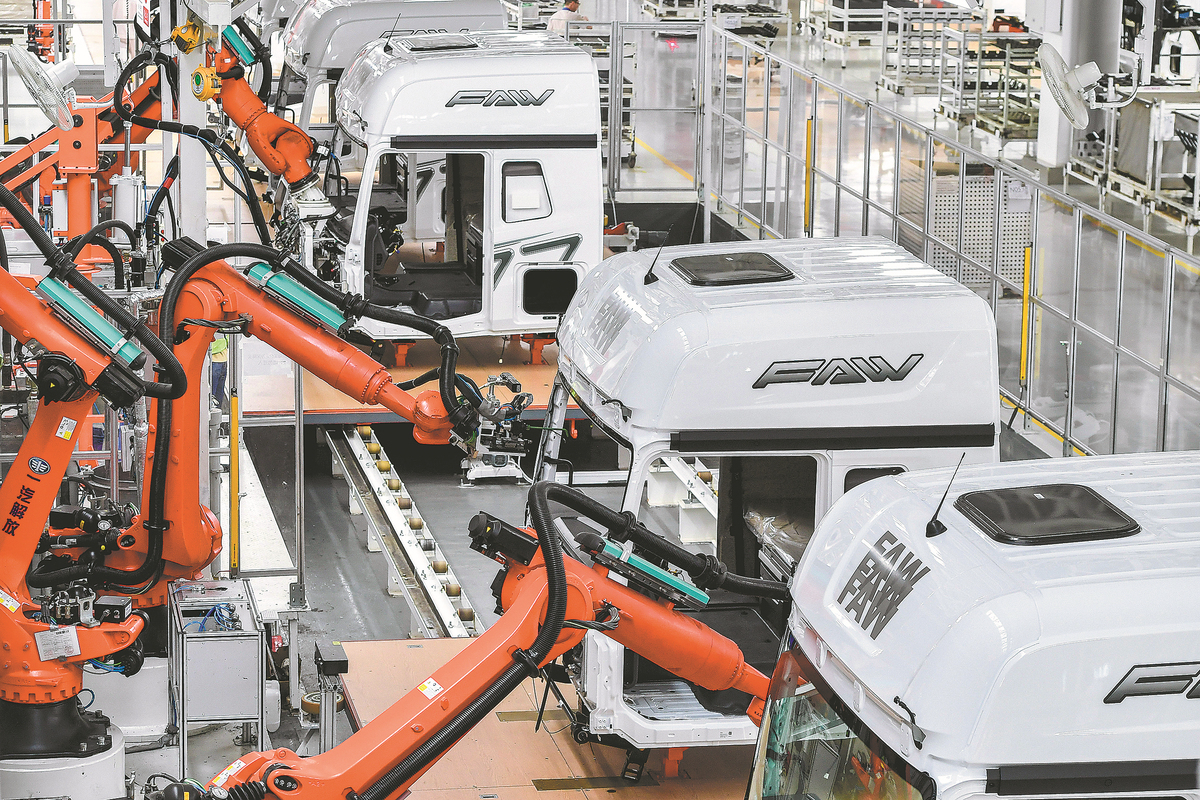
Central to the new productive forces' efficacy is the seamless integration of innovation elements. Deeply rooted in advanced technologies, the productive forces spawn fresh formats, models and driving forces, spearheading innovation-driven socioeconomic development. Examples abound, from the convergence of information technology and manufacturing to realize smart manufacturing, to the ubiquitous application of groundbreaking technologies such as big data, cloud computing, and the internet of things across different industries, fostering cross-industry integration and catalyzing technological innovation.
Moreover, the new productive forces underscore the paramount role of innovation. They symbolize a paradigm shift in productivity driven primarily by technological innovation, and characterized by efficiency and high quality. By charting the trajectory of industrial development, they radiate to interconnected sectors, giving rise to strategic emerging industries and future industrial clusters with profound leadership impacts.
They also accentuate breakthrough innovation. Being focused on substantially enhancing total factor productivity, they prioritize original, revolutionary and breakthrough technological innovations, leading to fundamental shifts in the industrial structure and even the broader socioeconomic paradigm. This is in stark contrast to the traditional innovation paradigm, which primarily focuses on improving the existing systems.
Advancing the new productive forces is necessary for driving high-quality development. Yet high-quality development depends on not only attaining the commanding heights in the global technological revolution and industrial transformation but also charting new frontiers of development and fortifying new competitive advantages.
At the heart of this evolution lie technological innovation, industrial transformation and transitioning economic development from being factor-driven to innovation-driven. This calls for a pivot toward emerging technologies, novel formats, models and data, and making marginal output more efficient and innovation capability long lasting, in contrast to the traditional reliance on factors such as land, labor and capital.
The new productive forces' development will help fuel the optimization and upgrading of the industrial structure, catalyze the emergence of new economic growth drivers such as the digital economy, intelligent manufacturing, new energy and advanced materials. These breakthroughs will help clear the growth bottlenecks that have long hindered traditional industries, while laying the foundation for a modern industrial system.
Additionally, by leveraging information technology to digitalize the production process as well as to build a smart production process, the authorities can strengthen resource allocation efficiency, minimize waste and foster greener, more sustainable socioeconomic development.
Importantly, this pursuit transcends quantitative growth to realize qualitative development. Aligned with the other elements propelling high-quality development, the pursuit prioritizes the quality of products and services, bolstering core competitiveness, and fulfilling the escalating aspirations of the people for a better quality of life.
The new productive forces' development catalyzes the shift in production relations, necessitating corresponding institutional reforms, including measures to better protect intellectual property rights, improving technology innovation policies and streamlining market access mechanisms, thereby fostering a favorable institutional environment for high-quality development.
Narrowing regional development gaps, these new productive forces will facilitate technological innovation and the restructuring of industry chains, enabling relatively less-developed regions to find new growth drivers, thereby promoting coordinated regional development and overarching social progress.
In summary, the ascendance of new productive forces has been playing a key role in China's economic modernization, and serving as a pivotal lever for modernizing the national governance system and governance capacity, and supporting the country's transition from high-speed economic growth to high-quality development.
The author is a research fellow at the Chinese Academy of Social Sciences' Institute of World Economics and Politics.
The views don't necessarily reflect those of China Daily.