Digging to discover the nation's roots







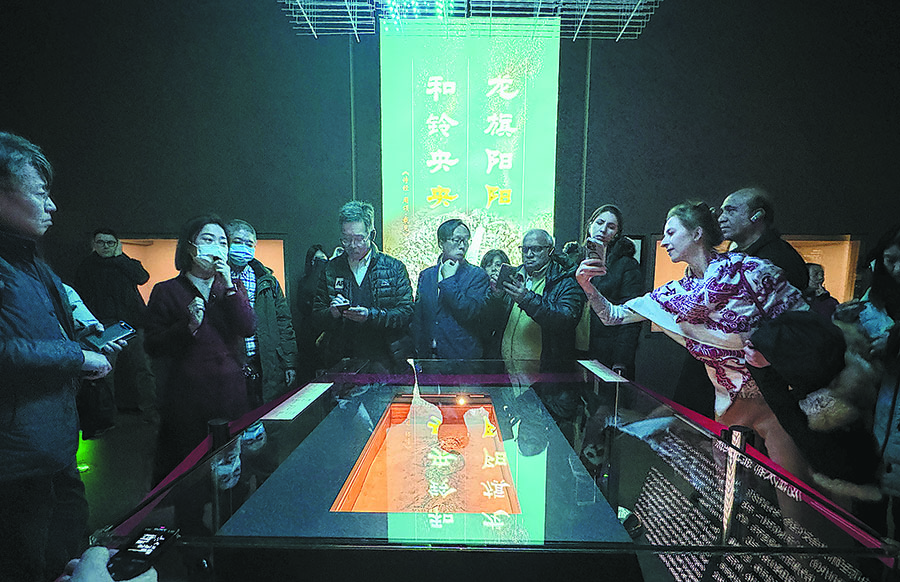
Specifically in archaeology, the formation of a state is usually embodied in remains of capital cities, palaces, high-level tombs, ritual items, and traces of war and violence, therefore these features can be taken as critical criteria for the birth of a civilization, Wang adds.
In his lecture after the museum tour, Wang summarized the social development of early Chinese civilization in chronological order, and introduced the key regional cultures of different periods and what they produced, their lifestyles, distribution of power, aesthetics, beliefs and representative legacies.
Exploring the exchange and mutual learning between civilizations is also one crucial aspect of the project to trace the origins of Chinese civilization, according to Wang, who, in the past decade, has been participating in joint archaeological excavations between China and countries including Uzbekistan, Honduras and Egypt.
It's clear that ancient Chinese people learned to grow wheat, keep sheep and produce bronze from other cultures — vivid proof that interaction between civilizations is an important driving force in progress, he says.
He adds that these days, Chinese archaeologists are paying increasing attention to remains found in southeastern coastal areas such as Fujian, Guangdong and Hainan provinces, which have maintained significant local characteristics, as well as to clues pointing to potential migration to islands in the South Pacific Ocean.
"It's not our intention to prove Chinese civilization is the oldest. Rather, we face up to our authentic history and are longing to explore what we have created and contributed to humankind and what we have learned from others. We want to tell the truth."
Wang stressed the importance of a global vision in archaeology, noting that China is a part of the world and that the scholars cannot develop an understanding of the characteristics of Chinese civilization without a comprehensive knowledge of other world civilizations.
Backed by archaeological techniques that have improved tremendously over the past two decades, this concern has led to more international collaboration. According to the National Cultural Heritage Administration, over the past decade, China has conducted 44 joint archaeological projects with 24 countries, and has carried out 11 international historical monument conservation programs in six.
"It's an important aspect in building a community with a shared future for mankind, because for us Chinese archaeologists, down the ages, world civilization has been a diverse and interrelated whole. We really need to enhance dialogue and learn from each other," Wang says.
From his perspective, many of the world's major ancient civilizations developed simultaneously, following similar paths of development, but cultivating distinctive features — for example, the Chinese valued jade while the Egyptians were fond of gold, the Chinese emphasized kinship while the Mediterranean merchants preferred social communities.
"Our future task includes studying and comparing the characteristics, similarities and differences of various world civilizations. Only on that basis can we find the causes of these characteristics," Wang says.