Why West shouldn't misread China's new development







In all ancient civilizations, especially in Asia, material and socio-cultural-spiritual development progressed more or less hand-in-hand. Hence, there was generally balanced human progress, even though all the civilizations had their share of shortcomings.
A major disruption occurred with the Industrial Revolution in the late 18th and 19th centuries. Spurred by new productive forces, the Industrial Revolution facilitated epoch-changing discoveries in science and innovations in technology, which exponentially raised many European nations' capability to generate material prosperity. As a result, European countries became fabulously wealthy.
However, the European countries used, rather misused, the new productive forces to consolidate their hold on their colonies in Asia, Africa and Latin America. They ruthlessly exploited and pillaged the colonies' resources, seeking to destroy native cultures and establish European civilizational superiority. Their fierce internal rivalry, though, led to two horrific world wars, which claimed millions of lives and ruined the economies of both the victims and perpetrators.
Hence, Western nations, despite their superior material wealth, became culturally, morally and spiritually impoverished. Even the birth of the United States was an outcome of the sordid history of colonization. European powers literally mass-annihilated almost all the indigenous people in the Americas in their lust for land and riches.
The US, in the last century, contributed to the further explosive growth of productive forces with revolutionary advances in science and technology, especially in computers and the internet, heralding the "information age".
Nevertheless, these productive forces, being at the service of an uncontrolled capitalist system, have been misused leading to the extreme concentration of wealth and power in the hands of a minority. Moreover, US administrations have abjured neither the Western instinct for global domination nor the habit of using their country's powerful productive forces to launch illegitimate wars.
The importance of the rise of "new quality productive forces" in China needs to be understood against this historical background. Many in the West have dismissed it as just another "buzzword" meant to divert the international community's attention away from China's economic slowdown.
However, the concept can be properly understood only in the context of the Chinese leadership's goal of developing "China into a great modern socialist country that is prosperous, strong, democratic, culturally advanced, harmonious, and beautiful". Seen from this perspective, the new quality productive forces, wedded to people-centric and planet-protective development, could be the harbinger of a significantly different, and balanced, kind of human development.
The rise of new quality productive forces in China will have both domestic and global impact. It is accompanied by, and is contributing to, positive changes in the West-dominated world order. For the first time in modern history, China is surging ahead of Europe and the US in scientific research and innovations in technology, especially in deploying new technologies and innovations.
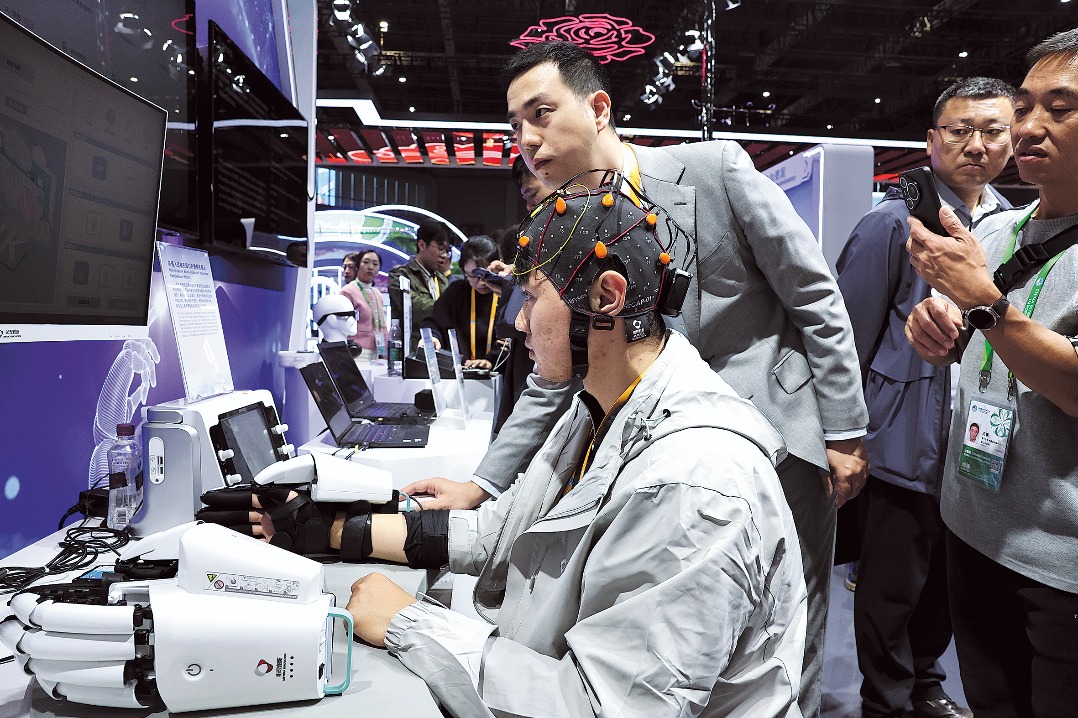
China's new quality productive forces are primarily in the areas of new energy, new materials, new hi-tech manufacturing systems, and new applications of artificial intelligence. In terms of the production and use of solar photovoltaic panels and other clean and green energy products, China is far ahead of the rest of the world. In fact, China installed more solar panels in 2023 than the US has ever built, setting new standards in low-carbon footprints.
Besides, there are more industrial robots in Chinese factories than in any other country. In space and ocean research, too, China is advancing at a pace faster than the West. For instance, it is developing the world's first quantum communications satellite network. China now ranks No 1 in science and technology innovation clusters in the world.
While China is making rapid strides in developing its strategic industries, its agriculture and traditional industries are also becoming smarter and more innovative. As a result of the huge innovation-led increases in productivity, quality and efficiency, the Chinese economy is sure to navigate its current challenges satisfactorily.
However, China's new development paradigm differs from that of the West in the past in one crucial respect: Chinese leaders have time and again emphasized that China will never seek hegemony irrespective of how prosperous it becomes. China is not trying to replace the West in global domination. Instead, it aims to help improve the world order by making it equitable, fairer, more representative and more democratic.
Five features set apart China's new quality productive forces from the Western template.
First, China has not become the world's second-largest economy by colonizing any other country or by exploiting or stealing other countries' resources. On the contrary, it has made much of the self-reliant technological advances despite the unlawful sanctions imposed by the US and other Western countries.
Second, China has not misused its technological prowess by waging deadly wars against far-off countries. It advocates resolving disputes through dialogue.
Third, China aims to use the scientific and technological breakthroughs primarily for boosting all-round development so its vast population can lead a high-quality life with common prosperity. It has already lifted about 800 million people out of extreme poverty within a short span of four decades ─ a feat unparalleled in history. The fact that common people are living much better lives, as I have seen during my travels across the country, shows China is committed to using its resources to enrich its human capital, an obligation many Western governments have nearly abandoned.
Fourth, China is sharing its development experiences with other countries so they can learn from them and apply them, if necessary, to boost their development. As a matter of fact, the Belt and Road Initiative shows China is committed to helping build a community with a shared future for mankind.
And fifth, in its 5,000-year history, China has achieved great feats in arts, culture, and science and technology, while seeking harmony in society ─ and in the world at large ─ although it has suffered many setbacks and foreign aggressions. Now that China has become a moderately prosperous society in all respects, it views its development propelled by new quality productive forces as a contributor to the rejuvenation of the Chinese nation and the creation of a better world order. Most Western observers fail to understand this civilizational wisdom guiding China's modernization.
The author is an advocate of India-China-Pakistan cooperation for a New South Asia and was an aide to former Indian prime minister Atal Bihari Vajpayee.
The views don't necessarily reflect those of China Daily.
If you have a specific expertise, or would like to share your thought about our stories, then send us your writings at opinion@chinadaily.com.cn, and comment@chinadaily.com.cn.