China's education a model for Sierra Leone to fight poverty







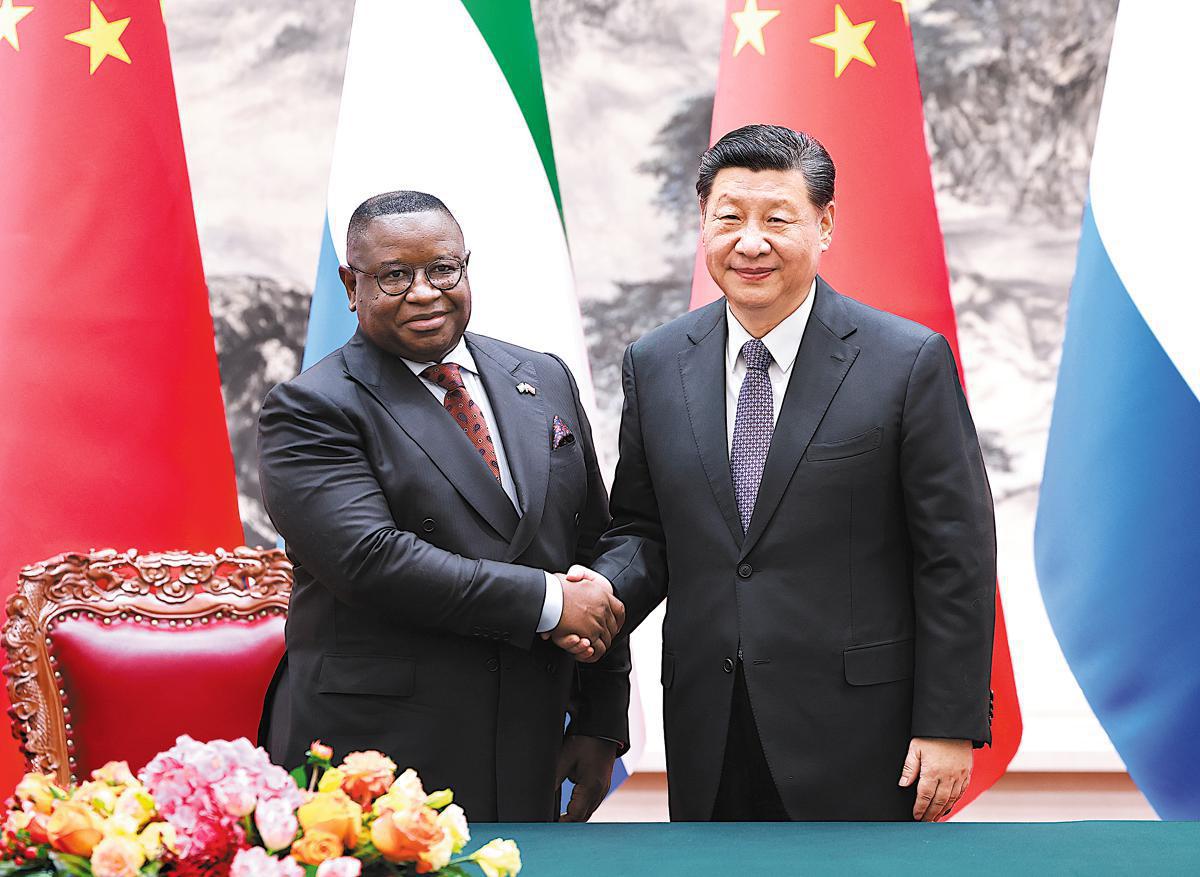
Sierra Leone, a country on the west coast of Africa, has a total area of 71,740 square kilometers and a population of 7.75 million.
Sierra Leone's economy relies mostly on mining, especially on diamond mining, and it is among the largest producers of titanium and bauxite, and a major producer of gold. Also, it has one of the world's largest deposits of rutile. But despite its natural wealth, about 53 percent of its population was living in poverty, according to 2011 data. Even though the country saw macroeconomic growth from 2003 to 2011, its per capita GDP is still much lower than the average per capita GDP of sub-Saharan Africa.
Sierra Leone has experienced several civil wars and abject poverty since it gained independence in 1961. It is one of the few countries that faces extreme poverty despite having precious natural resources such as diamonds and rare minerals. Among the issues that contribute to this poverty are poor governance and underdeveloped infrastructure, and lack of education.
Infrastructure in Sierra Leone is poor; it lacks roads, bridges and railways. The roads to most of the villages are not motorable, as a result, transporting goods and services to these areas has always been a challenge.
The literacy rate in Sierra Leone was only 47.7 percent for 2021. And this lack of education is the root cause behind the civil wars Sierra Leone has seen. Government funding to both government and non-government-assisted schools is inadequate, and the required learning materials such as textbooks, note books, pens and pencils are always low in supply, which serves as an impediment to teaching.
It is a proven fact that a country cannot reduce poverty if it does not educate its people and instil self-discipline in them. Education and self-discipline are necessary to help alleviate poverty and promote sustainable development.
For many years, it has been accustomed to a colonial system of education that focuses on producing individuals for white collar jobs but with low vocational and poor entrepreneurship skills which has led the country to where it finds itself in now. Therefore, there is a need for more reforms that would enable the country to move from this desperate state toward economic development.
China succeeded in eradicating absolute poverty by the end of 2020 because it accords high priority to education. It implemented the nine-year compulsory education policy to ensure everyone in the country receives the basic education so they can lift themselves out of poverty. China has won praise from the United Nations, the World Bank and other international organizations and institutions for lifting about 800 million people out of poverty in the last four decades.
To integrate and manage well the other resources, China focused on optimizing the use of human capital at all levels to foster development. Capacity building and advancement in technology are also important factors that helped China to design systems that helped implement policies that were geared toward eradicating poverty and devising a road map for high-quality development as opposed to the blind pursuit of resource-exploiting fast-paced growth.
With a literacy rate of close to 98 percent, the Chinese people are able to secure better jobs, and contribute to the growth of the country's economy.
Looking at China's goals (building a moderately prosperous society by the end of 2020, and building a great modern socialist country that is prosperous, strong, democratic, culturally advanced, harmonious, and beautiful by 2050), it is clear that with the available resources, it will achieve them because it has a well-educated, self-disciplined and innovative workforce.
China has made great strides toward development not because it has a magic wand but because it meticulously planned its development policies and painstakingly implemented them. So there is a lot Sierra Leone can learn from China and, if needed, replicate.
In fact, Sierra Leone can eradicate poverty if it at least makes primary and secondary education compulsory and closely monitors its implementation. It should also devise and implement policies that will help combat corruption at all levels, and find ways to eradicate poverty at all levels and get the people involved in the process.
The author is director of China-Africa Institute, University of Makeni, Sierra Leone.The views don't necessarily reflect those of China Daily.
If you have a specific expertise, or would like to share your thought about our stories, then send us your writings at opinion@chinadaily.com.cn, and comment@chinadaily.com.cn.