High-level opening-up to benefit other nations








China has become the world's second-largest economy due to its reform and opening-up policies. And the fact that the recent third plenary session of the 20th Central Committee of the Communist Party of China has vowed to promote "high-standard opening-up" means a vast range of new opportunities will be created for other countries, especially developing countries, including Brazil.
China has been reiterating that it is committed to aligning its rules and regulations on protecting intellectual property rights, granting industrial subsidies, safeguarding the environment and ecology, and defending workers' rights and interests with international standards.
This alignment would create a more stable and predictable platform for foreign companies that wish to invest or expand their operations in China. It will also create a more reliable and transparent business environment for developing countries, including Brazil, and enable companies from different countries and regions to explore new partnerships with their Chinese counterparts, and leverage a market regulated according to international standards to expand their businesses.
Also, better protection of intellectual property rights will encourage high-tech companies to invest in China, knowing that their innovations will be safeguarded.
The orderly opening-up of China's commodities, services, capital and labor markets has created huge opportunities for trade and international cooperation, and the country's decision to unilaterally open its door to less-developed countries demonstrates a commitment to inclusive and sustainable growth.
These moves will generate significant opportunities for countries such as Brazil, which are major exporters of commodities. Agricultural products such as soybean, meat, and coffee from developing countries can find a growing market in China.
Furthermore, by opening up its services market, China is allowing companies from various sectors to explore new opportunities in its domestic market, and by coordinating its trade policies with its fiscal, tax, financial and industrial policies, it has created a set of systems and policies that has boosted its exports and imports, and helped develop new models and forms of trade, such as digital and green trade.
Besides, developing countries can learn from China how to promote innovations in digital trade and apply the lessons to improve their e-commerce infrastructure, and follow sustainable and green trade practices in order to better protect the environment.
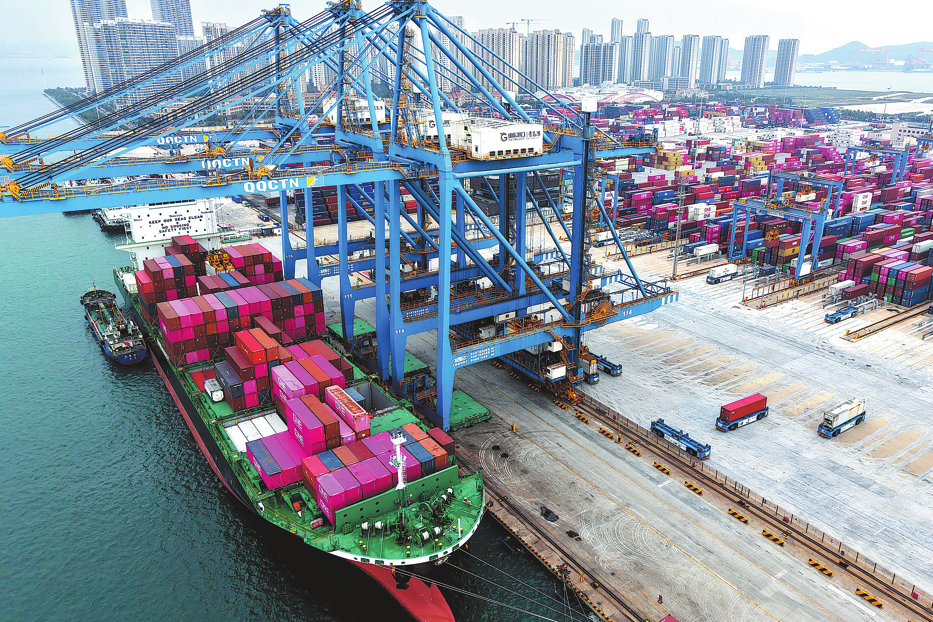
China is establishing commodity trade centers and global distribution centers to support the development of overseas logistics facilities, which means countries have higher possibility of collaborating with China to build and manage logistics infrastructure that would facilitate global trade. Learning from China's experiences in improving logistics, these countries can improve their operations and reduce costs.
Additionally, creating international logistics centers can facilitate the export of products and sharpen China's competitive edge in the global market. While the improvement of the export control structure and commercial remedy system will ensure that developing countries' companies operating in China get greater legal security and face fewer commercial risks, the innovative promotion of service trade by fully applying the negative list for cross-border services trade and developing pilot zones for cross-border e-commerce will create new opportunities for companies providing services such as consulting, education and technology.
And promoting pilot zones for cross-border e-commerce can facilitate companies from other developing countries to access China's vast consumer market.
Creating a first-class business environment that protects the rights and interests of foreign investors according to the law includes further shortening of the negative list for foreign investment. More sectors have been opened to investment from developing countries, with an increasing number of them exploring the new investment opportunities, especially in strategic sectors such as telecommunications, the internet, education, culture and medical services.
In particular, China is opening up its central, western and northeastern regions to the outside world while consolidating the leading economic role of the eastern coastal region. Foreign companies can thus establish partnerships with their Chinese counterparts in less-developed areas of the country.
Collaboration between Guangdong province and the Hong Kong and Macao special administrative regions in the Greater Bay Area provides another strategic platform for companies wishing to access the Chinese and other Asian markets.
Moreover, the Belt and Road Initiative provides a platform for multilateral cooperation in digital economy, artificial intelligence, energy and finance, which developing countries can use to create new opportunities in infrastructure and sustainable development projects. In fact, the initiative is aimed at improving connectivity among Belt and Road countries in order to promote trade and collaboration in various areas.
China's pursuit of high-standard opening-up offers many opportunities to other countries, including Brazil, to expand trade, invest in new fields, collaborate on development projects and strengthen economic relations between these countries and China.
In summary, China's new approach to opening-up will benefit not only the Chinese economy but also partner countries such as Brazil. With a more transparent and predictable business environment, expanded markets, policy integration, and innovation in trade and services, these countries can explore and maximize these opportunities to drive their economic growth and strengthen bilateral relations with China.
And strategic collaboration between them in logistics, technology, e-commerce and green technology can yield long-term mutual benefit, leading to a future of shared prosperity among nations.
The author is director of the China-Brazil Center for Research and Business. The views don't necessarily reflect those of China Daily.
If you have a specific expertise, or would like to share your thought about our stories, then send us your writings at opinion@chinadaily.com.cn, and comment@chinadaily.com.cn.