Housing pension to enhance living quality
Pilot system in 22 cities won't cause burden for homeowners, experts say







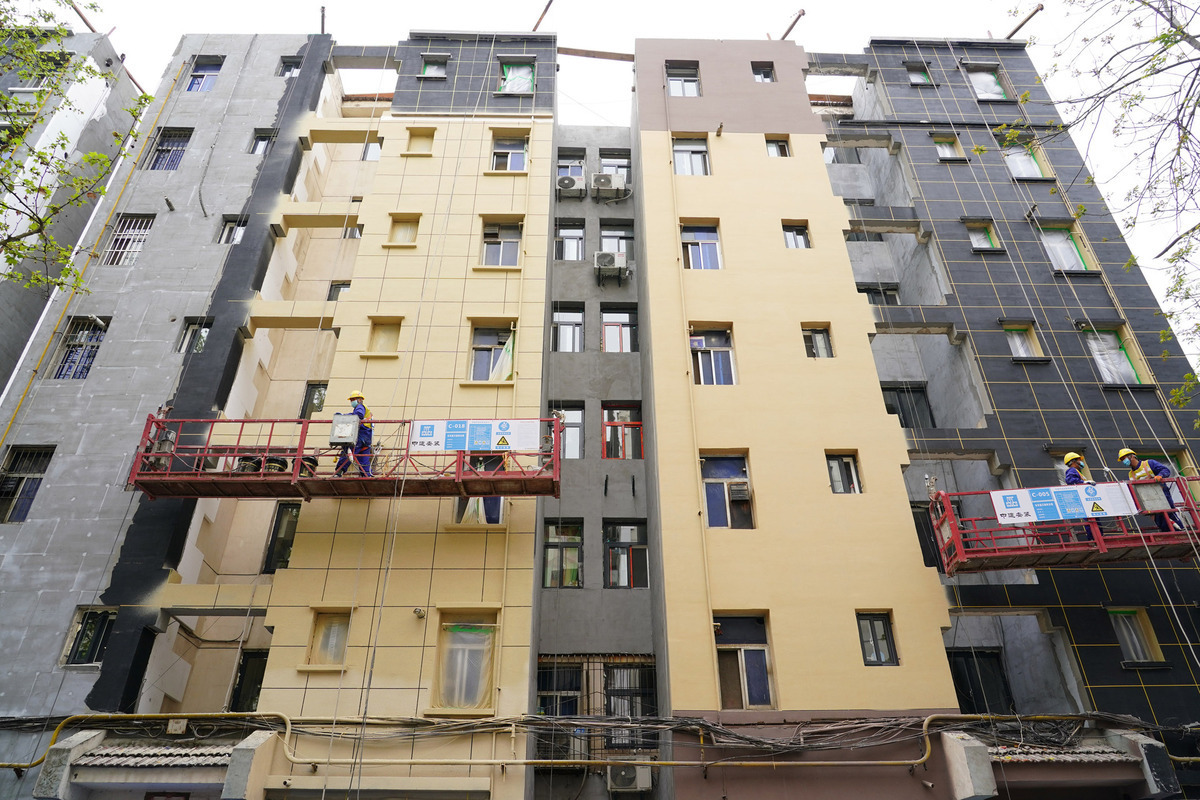
China's pilot housing pension system in 22 cities, including Shanghai, aims to better facilitate existing housing upgrades and enhance people's living environment, said an official and real estate experts, dispelling fears of the system being a new form of property tax.
The housing pension system consists of personal accounts and public accounts, the Ministry of Housing and Urban-Rural Development said in a statement on Monday.
Personal accounts have been established through homebuyers' contributions to a housing maintenance fund, while a certain proportion of land transfer fees, appreciation of housing maintenance funds and fiscal subsidies are likely to become sources of capital for the public accounts, it added.
"Housing pension" became a widely discussed and debated topic over the weekend after the State Council Information Office announced the piloting of the system during a news conference on Friday.
"A study on establishing a full life-circle housing safety management mechanism has been carried out. Under the mechanism, residences will see regular inspections, while housing pension and insurance systems will be established," said Dong Jianguo, vice-minister of housing and urban-rural development, at the news conference held in Beijing.
An editorial published on Monday on the social media account of Architecture magazine, a publication of the ministry, clarified that the housing pension is "not a property tax".
Since 1998, homeowners in China have been contributing to a housing maintenance fund, which covers regular upkeep expenses of residential buildings.
Yan Yuejin, vice-president of Shanghai E-House China Real Estate Research Institute, said: "The housing pension will comprise individual accounts and public accounts. The first is already paid through the housing maintenance fund, while the public accounts will be set up at an accelerated pace in the future."
He added that the housing pension is not a property tax in disguise, and spreading such ideas is "misleading, wrong and irresponsible".
Yin Fei, a professor at the Central University of Finance and Economics in Beijing, noted that in comparison with ordinary consumer goods, any residential property has a relatively long service life. During its lifetime, the owner will face the cost of maintenance, repair and even reconstruction, and such expenses can be termed as housing pension, he said.
"Following the principle of not increasing the personal burden and not impairing personal rights and interests, the capital for public accounts will be collected by local governments," Yin was quoted as saying by China Construction News, a publication associated with the ministry.
Chen Sheng, president of the China Real Estate Data Academy in Shanghai, said he sees little impact of the housing pension system on the real estate market in the short term, but it may help strike a supply-demand balance in the long term.
"The residential buildings constructed before the establishment of the housing maintenance fund may not have enough capital, which means homeowners may have to shell out extra maintenance money in the future. Owners of such property can consider selling homes they don't live in to reduce the burden," he added.
Guan Rongxue, a senior analyst at the Zhuge Real Estate Data Research Center, said the housing pension system for the assessment, repair and insurance of existing homes will have multiple impacts.
"With the system, the quality of housing can be improved. It is a trend to establish a housing pension system that can better solve potential safety problems, create living environment optimization and extend the living period," she added.
Li Yujia, chief researcher at the Guangdong Planning Institute's residential policy research center, said that Chinese people's living requirements will shift from "finding a place to live in" to "finding a better place to live in".
"As pre-owned homes outnumber newly built ones in more and more cities, it is a matter of time before cities with a high urbanization rate are required to solve problems involving existing homes such as safety, maintenance and renovation," Li said.
Apart from the housing pension system, China will also introduce other measures including regular inspections of residential buildings and introduction of a housing safety insurance system, in a bid to meet people's demand for better housing.
Xinhua contributed to this story.
wang_ying@chinadaily.com.cn



- Forum unites global experts to enhance city image communication
- Miao New Year celebrations get underway in Guizhou's Leishan county
- Mainland spokesman reiterates stand on Taiwan
- Fujian county's rural development becomes a big draw for Taiwan investors
- Nobel laureate in chemistry: Give young scientists more independence
- Are Asians really better at math?