BRICS a rising collective in a changing world







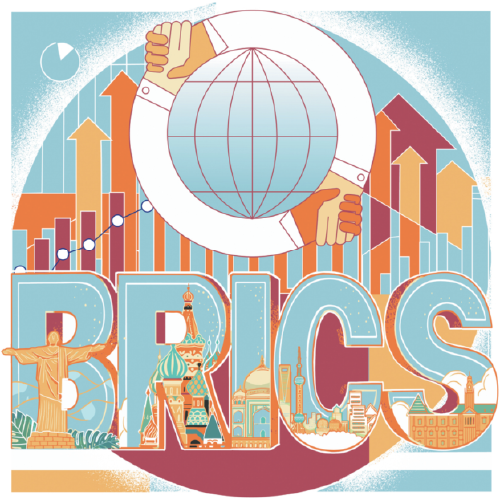
The 16th BRICS Summit in Kazan, Russia, from Tuesday to Thursday will see new members after the historic expansion, marking the beginning of a new era of cooperation for the grouping.
After the end of the Cold War, developing countries and emerging market economies have been seeking to better safeguard their national security, boost the economic development and improve their peoples' living standards. And they need a fair and just world order to promote economic globalization, multilateralism and democratic international relations.
BRICS has established a framework with the leaders' summits at the helm, supported by ministerial meetings. The grouping has been promoting practical cooperation in fields such as trade, finance, technology, agriculture, culture, education and healthcare.
In fact, BRICS has proposed a path of development that is different from Western models. It is a constructive path that is aimed at boosting global economic growth and improving global governance.
BRICS member states contribute about one-third of the global GDP, more than the cumulative share of G7 countries. BRICS spans several continents, with its members accounting for about 31 percent of the world's land and 46 percent of the global population. It also accounts for about 40 percent of the world's oil production and reserves. This means BRICS is in a position to meet the development requirements of not only its members but also non-member states and help alleviate global poverty.
BRICS, as a grouping of emerging market economies and developing countries, seeks to improve the world order and counterbalance the West's dominance of global affairs. Many developing countries are seeking BRICS' membership so they can help the grouping to eliminate inequalities in international organizations and institutions.
BRICS has been flourishing over the past decade because it believes in consultation and agreement instead of one country making arbitrary decisions or dictating terms to the other members.
The principles of openness, transparency, solidarity, mutual assistance, cooperation and shared development, as well as the spirit of inclusivity and mutual benefit unite BRICS members.
BRICS' new members are from the Middle East and Africa, regions that are the most representative of emerging markets and developing countries, and will help build closer and more solid partnerships.
The inclusion of Middle East countries in BRICS will boost cooperation in the oil and gas sectors. With the Israel-Palestine conflict showing no signs of ending and energy prices rising, BRICS members that are major producers and consumers of oil and gas need to strengthen cooperation to safeguard energy resources.
More than 30 countries have reportedly applied to join BRICS, because the grouping is democratic and truly representative.
BRICS member states are engaged in practical cooperation across multiple fields. Politically, they respect each other's sovereignty, national security and development interests, and oppose hegemony and Cold War mentality. Economically, BRICS held 14.06 percent of the vote in the World Bank and 14.15 percent in the International Monetary Fund in 2022. On the healthcare front, BRICS member states cooperated in vaccine research and development, most visibly during the COVID-19 pandemic.
Moreover, BRICS has become an important driver of South-South cooperation and has been making efforts to improve global governance.
At the 2017 BRICS Summit in Xiamen, Fujian province, China proposed the "BRICS Plus" cooperation model and promoted dialogue between emerging market economies and developing countries. "BRICS Plus" has been trying to amplify the voice of developing countries in the global governance system, laying a solid foundation for BRICS expansion.
At the Kazan summit, Russia will focus on "strengthening multilateralism for global development and security" across fields such as finance, trade, technology, industry, culture, education and the environment, with the member states aiming to reach a consensus on enhancing economic cooperation, improving global financial governance, maintaining global peace and stability, and expanding cultural exchanges, as well as discussing whether or not to include any more members.
Furthermore, Russia has outlined a "BRICS bridge" settlement platform for cross-border payments, including a digital currency. As Russian Finance Minister Anton Siluanov recently said, the existing financial system was established more than half a century ago and thus needs to be modernized and the financial requirements of developing countries need to be met by new organizations, instead of the weakening IMF and World Bank.
Jim O'Neill, the British economist who coined the term "BRIC" (Brazil, Russia, India and China), has said that the BRICS New Development Bank has been performing well and hoped the grouping will take measures to ensure the bank plays a bigger role in multilateral trade, climate action and tackling the infectious disease challenge.
This means BRICS and its organizations, despite working to improve global governance, have a long way to go before ensuring emerging market economies and developing countries get their due. Hence, member states need to work together to make BRICS a more powerful and truly multilateral and representational grouping.
The author is a professor at the China Center for Contemporary World Studies.
The views don't necessarily represent those of China Daily.
If you have a specific expertise, or would like to share your thought about our stories, then send us your writings at opinion@chinadaily.com.cn, and comment@chinadaily.com.cn.