



US cornered in its own 'small yard': China Daily editorial







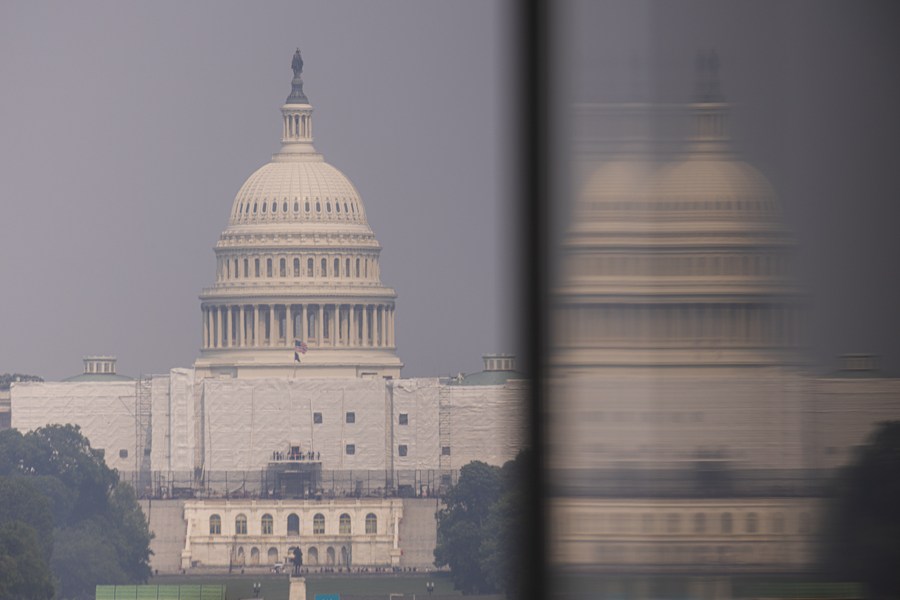
In its bid to ensure the United States wins the technological competition with China, the Joe Biden administration has been continually ramping up its efforts to transform the "high fence" of its "small yard" strategy into a de facto wall.
It has therefore been striving to effectively cut off meaningful connections between the two countries' technological sectors in fields that are at the cutting-edge.
As part of its push to prevent US products, capital and know-how from helping China outcompete the US in these cutting-edge technologies, the United States Treasury Department published a final rule on Monday for the implementation of President Joe Biden's August 2023 Executive Order to restrict US investments in specific Chinese technologies.
This is not "de-risking", but decoupling, and the antagonistic way the US is pursuing it will further poison the overall bilateral relationship, which is already in a thick shadow of fears of a new Cold War. Despite its rather general title, Biden's Executive Order on Addressing United States Investments in Certain National Security Technologies and Products in Countries of Concern was tailor-made for China.
Announced on Aug 9, 2023, the order is targeted at advancements in sensitive technologies and products that accelerate the development of advanced computational capabilities. It focuses specifically on semiconductors and microelectronics, quantum information technologies and certain AI systems, "sensitive technologies and products" identified as critical for the next generation of military, cybersecurity, surveillance, and intelligence applications.
The Treasury Department's Final Rule to implement Executive Order 14105, which will take effect on Jan 2, provides the operative regulations and a detailed explanatory discussion on their intent and application, which for all intents and purposes is aimed at restricting investments by US individuals and companies in advanced technologies and products in the Chinese mainland and the Hong Kong and Macao special administrative regions. It features an additional move against outbound investments in China.
Since the Donald Trump administration, Washington has made continuous attempts to build an ever-higher fence to curtail the momentum of Chinese technological breakthroughs. Following export controls, financial sanctions, high tariffs, and inbound investment screening, the White House has now taken a decisive new step to bring outbound investment under government oversight and control. Although the final rule does allow certain exceptions, they are largely nominal, as observers have pointed out. After all, no matter who gets elected in the impending presidential election, no matter which party controls the House or/and Senate, there is little chance this "small yard, castellated wall" approach will change any time soon. After all, containing Chinese scientific and technological progress has become a bipartisan consensus in US domestic politics, and a key pillar of US geopolitical strategy. Through continuous endeavors by both the present and previous US presidencies, Beijing has been cast as the foremost threat to US national security. And national security has been a handy rallying cry for US politicians to concentrate support both at home and abroad.
It remains to be seen how and to what extent the new rule will affect the US' allies and partners. Considering Washington's historical obsession with long-arm jurisdiction, it is very likely such restrictions will at some point be applied to critical third parties in one way or another. This is because, as Paul Rosen, assistant Treasury secretary for investment security, said in a news release, US investments include the intangible benefits such as managerial assistance and access to investment and talent networks that often accompany such capital flows.
On releasing the rule, the US Treasury stated the US was committed to "an open investment environment". And in a speech at Brookings Institution on Oct 23, US National Security Advisor Jake Sullivan denied popular perception that the US is abandoning the "positive-sum" world outlook. Instead of substantiating these claims, the new rule is evidence to the contrary.


















