Tech opening-up key to Chinese modernization








Emphasizing that opening-up is a defining feature of Chinese modernization, President Xi Jinping has said that Chinese modernization must be supported by scientific and technological modernization. High-level opening-up in the field of technology is crucial for accelerating China's journey toward becoming a tech powerhouse and advancing Chinese modernization.
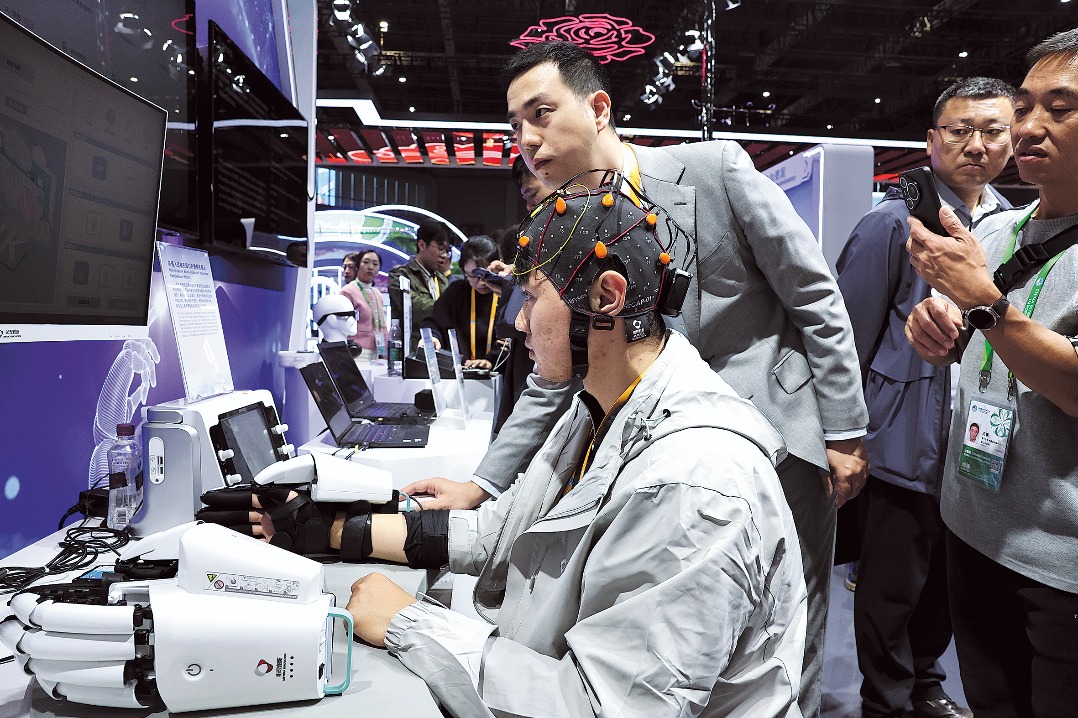
International cooperation in technology enhances China's innovation capabilities, and by expanding technological opening-up and collaboration, it can attract top global talents and institutions, thus facilitating the formation of cross-border research teams that produce high-quality results.
While such cooperation drives high-quality economic development, technological innovation spawns new industries, industrial models and growth drivers, serving as the core of new quality productive forces. In addition, high-level technological opening-up fosters the emergence and application of groundbreaking innovations, spurring new industries and deepening industrial transformation, thereby boosting the economy's intrinsic growth momentum.
Sharing technological advancements with the world allows China to construct a more open and inclusive global innovation network, facilitating the global flow and sharing of technological resources. This collective effort helps address global challenges such as climate change and public health, promoting the building of a community with a shared future for mankind.
Since the 18th National Congress of the Communist Party of China in 2012, China's achievements in technological opening-up and cooperation have been remarkable, with the level as well as the quality of China's participation in global basic research collaborations having significantly improved.
According to the 2024 Statistical Data of Chinese S&T Papers, in 2023, one-third of China's highly cited papers were the result of international collaborations led by Chinese researchers, and 20.4 percent of China's published papers were prepared with overseas co-authors from 177 countries and regions. China has deeply engaged in major international scientific programs and projects.
For instance, the Deep-time Digital Earth, or DDE, launched by Chinese scientists in 2019, uses big data, cloud computing and artificial intelligence to address Earth evolution issues and has attracted 29 international institutions and academic organizations as members. Chinese enterprises also play a leading role in technological innovation and cooperation. The World Broadband Association, initiated by China Telecom in 2022, now has more than 100 global members from more than 40 countries and regions, driving the advancement of the global broadband industry.
Through the Belt and Road Initiative, China has promoted high-level regional technological cooperation, signing intergovernmental science and technology agreements with more than 80 countries, establishing more than 50 joint laboratories under the Belt and Road Initiative framework, and setting up numerous agricultural technology demonstration centers and overseas industrial parks.
Additionally, China and Belt and Road countries have set up nine international technology transfer centers which have hosted over 300 tech exchange events, leading to the implementation of more than 1,000 collaborative projects.
But challenges remain. The complex international landscape poses risks to China's technological opening-up, with certain countries creating hurdles by resorting to unilateralism and trade protectionism. Also, China has to improve its ability to utilize global innovation resources, strengthen Chinese enterprises' global technological cooperation and make its policies and regulations compatible with global policies and regulations.
To further promote high-level technological openness and advance Chinese modernization, China needs to focus on three areas:
To begin with, China needs to implement more proactive, open and effective talent policies to create an inclusive research environment, establish global cooperation platforms to attract top global talents and help its workforce to develop a global perspective, while encouraging Chinese researchers to engage with international organizations.
Second, it should set up global research funds to create collaboration opportunities for international researchers, build major scientific infrastructure facilities such as radio telescopes and high-energy accelerators to attract top scientists to China — and develop platforms for managing scientific information resources to ensure the efficient flow and allocation of papers, reports and data.
And third, the country has to align its laws and regulations with those of high-standard international trade protocols and agreements like the Comprehensive and Progressive Agreement for Trans-Pacific Partnership and the Digital Economy Partnership Agreement to expand institutional opening-up, build multilateral platforms for the digital economy and AI, strengthen domestic intellectual property rights protection, and address governance issues in emerging technologies through global cooperation, while tackling risks such as privacy breaches and misinformation.
Yang Guoliang is a professor at the Institutes of Science and Development, University of Chinese Academy of Sciences; and Zhao Tengyu is an analyst at the China Telecom Research Institute. The views don't necessarily reflect those of China Daily.
If you have a specific expertise, or would like to share your thought about our stories, then send us your writings at opinion@chinadaily.com.cn, and comment@chinadaily.com.cn.