Smart grids empower sustainable development







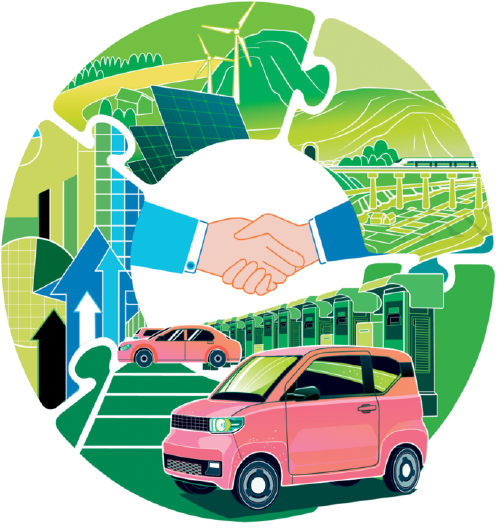
China's rapid development and ambitious goals of peaking carbon emissions before 2030 and achieving carbon neutrality before 2060 require a robust and adaptable infrastructure that goes beyond energy. Smart grids and artificial intelligence are critical technologies for optimizing energy management, integrating renewable resources, enhancing disaster resilience, and securing critical infrastructure.
The scope of smart grids and AI applications is continually expanding, playing a crucial role in China's energy transition. Smart grids enable the seamless integration of renewable energy while reducing inefficiencies in energy generation and distribution.
AI plays a pivotal role in several key areas. One of the main contributions is predictive maintenance, where AI continuously monitors grid components for signs of wear and tear, helping to prevent outages. Digital twins — virtual replicas of grid infrastructure — allow operators to simulate and optimize grid operations. For instance, in Hebei province, a wind farm's digital twin reduced curtailment rates by 20 percent. Another critical application is real-time demand response, where AI-powered systems dynamically adjust energy distribution during peak demand. In Shanghai, an AI-driven grid management program helped reduce peak loads by 30 percent during the heat wave in 2023.
Additionally, advanced energy storage technologies, such as flow batteries and compressed air energy storage (CAES), are optimized by AI to ensure energy is available when and where it is most needed. In Jiangsu province, a CAES plant currently provides 350 MW of long-duration storage, stabilizing grid performance.
AI and smart grids are revolutionizing transportation infrastructure by electrifying mobility and seamlessly integrating transportation systems with energy networks. Key innovations in this area are driving significant transformation.
Vehicle-to-grid (V2G) integration is one such innovation, where electric vehicles (EVs) serve as mobile energy storage units. These vehicles can feed power back into the grid during peak demand, enhancing grid stability and reducing reliance on fossil fuels. By 2025, over 1 million EVs in China are expected to be part of V2G systems, contributing to a more resilient and sustainable energy network.
Another critical development is the implementation of smart charging networks. AI-driven charging stations optimize the charging schedules of EVs, reducing their impact on the grid and lowering energy costs. For example, a pilot project in Guangdong province reduced peak charging loads by 15 percent in its first year. That not only alleviated the pressure on the energy grid during high-demand periods but also improved the overall efficiency of EV charging.
The impact of smart grids extends beyond energy management to support broader urban infrastructure, ensuring sustainability and efficiency in smart cities — for instance, in cities such as Tianjin, AI is being leveraged to integrate heating, cooling, and electricity systems, which helps reduce emissions and improve overall efficiency.
AI is also playing a critical role in water and wastewater management, with algorithms optimizing the distribution of water and treatment processes and ensuring more efficient use of resources. In Beijing, for example AI-driven water management systems have reduced leakage rates by 12 percent.
Also, AI is transforming traffic flow optimization in smart cities, helping to alleviate congestion and enhance fuel efficiency. In Hangzhou, Zhejiang province, for example, the AI-based traffic management system has reduced travel times by 20 percent on major corridors. These AI applications are central to building smarter, more sustainable urban environments.
China's infrastructure is exposed to significant risks from natural disasters such as floods, earthquakes, and typhoons. And smart grids and AI play a vital role in enhancing disaster resilience by providing advanced tools for monitoring and response. AI-powered real-time monitoring systems track environmental conditions, detecting potential risks and preventing cascading failures.
For instance, Guangdong province's smart grid initiative reduced fault detection times by 40 percent in 2022.In addition, disaster simulations using digital twins are helping to identify vulnerabilities and improve recovery strategies. In the case of the Yangtze River Flood Control System, a digital twin is used to coordinate dam operations during floods, minimizing damage.
The more interconnected smart grids become, the more vulnerable they become to cyberattacks. With AI playing a crucial role in strengthening grid security, anomaly detection becomes easier as AI algorithms analyze network traffic in real time to identify and respond to cyber threats. For example, in 2023, China's State Grid deployed an AI-powered cybersecurity platform, reducing intrusion detection times by 60 percent. Another important tool is quantum cryptography, which leverages quantum key distribution (QKD) to provide unbreakable encryption for high-voltage grid control systems. A QKD system deployed in Beijing has significantly improved data security.
Beyond energy infrastructure, AI and smart technologies are also enhancing the security of other critical systems. For instance, in Sichuan province, a pilot program using AI to monitor high-speed rail tracks resulted in a 25 percent reduction in maintenance costs. In the field of telecommunications, AI helps secure data transmission and prevent service disruptions in 5G networks.
AI-driven solutions contribute significantly to the circular economy by optimizing resource use and minimizing waste. One key application is recycling rare earth elements, where AI technologies are used to identify and recover valuable materials from electronic waste. A pilot project in Guangdong achieved an 85 percent recycling rate for rare earth elements in discarded batteries and electronics.
To maximize the potential of smart grids and AI integration, China should focus on several key areas. The development of national standards is essential to ensure seamless communication between diverse infrastructure systems, facilitating greater interoperability. While talent development is essential to expand training programs to cultivate a skilled workforce in AI, improve energy management, and boost infrastructure resilience, a strong focus on rural electrification is necessary to bridge the urban-rural divide.
The integration of smart grids and AI extends far beyond energy, transforming transportation, urban infrastructure and disaster resilience, while securing critical systems against emerging threats. By leveraging these technologies, China can achieve a more sustainable, resilient and interconnected future. Strategic investments, robust policies, and collaboration between sectors will ensure that smart grids and AI contribute to China's long-term stability and global leadership in innovation.
The author is an IEEE and ASME fellow, chairman, president, and CEO of Energy Policy and Security Associates, and a professor emeritus at the University of Minnesota.
The views don't necessarily reflect those of China Daily.
If you have a specific expertise, or would like to share your thought about our stories, then send us your writings at opinion@chinadaily.com.cn, and comment@chinadaily.com.cn.