US-China relations: The road to a strategic breakthrough







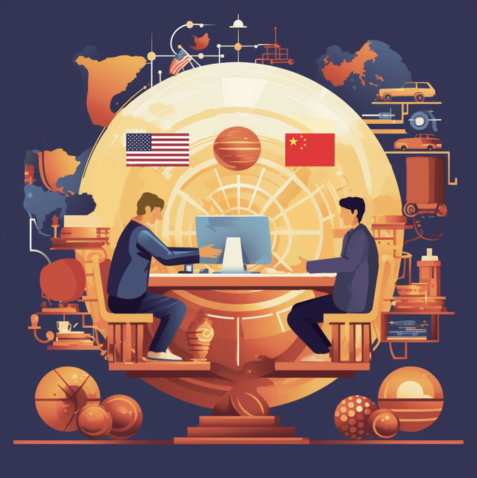
The passing of the 39th President of the United States, Jimmy Carter (1924-2024), has sparked significant commentary on the history and trajectory of US-China relations. Carter's administration marked a watershed moment, as it was during his presidency that the United States and China formally established diplomatic ties. To assess the current state of US-China relations, it is crucial to interpret this historic moment accurately.
Carter's decision to recognize the People's Republic of China and establish official relations in 1979 was not an abrupt shift but rather a continuation of the policy initiated by President Richard Nixon (1913-1994) and his National Security Advisor, Henry Kissinger (1923-2023). Nixon's groundbreaking visit to China in 1972 signaled the start of the US opening to Beijing. At the time, this rapprochement was shaped by the strategic imperatives of the Cold War, particularly the US effort to counterbalance the Soviet Union's influence. For American policymakers, including Carter's National Security Advisor Zbigniew Brzezinski (1928-2017), China was viewed as a tactical ally in the broader strategy of containing Soviet power.
This tactical alignment persisted throughout the remainder of the Cold War, with the United States benefiting from its relationship with China as a counterweight to Soviet ambitions. China, for its part, saw its new relationship with the US as a means to deter the USSR from escalating tensions to a full-scale conflict following the Sino-Soviet split.
The end of the Cold War in 1991 brought significant shifts. With the collapse of the Soviet Union, the strategic rationale that had underpinned US-China cooperation dissipated, leaving room for new dynamics to emerge.
What few US strategists, whether Kissinger, Brzezinski, or others, fully anticipated was the scale of China's rise as an economic and geopolitical power. One should add that China's success was not solely caused by the US opening to China. While the latter may have facilitated China's return to the center of global affairs, it did not determine it, as the country's modernization was driven primarily by internal factors. This partly explains why American strategists were unable to foresee China approaching the point of surpassing the US economy and, in doing so, altering the global balance of power.
By the mid-1990s, some voices within the US security establishment, including figures like Andrew W. Marshall (1921-2019), began framing China as a strategic rival. As China's economic growth accelerated and its influence expanded, concerns grew in Washington about the implications of this rise for the American position in the world.
For much of the early 2000s, however, the US remained preoccupied with the war on terror, which diverted attention and resources away from China. This period ended with the Obama administration, which announced a "pivot to Asia", signaling a renewed focus on the Indo-Pacific region. Subsequent administrations, including the first term of Donald Trump and the presidency of Joe Biden, have continued this trend, emphasizing policies aimed at countering China's influence and maintaining US primacy in the region.
Looking ahead, the question arises: Will the 47th President of the United States continue this trajectory of strategic competition with China? Many analysts believe so, given the bipartisan consensus in Washington on the need to contain China. However, another question has to be raised: What would constitute a positive breakthrough in US-China relations?
For such an advancement to occur, the US must certainly abandon the view of China as merely a tactical player in its geopolitical priorities. China, with its economic, technological and geopolitical clout cannot accept the role of a junior partner to any nation. Likewise, the notion of "containing" China is increasingly unrealistic. Given the deep interdependence between China and the rest of the world, any attempt to contain China is tantamount to a misguided effort to halt global progress.
Instead, the US and China must work toward a new strategic understanding based on mutual respect and equality. This would require both nations to recognize each other's legitimate interests and find common ground on pressing global issues, from the fight against poverty to trade and security. Such a rethinking of the relationship may seem ambitious, but history shows that strategic surprises can and do happen!
In the 1960s, few would have predicted that the US and China, estranged for many years, having fought against each other in the Korean War, and divided along ideological lines, would find a path to rapprochement, culminating in the establishment of diplomatic relations in 1979. This development was made possible by visionary leaders who understood the importance of bridging divides for the sake of global stability. Strategic surprises are often viewed as negative disruptions, but they can also be positive breakthroughs.
The path to a better world, one that is more stable and prosperous, requires vision and courage. Leaders on both sides must rise above short-term considerations and ideological differences to shape a future where cooperation outweighs competition. Finding a path to a strategic breakthrough in US-China relations, one that advances the progress of humanity, is a true test of leadership.
As the US and the world reflect on the legacy of Jimmy Carter and the bold steps taken during his presidency, it is a timely reminder that progress is possible when individuals dare to chart a new course.
David Gosset is the founder of the China-Europe-America Global Initiative. He is the editor of China and the World in three volumes, and the creator of the Inspiring Series, a collection of books that aims to introduce China to the world. The views don't necessarily reflect those of China Daily.
If you have a specific expertise, or would like to share your thought about our stories, then send us your writings at opinion@chinadaily.com.cn, and comment@chinadaily.com.cn.