


Time to raise a glass to baijiu
World's top-selling alcoholic drink, by volume, enjoys growing international demand for its unique flavor, Yang Yang reports.







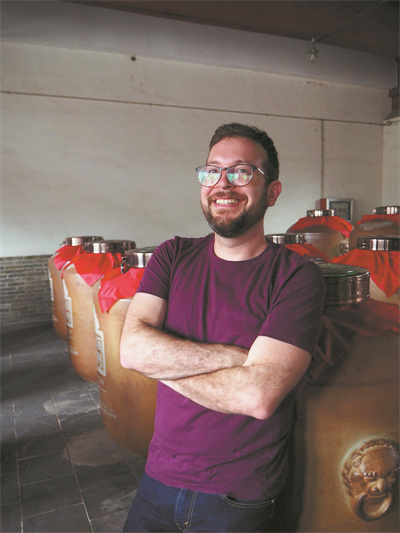
In 2018, he co-founded the baijiu brand Ming River with the team behind Capital Spirits Baijiu Bar in Beijing. Now based in Athens, Greece, he is promoting the traditionally crafted brand, exporting it to 37 states in the US and 15 countries and regions, including Japan, Singapore, Indonesia and Europe, and sales are picking up, he says, although the process has been slow.
For the first two years, his team had to spend a lot of money on marketing because in bars and mainstream restaurants outside of China, there was not much awareness of baijiu. They also tried to teach people about the drink and how to enjoy it. "It was like pushing a boulder up a hill", Sandhaus says.
"A lot of our earlier efforts are starting to pay off, and I think there's growing enthusiasm," he says, adding that in July, about 400 people lined up to taste Ming River at one of the biggest alcohol industry events in the US.
In 2011, as a diplomatic spouse, Sandhaus had to quit his job in the publishing industry.
By then he had published three books, two history books and one memoir.
With a lot of free time, he decided to work on baijiu, a different field.
As an old Chinese saying goes, "to succeed, one needs favorable timing, advantageous location, and good relationships". After doing some research, Sandhaus found that Sichuan produces about 70 percent of all the baijiu in the country.
In Chengdu, he attended the annual liquor and candy conference, a major networking event for the baijiu industry, where he visited distilleries, exchanged business cards and introduced himself and his project. Some agreed to let him visit their facilities.
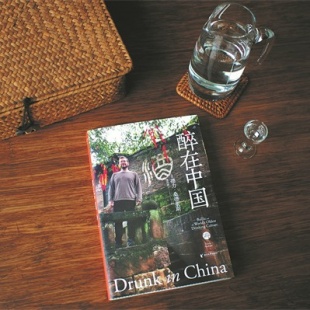
Sandhaus began his exploration with a visit to the Kweichow Moutai distillery, followed by visits to Guangxi Zhuang autonomous region, and provinces of Guangdong, Fujian, Zhejiang and Shanxi, as detailed in his book Drunk in China.
"For the most part, people were incredibly generous and hospitable. The book really would not have been possible if not for an incredible amount of generosity shown to a stranger," he says.
Apart from the generosity and hospitality, he found that the most impressive thing on an industrial level was the breathtaking size of the distilleries of famous brands of the liquor.
"If you go to a distillery in Europe or the US, it might be a big factory, but when you go to Moutai or Luzhou you see distilleries that are like cities. There are hundreds of buildings with thousands of people producing baijiu in the traditional way. It's hard to imagine," he says.
A comment on amazon.com reads: "As a fan of baijiu and the cult/culture that surrounds it, this book was everything I'd hoped it would be. Part history, part personal narrative and part deconstruction of the most popular drink you might never have heard of. "
Drunk in China is divided into three main parts — the 9,000-year history of baijiu culture, Sandhaus' explorations around China, and foreign misconceptions of the liquor.
"Baijiu's history is a subject that really fascinates me. … It's really important when you're trying to answer a question as big as where did this drinking culture come from. There are answers to these questions, and many of them go back thousands of years," Sandhaus says.
"Both through travel and through history, I wanted to show the drinking culture in China," he adds.
"Seeking mutual understanding is a lifelong pursuit worth the effort," one reader writes in the comments on review platform douban.com. "Understanding between countries, regions, cultures and beliefs is paramount, and holds the greatest significance in communication between nations and individuals."
For Sandhaus, baijiu is not just a drink but a mirror reflecting ancient China and the modern world, his key to better understanding both.
"What I want to do is look at China through beer goggles — or, more precisely, through baijiu goggles — to bring sense to seemingly senseless drinking rituals, to add a little flush," Sandhaus writes in the introduction.
"Alcohol has given meaning and form to Chinese lives. Far from engaging in a juvenile celebration of inebriation for its own sake, I have aimed to examine the many ways in which alcohol has shaped Chinese society and its rituals, at times with disastrous consequences," he writes.
As for misconceptions, for people from different cultures, one of the easiest ways to learn about each other is to sit down, and have food and drink with other people, Sandhaus says, adding "that is one of the reasons I wanted to write this book".