Canada's auto industry faces 'steely' barriers
Experts warn of financial implications, disruption to integrated supply chains







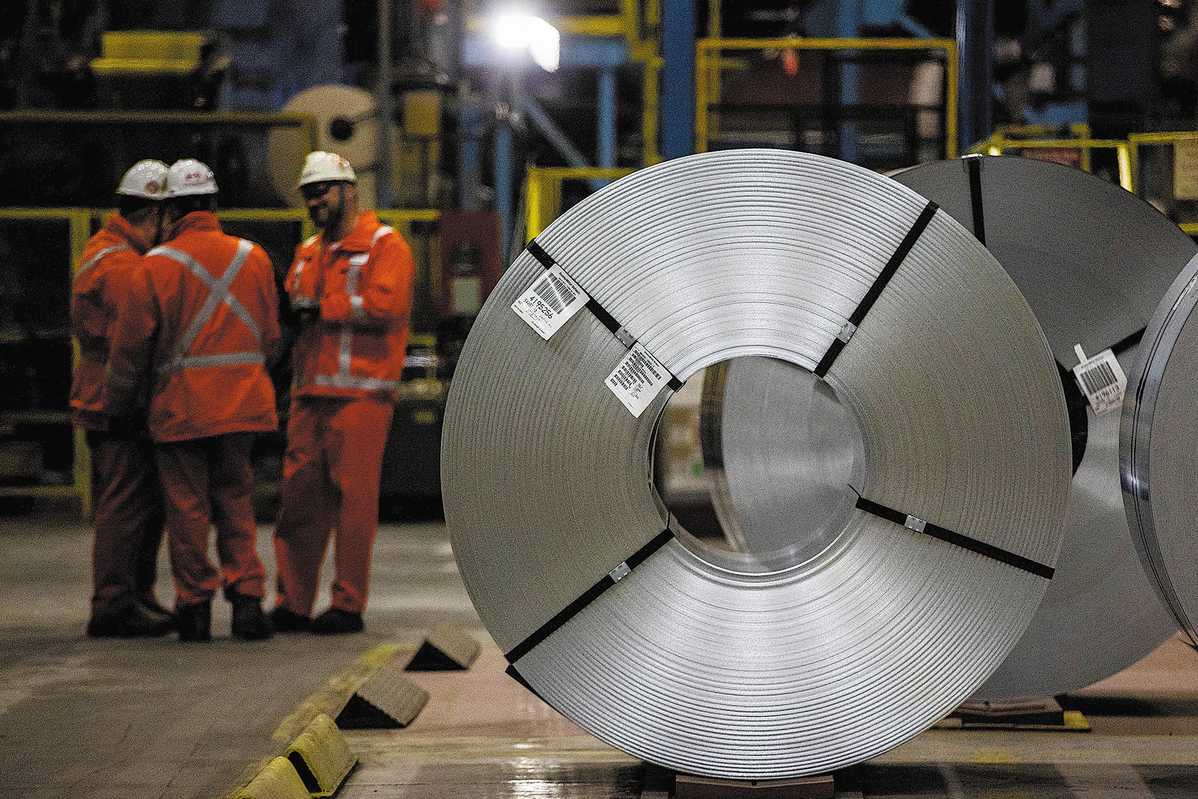
US President Donald Trump's plan to impose a 25 percent tariff on steel and aluminum imports can potentially affect industries reliant on cross-border trade, particularly the auto industry, experts say.
Kim Richard Nossal, a professor emeritus at Queen's University in Kingston, Canada, highlighted the deep economic interdependence among the United States, Canada and Mexico in the auto sector.
"Automobile manufacturers in North America have increasingly integrated their operations so that today there is essentially no border between the three countries," Nossal said.
The new steel and aluminum tariffs could dismantle that system because auto parts routinely cross national borders numerous times before final assembly, he said.
"If such a part is subject to a 25 percent tariff every time it crosses into the US on its way to final assembly, it will quickly lead to a collapse of integrated supply chains."
The same applies to steel and aluminum, key materials for car production, which both Mexico and Canada export to the US.
"These measures, auto industry experts warn, will have the effect of closing down auto production North America-wide very quickly," Nossal said.
The implications extend beyond Canada. With such high levels of integration, Nossal said the distinction between US and Canadian automakers is largely artificial. "There is no such thing in a North American context as an 'American' automaker," he said, indicating that US manufacturers and consumers will also bear the cost of the tariffs.
"Because of the high degree of integration, there are few measures that either Mexico or Canada could take on their own to protect the industry," he said.
Instead, public warnings from Canadian and Mexican officials emphasizing the harm to US workers and businesses might be the most effective strategy, he added.
"The only way to protect such a highly integrated industry is to publicly warn the American president that his measures will have highly negative effects on Americans, too," Nossal said. "Since it will be their assembly lines that will shut down along with assembly lines in Mexico and Canada."
Canada and Mexico could also impose retaliatory tariffs or adopt other economic measures, such as restricting the sale of US alcoholic drinks in government liquor stores or encouraging boycotts of US goods and travel, he said.
"As we are all finding out, it is very hard for any country that is subject to American tariffs to counter these measures when the US president claims that it is the country being tariffed that 'pays' the cost."
Mesbah Fathy Sharaf, a professor of economics at the University of Alberta in Edmonton, Canada, said that as one of the largest suppliers of steel and aluminum to the US, Canada will face significant economic repercussions.
It is the largest supplier of steel and aluminum to the US, accounting for 23 percent of US steel imports and almost 60 percent of its aluminum imports last year, according to data website Statista.
"Canadian exporters could experience reduced demand from US buyers due to higher costs, potentially leading to decreased production and job losses within the sector," Sharaf said.
"Additionally, US companies that rely on Canadian steel and aluminum may seek alternative suppliers, leading to economic disruptions in Canada."
'Political motivations'
Sharaf also pointed to what he called the political motivations behind Trump's move.
"The tariffs are largely driven by Trump's 'America First' policy, which seeks to protect domestic industries from foreign competition," he said.
The actions are aimed at appealing to blue-collar workers in key election swing states such as Pennsylvania and Ohio, which have significant steel and aluminum industries, he said.
"Additionally, the tariffs could be a negotiating tactic in broader trade discussions," Sharaf said.
"Canadian steel and aluminum producers will face increased costs as they try to absorb part of the tariff burden or pass it on to US buyers, which may make their products less competitive."
With less than a month before the tariffs take effect, the possibility of resolving the issue through negotiations remains uncertain.
Canada's best strategy, he suggested, would be to leverage diplomatic and economic channels to minimize the effect of the tariffs.
gaoyang@chinadailyusa.com