Sweet prospects for nation's blueberry industry







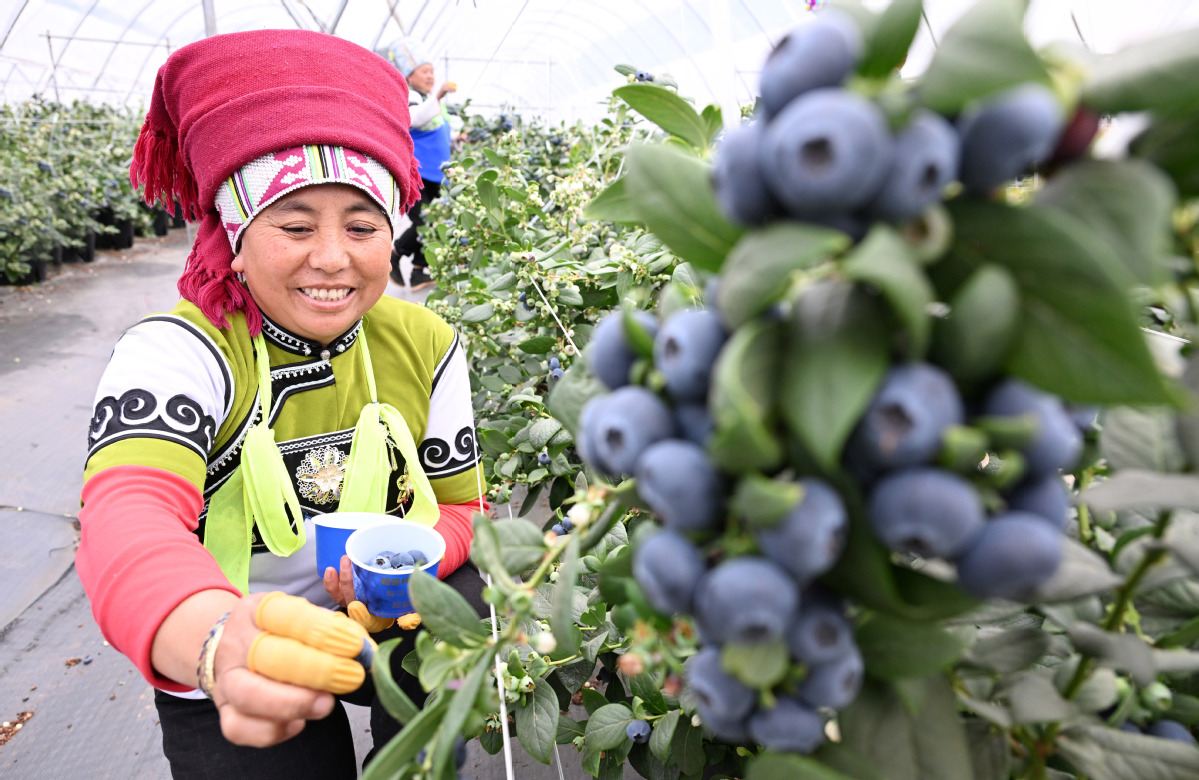
The total blueberry output in China — the world's largest blueberry producer — reached about 780,000 metric tons in 2024, a 197 percent increase from 2020, driven by improved planting technology and rising market demand from Chinese consumers, according to industry experts.
Wu Lin, chairman of the small fruit branch of the Chinese Society for Horticultural Science, said in 2024, China's blueberry cultivation area expanded to 1.44 million mu (95,381 hectares), up 44.38 percent from 2020.
Yunnan province, with its diverse altitudes and ample sunshine, emerged as the top-producing region, yielding 182,900 tons, a 510 percent surge from 2020. It contributes about 30 percent of the country's total production.
Other major producing regions include provinces of Guizhou, Liaoning, Sichuan, Anhui, Shandong, Jilin and Jiangsu.
"China has five major production bases spanning from south to north, ensuring a year-round supply of blueberries," said Wu, who is also a professor at Jilin Agricultural University.
By 2025, the blueberry cultivation area in China will expand further to 1.55 million mu, with total output expected to reach 897,400 tons.
The rapid growth has been driven by new varieties and advanced technologies.
"The widespread adoption of evergreen blueberry varieties, which require little to no chilling, has extended fruiting periods, enhanced fruit quality, and expanded market sales," said Wu. He added that substrate cultivation techniques have transformed traditional growing methods and allowed for expansion into new regions.
Wu said the industry has been shifting from a quantity-driven approach — focused on rapid expansion and high yields — to a quality-oriented strategy that prioritizes fruit quality and premium pricing.
China began importing fresh blueberries in 2012, with imports peaking in 2019 before declining after 2023.
The total import value rose from $184.3 million in 2020 to $306.7 million in 2022, but declined to $260.3 million in 2023 as domestic production increased.
Wu attributes the drop in imports to Yunnan's rising blueberry output, which has increasingly filled the winter market gap.
As a result, the number of countries exporting blueberries to China dropped from nine in 2019 to five after 2020, with Peru and Chile dominating the market.
In 2023, Peru accounted for 84.67 percent of China's total blueberry imports, while Chile contributed 15.31 percent.
On exports, China first shipped fresh blueberries abroad in 2020. According to Customs data, by 2024, Chinese blueberries were exported to at least a dozen countries, with total export volume rising from 113 tons in 2020 to 1,012 tons in 2023.
In the first eight months of 2024, export volume reached 2,314 tons. Export value soared from $352,650 in 2020 to $21.98 million as of August 2024. The rise in production has been fueled by the growing popularity of blueberries among Chinese consumers.
At Wumart, a Beijing-based supermarket chain, Yunnan blueberries have seen monthly sales growth averaging 20 percent since March, according to the retailer's spokesperson.
On Monday, a batch of 16 tons of Imberry blueberry products from Yunnan province debuted at Beijing Xinfadi wholesale market, one of the country's largest food supply hubs.
Zhang Yuelin, general manager of Xinfadi market, said: "The demand for mid-to-high-end blueberries is rising rapidly, driven by growing awareness of health diets and the influence of livestreaming sales from lifestyle social platforms."
Zhang added that Xinfadi plans to expand its fruit market, with a focus on imported and high-end fruits to enhance supply chain efficiency in the sector.
Despite a rapid expansion, China's blueberry industry faces significant challenges, particularly in variety development and market standardization.
Wu said the independent variety innovation should be accelerated, with patenting and licensing expected to become a key trend in the industry.
wangzhuoqiong@chinadaily.com.cn