Weaponized smear







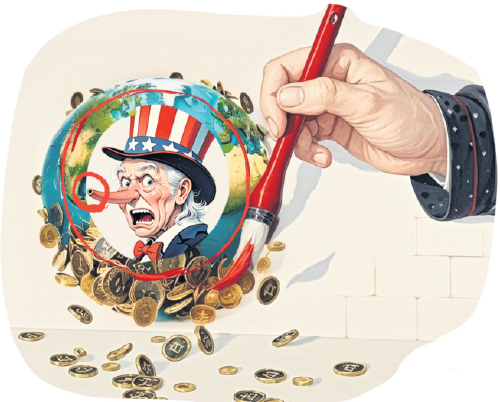
The China "debt-trap" narrative is a falsehood that is a tool of geopolitics
Although it has been debunked thoroughly by international experts, the "China debt-trap" narrative keeps surfacing as a mantra of anti-China campaigns. Most recently, a Swedish member of parliament brought it up in a public debate as part of what he called "China's aggressive neocolonial operations in Africa". While the impact of this narrative has diminished in recent years in the Global South, with more and more nations joining the Belt and Road Initiative, it is being repeated in the West to mobilize forces that consider China's successful and peaceful rise as a geopolitical threat.
The narrative was launched as part of the first Donald Trump administration's tool kit to counter the influence of China. In 2018, according to US media reports at the time, the United States Department of State commissioned two Harvard University students to write a report which was titled "Debtbook Diplomacy: China's Strategic Leveraging of its Newfound Economic Influence and the Consequences for US Foreign Policy".The Department of State informed the US and international mass media in May 2018 of the report and helped promote it. At the end of 2018, the Department of State even bragged in its financial report to US Congress that "the department continues to message on this subject, delivering additional high-performing materials, including: Harvard study warns of perilous 'debt-trap diplomacy'".
The Department of State requested more financing for such operations. In 2021, the US Congress responded through "the Strategic Competition Act of 2021", allocating $300 million every year from 2022 to 2026 for this purpose. A major part of the financing will be utilized, according to the text of the Act, to provide "support for local media "stating that "the secretary of state, acting through the assistant secretary of state for democracy, human rights, and labor and in coordination with the administrator of the US Agency for International Development, shall support and train journalists on investigative techniques necessary to ensure public accountability related to the BRI".
In September 2021, Zimbabwean media revealed that the US embassy in the country was recruiting and financing young activists and journalists to tarnish the investments made by China in the country as harmful to the nation. This made it clear that the anti-BRI propaganda with the debt-trap narrative as its main tool was going into high-gear throughout the world. A USAID-financed NGO in Serbia made global headlines by claiming that cancer rates had risen in Smederevo, a town where a Chinese steel plant was operating. The health authorities in Smederevo later challenged the information presented to the international media by the NGO.
The USAID's role in financing anti-China and anti-BRI smear campaigns is well documented. It funds NGOs both in the US and abroad to recruit and organize talented "young leaders "and "opinion makers" pumping both finances and disinformation about China's investments in the Global South through the BRI. The William & Mary's Global Research Institute's so-called information lab, AidData, is well known as such a USAID-financed source of disinformation about the BRI. It is not clear how the shutting down of the USAID will impact the channeling of the resources allocated by US Congress to anti-China and anti-BRI operations, but it is a strong blow to such operations according to some Western media.
The irony is that if the US had used these large amounts of money to do good in Africa through public goods projects rather than tarnishing the BRI and China with disinformation, the US would have had greater soft power in its competition with China. For example, with the $1.5 billion, the US could build 250 hospitals of the same type as the China-built Mahusekwa Hospital for antenatal care in Mashonaland in Zimbabwe, which cost $6 million. The same amount could be used to build about 500 level-three hospitals such as the Gachororo Health Centre in Juja, Kenya, a 200-bed facility that cost $3.2 million. However, such win-win thinking does not penetrate the mind of policymakers in Washington who are saturated with the zero-sum game of geopolitics.
There are two ways to deal with the debt-trap narrative: one is to show its fallacies in a systematic and pedagogical way; the other is to develop innovative methods in financing infrastructure along the BRI in addition to the way China has successfully done in the first 10 years. It is a matter of reality that many nations, especially developing countries, are in dire need for infrastructure to release their economic growth potential and sustain it. Nations are tired of aid programs that have continued for decades without any tangible results in their attempts to eliminate poverty and achieve prosperity.
Regarding the first point, a three-step method of exposing the fallacies of the debt-trap narrative can be adopted so that it can be applied to any country that is alleged to be a victim of a "Chinese debt-trap". The three steps are examinations of the composition of the debt of that country, the quality of the debt incurred by that country, and finally the sources of financial instability in that country. The samples used to develop this method are famous cases singled out by the narrative creators: Sri Lanka, Zambia, Kenya, Pakistan and Montenegro. They show that there is no basis for blaming China for the financial problems of those countries.
As for financing infrastructure in Belt and Road countries, it is imperative to continue the success of the Chinese method of low-interest and long-term loans no matter what the opponents say. But China alone cannot fill the gap of tens of trillions of dollars necessary for developing modern infrastructure in Asia, Africa and South America. Other actors have to step up and resources have to be pooled. First, nations must develop national financial institutions to mobilize local resources through national "development banks".Regional development banks are also advisable. For example, the Arab countries of the Gulf have more than $4 trillion in their sovereign wealth funds. The Chinese financial markets can also become a source of credit, as has been proven by the Panda bonds that are becoming increasingly popular in developing countries. In addition, bilateral development funds between creditors and debtors can be created in which a small portion of the natural resources of debtor country can be leveraged to generate credit from financial institutions in the creditor nations. In addition to China's rise, the BRI is one of the great success stories of the 21st century. It must be promoted and defended against ill-intended and geopolitically motivated attacks such as the "debt trap "narrative.

The author is vice-chairman of the Belt and Road Institute in Sweden and a distinguished research fellow at the Guangdong Institute of International Strategies. The author contributed this article to China Watch, a think tank powered by China Daily. The views do not necessarily reflect those of China Daily.
Contact the editor at editor@chinawatch.cn.