Nurturing new talent key for nation's growth
Advisers call for boosting use of AI in education, improving vocational courses







National political advisers have emphasized the importance of nurturing talent that can support China's social and economic development, as called for by President Xi Jinping during the two sessions, the annual meetings of China's top legislative and political advisory bodies.
After participating in a joint group meeting attended by Xi last week, national political advisers from the education sector said the new generation of capable young people is expected to adapt to evolving technology while maintaining strong moral grounding, intellectual ability, physical vigor, aesthetic sensibility and work skills.
Xi stressed at the meeting that it is necessary to keep pace with the times and master the tools and methods of applying artificial intelligence to empower education, while at the same time ensuring that the cultivation of students' intellectual ability and problem-solving skills is not neglected.
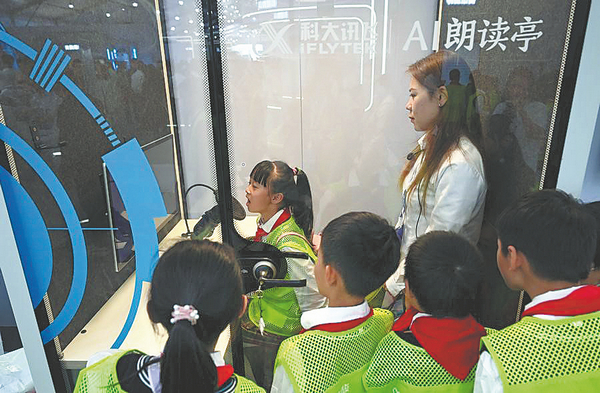
Speaking on the transformative impact of AI on education, Xu Kun, president of Beijing University of Posts and Telecommunications and a member of the National Committee of the Chinese People's Political Consultative Conference, the nation's top political advisory body, said the future of education will shift from traditional teacher-student interactions to a dynamic model involving students, teachers and AI.
"The role of teachers will evolve from merely delivering knowledge to designing learning environments, as well as inspiring and guiding students," Xu said. "Our priority is to cultivate students' core competencies that go beyond AI, such as imagination, aesthetic appreciation, empathy and critical thinking," he said.
During the group meeting, Xu suggested leveraging the country's advanced information network infrastructure to develop a more intelligent, interconnected education system that supports talent development and scientific innovation.
He said the government, universities and industry can collaborate to build an open-source ecosystem that integrates data, models and computing power into education.
At the panel discussion, President Xi also said that China must coordinate primary, higher and vocational education and optimize public as well as private investment to enable a more reasonable and efficient distribution of education resources.
Zhang Yunkai, a national political adviser and vice-president of Hebei Jiaotong Vocational and Technical College, said that Xi has a deep passion for education and a profound understanding of educational issues.
"At the meeting, I strongly felt his unwavering commitment to education," Zhang said.
Zhang's speech at the meeting was focused on how to better align vocational education with industrial development and suggested innovating the industry-education integration system and enhancing technical service capabilities.
For the past three years, Zhang has advocated vocational education reform. This year, he made a proposal on further promoting cooperation between schools and enterprises, ensuring that learning in classrooms aligns with workplace needs and academic disciplines correspond to industrial demand.
Liu Lin, a CPPCC National Committee member and president of Beijing City University, suggested an early introduction of vocational education by incorporating career awareness and experiential courses into primary and secondary schools.
These courses should align with children's interests and be integrated with labor and science education to help young students develop a correct understanding of careers while improving their practical skills, Liu said.
Meanwhile, more application-oriented universities should be encouraged to offer vocational undergraduate programs, steadily expanding the scale of vocational education with bachelor's degrees.
"This expansion will ensure that vocational education produces highly skilled professionals who are better equipped to meet the demands of economic and social development," Liu said.
Cultural confidence
In addition, Xi emphasized the need to integrate moral education into intellectual, aesthetic and labor education.
During the meeting, Ma Jinglin, a national political adviser and the principal of Beijing No 4 High School, shared how the school integrates traditional Chinese culture into its curriculum.
He highlighted courses that introduce intangible cultural heritage to students and activities that take students out of the classroom to experience the vitality and unique value of traditional culture.
Ma suggested developing tailored traditional culture textbooks based on students' cognitive abilities at different age levels, and strengthening collaboration between schools and families to promote cultural education.
It is essential to nurture students' cultural confidence through textbooks, curricula and daily activities, Ma said. While more young Chinese people can be on a par with their foreign peers in terms of material wealth, only with deeper cultural confidence can they truly contribute to the building of the nation, he added.


- First cross-border event debuts at the National Games
- China Focus: National Games enhances coordination under 'one country, two systems'
- China's Fujian aircraft carrier to make regular appearances on high seas: spokesperson
- A decade of dialogues
- HK: a stage for art and cultural dialogue
- Tapping truly unknown wonders