Joint efforts to boost growth of commercial space sector







The central government, trade unions and enterprises should work together to make a comprehensive development road map to facilitate the sustainable growth of China's commercial space sector, said an industry insider.
Wang Runfu, a senior researcher at the China Academy of Space Technology, said that the commercial space sector is on the rise in China because it fits in well with the nation's overall development strategy, providing an example of high-quality development, new quality productive forces, advanced science and technology, and high-end manufacturing capability.
"In 2024, the commercial space sector was listed in the Government Work Report as one of the 'new engines of economic growth', marking the first time that the industry appeared in such an important government document. It was mentioned twice in this year's Government Work Report, as the government vows to promote the secure and sound development of several 'emerging sectors' such as commercial space and low-altitude aviation," he said.
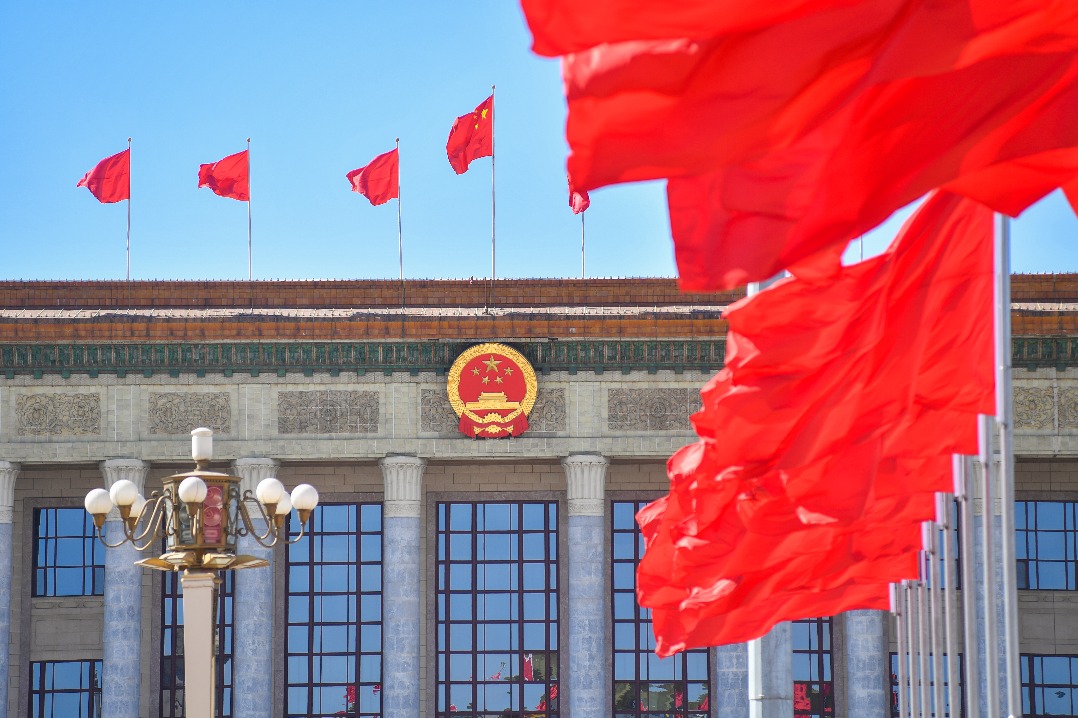
Wang, who is also a national political adviser, made the remarks in an exclusive interview with China Daily on the sidelines of the third session of the 14th National Committee of the Chinese People's Political Consultative Conference, which concluded in Beijing on Monday.
"Considering its strategic significance, relevant central departments should cooperate with trade unions and enterprises in the space community to make a comprehensive development road map to better regulate this sector, determine its directions, coordinate and integrate efforts from all aspects, foster cross-industry collaboration and specify support policies and measures from governments," Wang said.
The making of such a road map is necessary and meaningful because most of the existing policies and rules were made before the commercial space sector was born and developed, and they are more suitable for State-owned companies and government-funded programs, the researcher said.
"For instance, there are multiple companies in China striving to build their massive space-based internet networks, and each of their networks, according to their plans, will have hundreds or even thousands of satellites," he said. "On the one hand, this will create a tremendously big market with enormous business potential. On the other hand, realizing their ambitious plans requires government guidance, huge investment in infrastructure, business profitability and a solid foundation of satellite design and manufacturing capacity."
The researcher said there are still some shortcomings in the industry chain that will require persistent, joint efforts by the government and the entire space community to resolve, and he suggested that the central government establish a set of national-level mechanisms to help commercial space enterprises develop new technologies and techniques.
Sector's voices
Yang Yiqiang, a senior rocket scientist and founder of CAS Space, a Beijing-based rocket company owned by the Chinese Academy of Sciences, said the commercial space sector represents a natural progression in China's space industry development.
"To strengthen the nation's space capabilities, it is imperative to create an integrated development framework that deeply combines advantages of State-funded contractors and commercial sector forces," he said, adding that to develop a commercial space industry with Chinese characteristics, three fundamental principles must be observed.
"First, commercial space businesses should be done in accordance with China's actual conditions. I mean that though the nation has possessed a certain level of scientific and technological capabilities, there remains a significant gap compared with the United States in terms of spacefaring power. Chinese commercial space enterprises should adhere to objective, reasonable development strategies and avoid unrealistic, overambitious projects.
"Second, domestic enterprises face greater financing challenges than their American counterparts such as SpaceX, with many investors demonstrating impatience and unwillingness to grant domestic commercial space enterprises room for trial and error. It is important that more 'patient capital' comes to this sphere and plays a major role. At the same time, the government must ensure greater stability and continuity in policies pertaining to the space industry to let investors rest assured that its support for the commercial space sector is long-lasting and stable," Yang said.
Third, the industry must maintain close alignment with national strategies and precisely target market demands, he said.
"The current priority for commercial players should be providing low-cost and reliable launch solutions to support the in-orbit construction of China's multiple mega internet networks," Yang said.
Meanwhile, relevant government authorities should methodically advance the commercialization of China's space industry by fully opening low-orbit launch services to fair competition between State-owned contractors and private enterprises. This market-oriented approach could later expand to include high-orbit launch operations and encourage government-backed programs to incorporate qualified private players.
"Such phased measures would align with national priorities while leveraging market forces to strengthen China's comprehensive space capabilities," he added.
Xu Ming, chairman and CEO of GalaxySpace, a leading private satellite maker in Beijing, underscored the sector's push to align with national goals, saying the commercial space sector has gained prominence in China's innovation-driven economic road map.
He said that the mention of the commercial space sector in the 2025 Government Work Report has "greatly galvanized the resolve of commercial space enterprises to accelerate sci-tech innovation at the global forefront".
"With growing confidence in the prospects of this sector, we are more determined than ever to contribute to building China into a space power," he added.
Future growth will rely on stronger policy coordination, improved industrial regulations and legal safeguards, such as a national space law, to ensure private entities' participation in space-based infrastructure projects, he said.
Xu called for fair competition and more opportunities for private players, adding that more tolerance should be given to trial and error by enterprises to encourage innovation and new businesses.
Zhang Changwu, founder and CEO of LandSpace, a private rocket maker in Beijing, said that China's commercial space industry has achieved remarkable progress in recent years, but there remains much room for improvement.
"Currently, China still needs to accelerate efforts to catch up with the United States when it comes to technological capability and the industry's maturity and share in the global market," Zhang said.
"To match world-class standards, China must expedite breakthroughs in reusable rocket technology, reduce launch costs and carry out more launches," he added. "Relevant authorities must optimize their launch approval procedures and relax requirements on companies wishing to enter the satellite internet field, to allow qualified participants to engage in network construction."



- Forum unites global experts to enhance city image communication
- Miao New Year celebrations get underway in Guizhou's Leishan county
- Mainland spokesman reiterates stand on Taiwan
- Fujian county's rural development becomes a big draw for Taiwan investors
- Nobel laureate in chemistry: Give young scientists more independence
- Are Asians really better at math?