Astronomers unveil 1st 3D map of Milky Way interstellar dust properties







BEIJING -- Chinese and foreign astronomers have unveiled the first three-dimensional map of the properties of interstellar dust in the Milky Way. This breakthrough will provide critical support for precise astronomical observation, and for studies in the areas of astrochemistry and galactic evolution.
The research was led by Zhang Xiangyu, a Chinese doctoral student at Germany's Max Planck Institute for Astronomy, in collaboration with his advisor, Dr. Gregory Green. It was based on data from China's Large Sky Area Multi-Object Fiber Spectroscopic Telescope and the European Space Agency's Gaia space observatory, and its findings have been published as the cover story of the latest issue of the Science academic journal.
The interstellar medium — the matter and radiation in the space between stars — is crucial for the Milky Way's material cycle and star formation. Most elements heavier than hydrogen and helium in the interstellar medium exist as solid dust particles. Dust absorbs and scatters starlight, making distant stars appear dimmer and redder in a phenomenon known as "extinction." Most astronomical observations require extinction correction, Zhang said.
By integrating precise stellar parameters from LAMOST with low-resolution spectroscopic survey data from Gaia, astronomers compiled the first comprehensive catalog detailing the absorption and scattering from interstellar dust for over 130 million stars. Using this catalog, they have successfully constructed a 3D map of dust distribution and properties across the Milky Way, reaching distances of up to 16,308 light-years away.
This milestone achievement leverages LAMOST's unique advantages, including its large field of view and multi-object spectroscopic capabilities, Zhang said.
The 3D map covers vast spatial scales, revealing close correlations between dust properties, star formation and the structure of the Milky Way. It provides critical insights for research in the areas of astrochemistry and galactic evolution, he noted.
In addition, the observation of dust distribution challenges long-standing expectations related to the intermediate-density regions near dust cloud centers, and suggests potential new mechanisms for interstellar organic matter growth, Zhang said.
"Dust serves as the building material for planets like Earth and plays a catalytic role in the Milky Way's chemical evolution. The newly released 3D map opens a new window for the study of dust and the Galaxy. It not only offers a vital reference for astronomical observations but also provides fresh perspectives and possibilities for the exploration of astrochemistry, star formation, the galactic carbon cycle, and even the origin of life," he said.



- National Games vibe is everywhere in Guangzhou
- Forum unites global experts to enhance city image communication
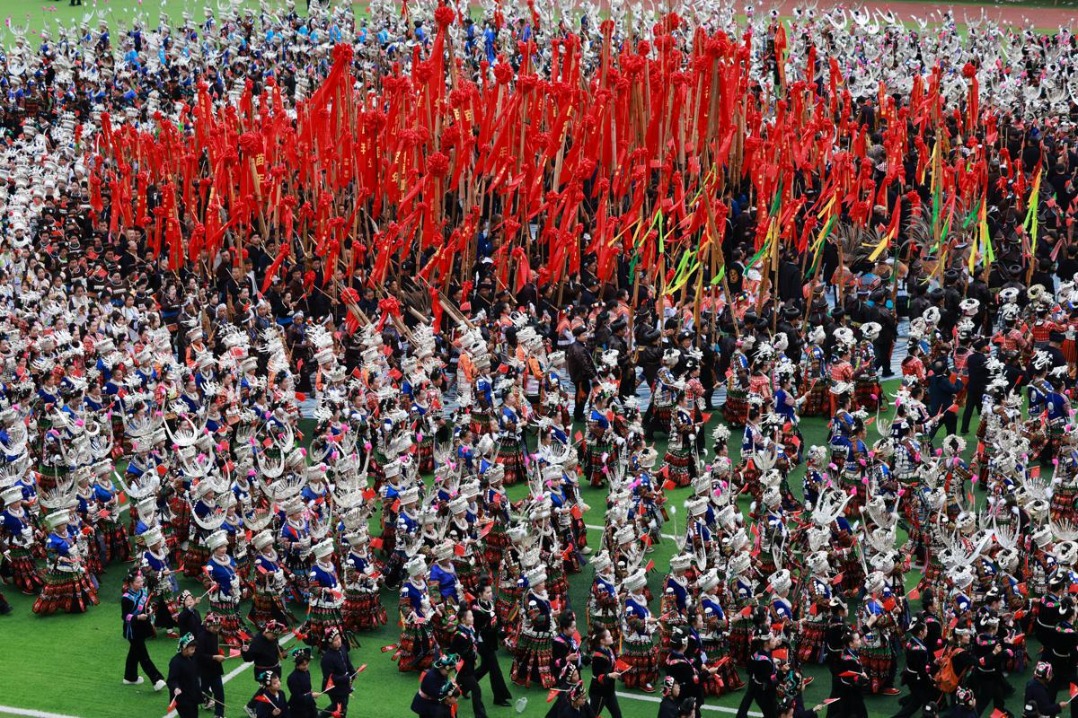
- Miao New Year celebrations get underway in Guizhou's Leishan county
- Mainland spokesman reiterates stand on Taiwan
- Fujian county's rural development becomes a big draw for Taiwan investors
- Nobel laureate in chemistry: Give young scientists more independence