Tech startup eyes cheaper robots, new applications







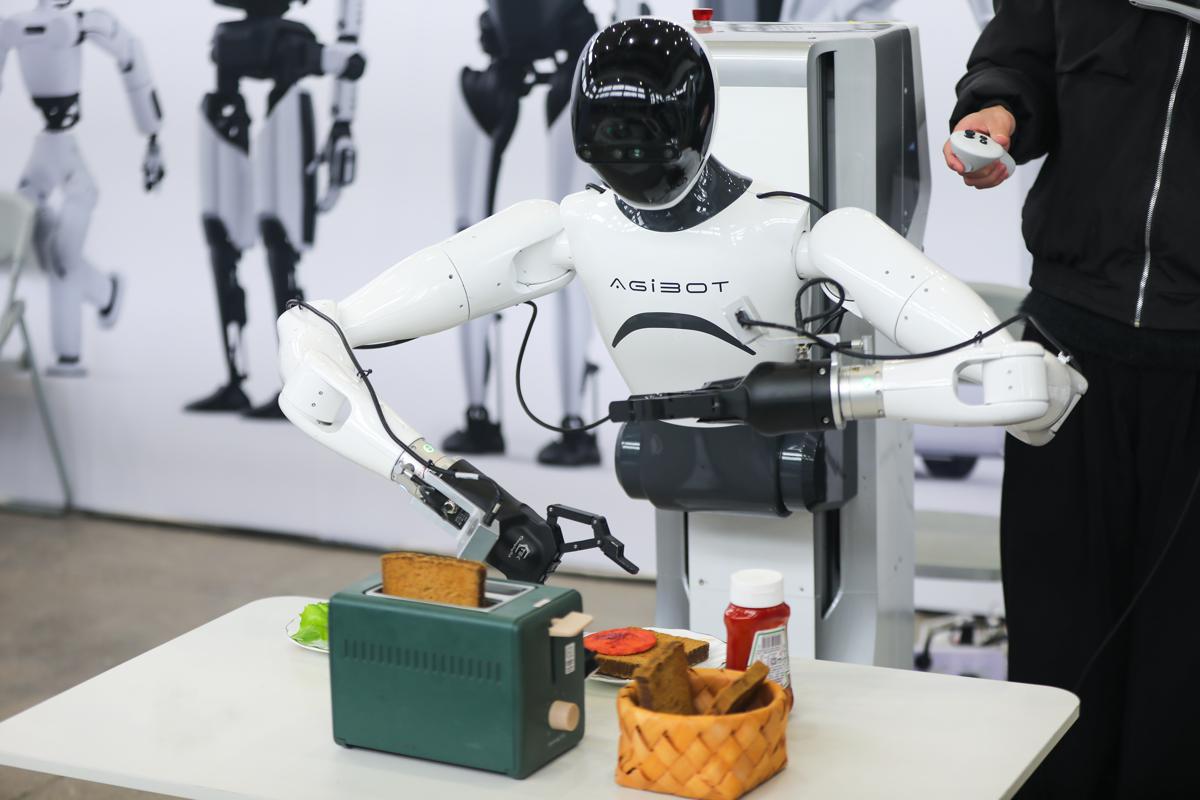
In a high-tech factory in Shanghai, engineers meticulously piece together humanoid robots, while rows of newly made machines await testing.
The factory, in Lin-gang Special Area, is the first in Shanghai to mass produce humanoid robots.
Though it has only been operational for less than a year, it has already produced more than 1,500 humanoid robots, according to AgiBot, the artificial intelligence and robotics startup that runs the factory.
The company plans to open a second factory in Shanghai this year, and is aiming for an annual capacity of 10,000 units.
"At scale, our robots will cost under 200,000 yuan ($27,500) — less expensive than a family car," said Peng Zhihui, co-founder of AgiBot.
Initially targeting a monthly output of 100 units, the plant's production surged to more than 15 units daily due to soaring market demand.
As 2025 is widely anticipated to be the first year for the mass production of humanoid robots, Chinese companies such as AgiBot are scrambling to show their technological and manufacturing prowess.
On the list of 100 global humanoid robotics-related companies, which was recently released by United States investment bank Morgan Stanley, 37 are from China, including UBTech and BYD. The China Electronics Society forecasts that China's humanoid robot market will reach 870 billion yuan by 2030.
Humanoid robotics is a perfect example of embodied AI, a phrase that was highlighted in China's 2025 Government Work Report. Embodied AI refers to AI integrated in physical hardware.
Qiao Hong, an academician at the Chinese Academy of Sciences, said: "Humanoid robots are a particularly promising area. China has established a core technological foundation for the large-scale and cost-effective production of high-performance robotic systems."
AgiBot, for instance, credits Shanghai's advanced manufacturing ecosystem and the Yangtze River Delta's mature supply chain — particularly crossover components from the electric vehicle sector — for its rapid growth.
Zhang Shaozheng, general manager of manufacturing at AgiBot, said: "From an industrial chain perspective, we've leveraged synergies with the new energy sector, particularly in components like electric motors and gearboxes. It is precisely these mature supply chains that enabled us to produce humanoid robots at scale in such a short timeframe."
But building a robot's body is just the first step. How to develop its "brain" is also crucial.
Last week, AgiBot launched an AI large language model, the GO-1, to accelerate the training of robots. The model enables robots to rapidly generalize new tasks with minimal training, significantly lowering the technical barriers for embodied AI applications, AgiBot said.
The GO-1 model leverages real-world human demonstrations and internet-sourced video data to enhance contextual understanding of human activities.
At AgiBot's robot training center in its Shanghai factory, 100 humanoid robots learn to pour tea, fold laundry and arrange tables in simulated everyday environments — from cafes to living rooms. These machines generate high-quality action datasets daily by imitating human behavior, which is crucial for training the GO-1 model.
Yao Maoqing, a partner of AgiBot and president of its embodied intelligence business unit, said: "Even a simple water-pouring action requires nearly 100 high-quality data samples for training. These datasets, collected from the 100 robots, are uploaded to the cloud computing platform for model iteration, eventually enabling universal task deployment."
Currently, repetitive industrial tasks remain the initial focus for the application of humanoid robots. Yao highlighted logistics as a prime example.
"While automated guided vehicles excel at transporting goods, tasks such as packaging variable-sized items demand real-time adjustments and error correction — a challenge perfectly suited for humanoid robots. AI control allows them to rethink strategies upon failure, much like humans," he said.
As technologies evolve, AgiBot envisions broader applications. "Humanoid robots' flexibility fills the gap between rigid automation and human labor," Yao said.