Crucial to maintain responsible and pragmatic momentum of ties: China Daily editorial







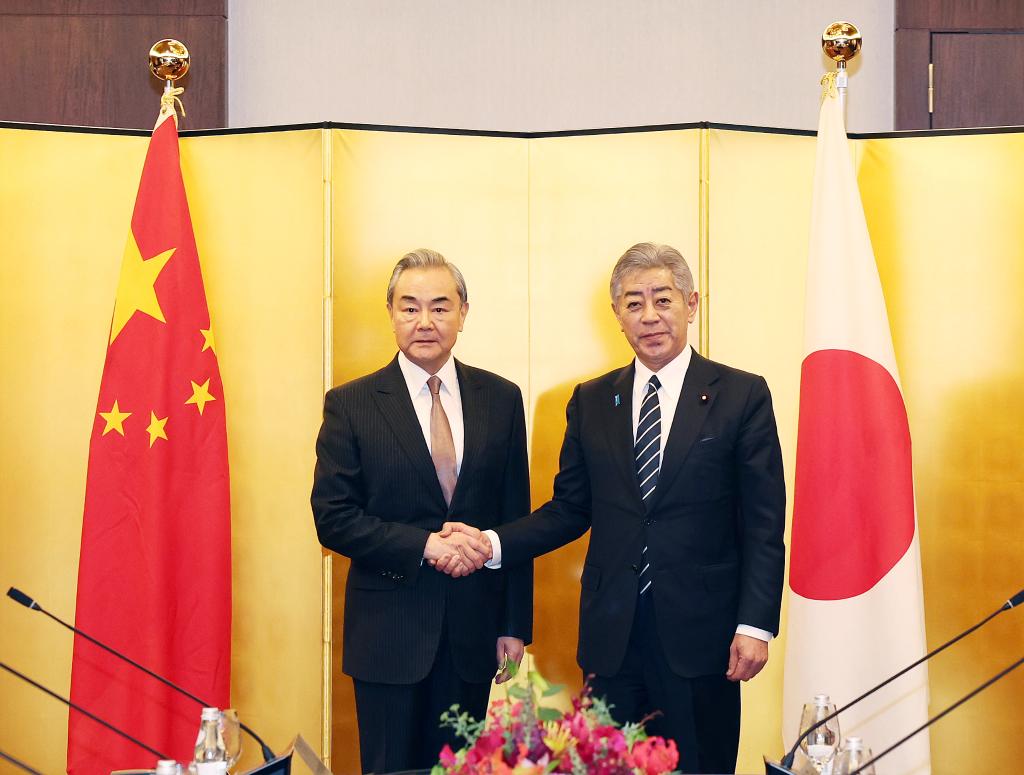
If acted on with sincerity, the outcomes of the recent meetings Chinese Foreign Minister Wang Yi had with the Japanese side in Tokyo will mark a significant remedial step for relations between China and Japan. One that will have the positive knock-on effect of strengthening regional stability.
It was with a shared historical sense of responsibility that China and Japan broke the ice between them, normalizing diplomatic relations in 1972; and it is with that sense of responsibility and the spirit of pragmatism that they have managed to keep relations on the right development track over the years. Despite this, the development of the ties has never been plain sailing, as it has repeatedly been troubled by the two neighbors' maritime disputes, divergences on historical issues and Tokyo's provocative relations with Taipei, etc.
However, an important reason why bilateral trade has increased more than 300 times since 1972, and remained at a high level of $300 billion for 15 consecutive years, with the accumulated bilateral investment reaching nearly $140 billion, is that the two sides have always sought to engage in clear-the-air dialogue whenever their ties have become strained. In this process, their historical bonds and cultural affinity have proved to be of practical value.
By preventing their divergences from defining their overall relationship, they have been able to continually tap into the structural complementarity between the two economies, which has brought tangible benefits to the two countries and the broader region.
With relations having deteriorated under the previous Japanese government, which had committed to one-sided pro-US policy, it was with the same sense of responsibility and pragmatic spirit that the two sides started mending their ties in November after the two heads of state held a meeting in Lima, Peru. In that meeting, the two leaders agreed to endeavor to build a constructive and stable China-Japan relationship fit for the new era. It is under the guidance of this heads-of-state diplomacy that the two neighbors have markedly accelerated their joint efforts to translate the political intentions into reality.
Wang's intensive diplomatic engagement with the Japanese side over the weekend being the latest endeavor in that regard. As well as attending the 11th China-Japan-ROK Trilateral Foreign Ministers' Meeting and the Sixth China-Japan High-Level Economic Dialogue, Wang had talks with his Japanese counterpart Takeshi Iwaya, as well as Japanese Prime Minister Shigeru Ishiba, along with other senior officials including Chief Cabinet Secretary Yoshimasa Hayashi and Secretary General of Japan's National Security Secretariat Masataka Okano. He also met with the representatives of several China-Japan friendship groups.
The 20-point consensus the two sides reached in their first high-level economic dialogue in six years, which covers green development, environmental protection, elderly care services, service trade, food safety, supply chains and intellectual property rights protection, among other areas, indicates their shared will to markedly enrich the economic dimension of the China-Japan strategic relationship of mutual benefit, and work together to build a constructive and stable economic and trade relationship that meets the demands of a new era.
That means after months of painstaking efforts, the two sides have rebuilt a three-track model — intensive political engagement, broad economic cooperation and active cultural exchanges — to help stabilize ties. This is based on the four political documents between them, and is an approach that has proved to be an effective booster of ties in the past. This is not only in line with their shared sense of responsibility and the pragmatic spirit that prioritizes the two countries' common interests, but also accords with regional anticipations. For, as Wang said, in the increasingly complex and uncertain international environment, cooperation between China and Japan can serve as a strong countermeasure against the unilateralism and protectionism that have been generating global turbulence.
But for the good of themselves and the region as a whole, the reconciliation of their relations should by no means be a makeshift option in response to the increasing instability in the international situation. Rather it should be the long-term strategic choice of the two neighbors to work together to safeguard peace and security in Asia.