Washington's extreme tariff strikes will backfire







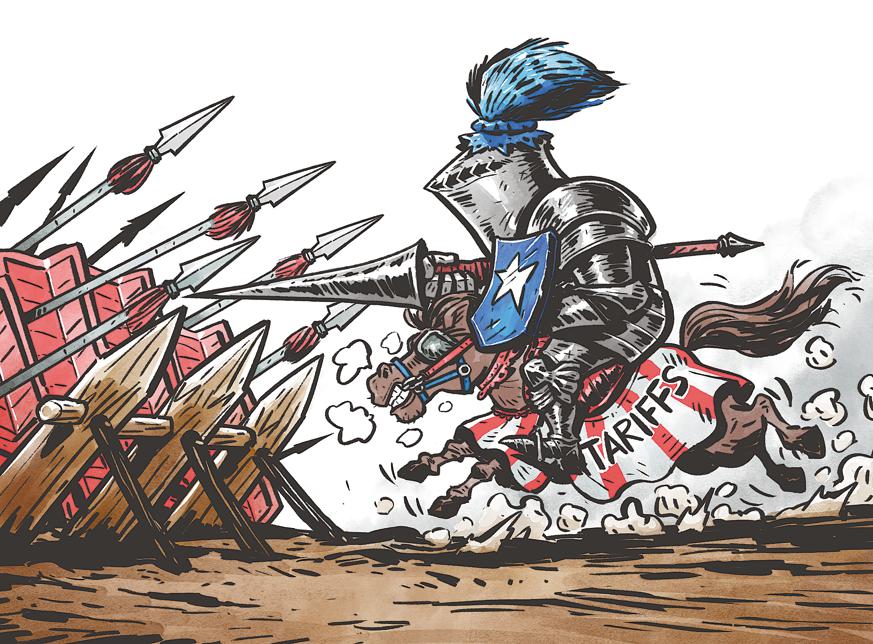
In the world of geopolitics, "maximum pressure" is fast becoming shorthand for "maximum miscalculation". The United States, in its latest attempt to strong-arm China, has unveiled a new round of tariff hikes and scrapped the longstanding duty-free threshold for small packages shipped from China. The result is the highest tariff wall in the history of Sino-US trade. It's impressive in scope, if not in strategy.
Behind these moves lies a persistent delusion: that the United States has long been short-changed by global trade. Acting on this grievance, Washington is wielding tariffs like a hammer, hoping every economic challenge is a nail. But in doing so, it is chipping away not at China's economic resolve, but at the very foundations of the global system it once helped build. Flouting World Trade Organization rules and reneging on hard-won commitments, the US is undermining the rules-based multilateral trade order and accelerating the erosion of global economic stability.
This strategy is not just short-sighted — it's self-sabotaging. For every tariff slapped on Chinese goods, there's a ripple effect across global supply chains, many of which still flow through Chinese ports, factories, and innovation hubs. Yes, the damage to Chinese companies is real — but it's also diminishing. China has been here before. And every time Washington pulls this stunt, the world gets a little better at working around it.
What the US has grossly underestimated is China's capacity to weather economic storms. With the world's most comprehensive industrial system and unparalleled supply chain integration, China's economy has what strategists might call "strategic depth". It's hard to outmaneuver a country that produces nearly everything, and usually at scale. More important, China has resources — both natural and technological — that are essential to industries Washington cares deeply about. For instance, rare earth minerals.
Indeed, in rare earths, the US faces a paradox: It wants to decouple from China, but its defense and tech industries still depend heavily on Chinese exports. That's the economic equivalent of trying to fly without wings.
Meanwhile, China has been busy future-proofing its trade strategy. The days of heavy dependence on the US market are over. China's exports to the US dropped from 19.2 percent in 2018 to 14.7 percent in 2024, while its trade ties with the Association of Southeast Asian Nations, the European Union, the Belt and Road partners, and Latin America have deepened dramatically. For five straight years, China and ASEAN have topped each other's trade charts, and in Latin America, China is now the second-largest trade partner and third-largest investor. This diversified portfolio functions like a financial hedge: It spreads the risk and blunts the blow of any single market's tantrums.
Domestically, China is leaning into its own market muscle. With a vast and growing market, rising consumption and a hefty government push, the country is building what might best be described as a "shock-absorbing economy". Add in the AI-powered rise of cross-border e-commerce, and you've got a trade machine that's not just surviving the pressure — it's evolving under it.
So what has the US gained by turning up the heat? Certainly not leverage. If anything, its actions have pulled back the curtain on an increasingly aggressive economic nationalism — one that's less about protecting workers than about asserting dominance. The trouble is, coercion doesn't play well in the 21st century. As China has repeatedly made clear, threats and pressure aren't the way to engage with a sovereign nation. You can't bully your way into a balanced trade relationship, and you definitely can't tariff your way into economic supremacy.
In the end, Washington's maximum pressure campaign isn't just failing — it's boomeranging. And the harder it pushes, the more obvious the truth becomes: you can't win a trade war when you've already declared war on trade itself.
The author is a professor at the Law School of East China University of Science and Technology. The views don't necessarily reflect those of China Daily.
If you have a specific expertise, or would like to share your thought about our stories, then send us your writings at opinion@chinadaily.com.cn, and comment@chinadaily.com.cn.