Beijing reopens museum with Han era grandiose







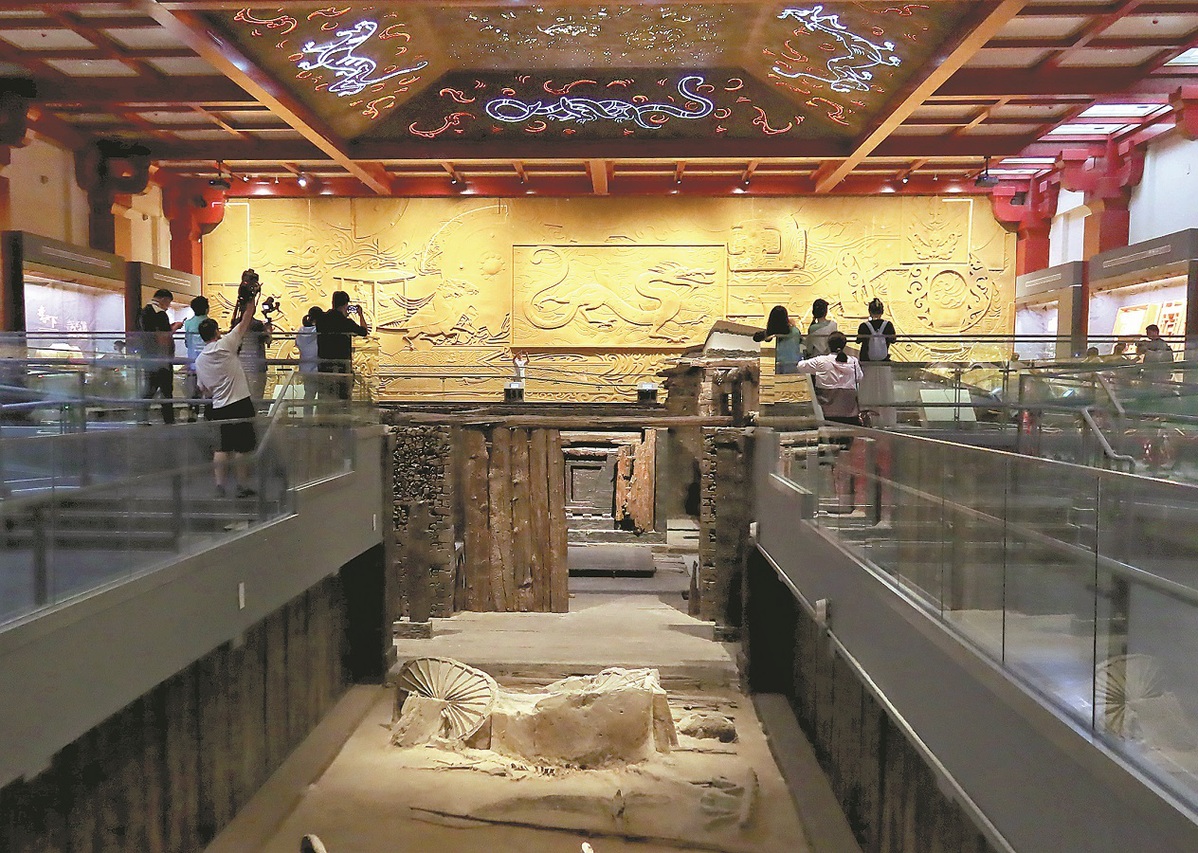
After a 13-year expansion and reconstruction, a key archaeological museum in Beijing reopened to the public on Tuesday, offering visitors a glimpse into the grandeur of the Han Dynasty (206 BC to AD 220).
The Beijing Dabaotai Site Museum, located in the southwest of the capital, was built in situ atop an important archaeological site. The newly upgraded venue spans more than 23,000 square meters, including 2,800 square meters of exhibition space.
Discovered in 1974, the more than 2,000-year-old Dabaotai site stunned researchers by providing rare, intact physical evidence of huangchang ticou, a high-level Han burial practice described in ancient texts, on Tomb No 1.
Huangchang ticou refers to a tomb chamber built with yellow cypress heartwood logs stacked inward to form a protective shell. The design mimics royal palaces and was used for the burials of royalty or high-ranking nobles.
The finding was hailed as a milestone in the history of archaeology in New China and was included in the Top 100 Archaeological Discoveries of the past century in 2021, when China marked 100 years since the birth of modern archaeology in the country.
"People during the Han Dynasty would serve the dead as one served the living," said Bai Yunxiang, a veteran archaeologist with the Chinese Academy of Social Sciences. "The tomb had a monumental scale and sophisticated design. It reflected architectural ingenuity and the essence of national ceremonial civilization."
The mausoleum is believed to be the final resting place of Liu Jian, a vassal king in the first century BC, and his queen.
Liu was a grandson of Emperor Wu, one of the most renowned rulers of the Han Dynasty. His father once attempted and failed to seize the throne, resulting in Liu being stripped of his noble titles. Years later, a succeeding emperor granted him the status of vassal king, though with a smaller domain.
At the museum, Liu's cypress tomb chamber has been placed at the center of an indoor gallery, accompanied by burial pits for chariots and horses. The tomb structure was reinforced during the museum's reconstruction, according to museum director Yang Zhiguo.
The queen's tomb, known as Tomb No 2, remains underground in an outdoor area. Its layout is outlined on the surface to help visitors understand its structure while adhering to preservation principles.
"It follows the principle of minimum intervention in protection," Yang said.
Originally established in 1983, the Beijing Dabaotai Site Museum was the first museum in China to focus on a Han-era archaeological site. The Han Dynasty is widely considered a peak of national strength in Chinese imperial history, and the area now known as Beijing was of strategic importance along the northern frontier.
"Dabaotai is not only significant for understanding Beijing's past," Bai said.
"It also provides crucial insights into Han politics and how the dynasty governed its northern territories."
The museum is open to the public free of charge from Tuesday to Sunday, with some temporary exhibitions requiring paid admission.
"Dabaotai offers a glimpse of a unified country with cultural diversity," said Zhang Lixin, director of the Beijing Municipal Cultural Heritage Bureau, during the museum's opening ceremony on Monday.
"It's also a vivid example of traditional Chinese etiquette and cosmology. This new museum will help bring renewed life to the site in modern society."
Zhang said the venue aims to become a hub for showcasing Hanera culture in Beijing by collecting more related artifacts and promoting archaeology-themed tourism.




- Exhibition commemorating the epic relocation of universities opens in Fujian
- Twelve punished for scaffold collapse that killed 7 in Shandong
- Slovenian official visits whole-process people's democracy practice site of CPPCC committees
- China's commercial rocket maker puts two satellites into orbit
- People in Taiwan commemorate victims of White Terror period
- China successfully launches new test satellites