A cultural expression
Shanghai-style attire a symbol of female independence and liberation. Yu Yilei and He Qi report.







Editor's Note: Using a blend of words and visuals, this series explores unique communities and reveals the heart of China through food, architecture, craftsmanship, landscapes and traditions.
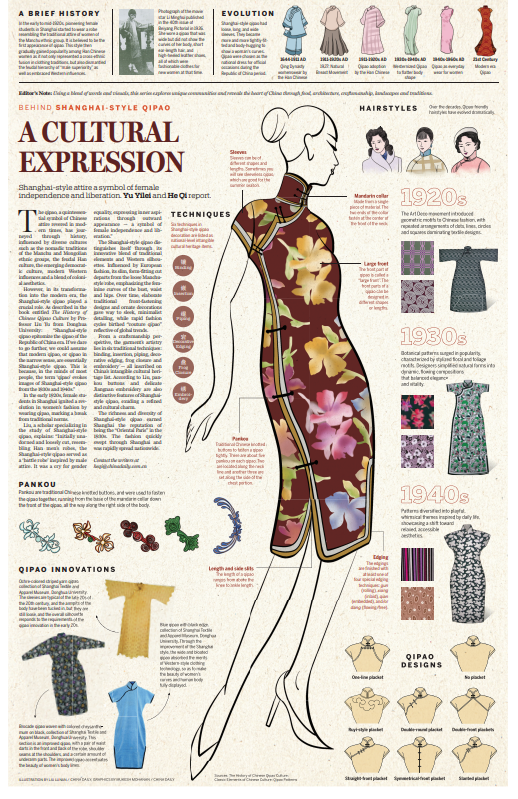
The qipao, a quintessential symbol of Chinese attire revered in modern times, has journeyed through history, influenced by diverse cultures such as the nomadic traditions of the Manchu and Mongolian ethnic groups, the feudal Han culture, the emerging democratic culture, modern Western influences and a blend of colonial aesthetics.
However, in its transformation into the modern era, the Shanghai-style qipao played a crucial role. As described in the book entitled The History of Chinese Qipao Culture by Professor Liu Yu from Donghua University: "Shanghai-style qipao epitomize the qipao of the Republic of China era. If we dare to go further, we could assume that modern qipao, or qipao in the narrow sense, are essentially Shanghai-style qipao. This is because, in the minds of most people, the term 'qipao' evokes images of Shanghai-style qipao from the 1930s and 1940s."
In the early 1920s, female students in Shanghai ignited a revolution in women's fashion by wearing qipao, marking a break from traditional norms.
Liu, a scholar specializing in the study of Shanghai-style qipao, explains: "Initially unadorned and loosely cut, resembling Han men's robes, the Shanghai-style qipao served as a 'battle robe' inspired by male attire. It was a cry for gender equality, expressing inner aspirations through outward appearance — a symbol of female independence and liberation."
The Shanghai-style qipao distinguishes itself through its innovative blend of traditional elements and Western silhouettes. Influenced by European fashion, its slim, form-fitting cut departs from the loose Manchu-style robe, emphasizing the feminine curves of the bust, waist and hips. Over time, elaborate traditional front-fastening designs and ornate decorations gave way to sleek, minimalist detailing, while rapid fashion cycles birthed "couture qipao" reflective of global trends.
From a craftsmanship perspective, the garment's artistry lies in six traditional techniques: binding, insertion, piping, decorative edging, frog closure and embroidery — all inscribed on China's intangible cultural heritage list. According to Liu, pankou buttons and delicate Jiangnan embroidery are also distinctive features of Shanghai-style qipao, exuding a refined and cultural charm.
The richness and diversity of Shanghai-style qipao earned Shanghai the reputation of being the "Oriental Paris" in the 1930s. The fashion quickly swept through Shanghai and was rapidly spread nationwide.
Contact the writers at heqi@chinadaily.com.cn



- China successfully launches new test satellites
- China launches Lijian 1 Y9 carrier rocket
- First cross-border event debuts at the National Games
- China Focus: National Games enhances coordination under 'one country, two systems'
- China's Fujian aircraft carrier to make regular appearances on high seas: spokesperson
- A decade of dialogues