Researchers help protect Cambodian dolphins







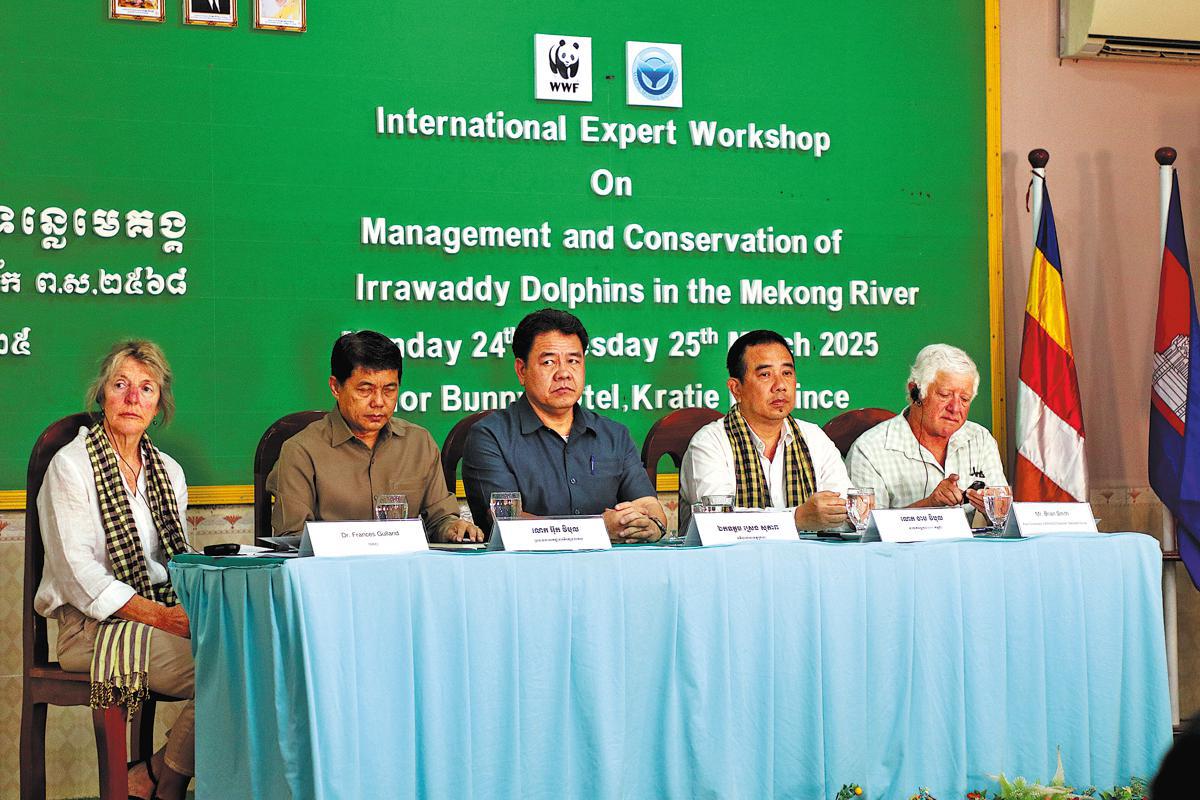
China's experience in the conservation of the Yangtze finless porpoise using advanced monitoring equipment and artificial intelligence is being applied to the protection of Irrawaddy dolphins in the Mekong River in Cambodia.
Irrawaddy dolphins inhabiting the Mekong River form a subpopulation, with current research estimating only about 89 remaining. Due to barriers such as dams, this group is confined to a roughly 180-kilometer-long stretch of the river within Cambodia. In terms of population size and habitat range, they are even more endangered than the Yangtze finless porpoises, which number 1,249, according to Mei Zhigang, researcher at the Institute of Hydrobiology, Chinese Academy of Sciences.
Their facial features are remarkably similar, though the Irrawaddy dolphin is larger and has a dorsal fin. Both are small-toothed whales that inhabit river environments and rely heavily on sound waves for navigation, communication and hunting, said Mei, who is also deputy secretary-general of Wuhan Baiji Dolphin Conservation Foundation.
"This shared trait made it possible to adapt the world's first real-time passive acoustic monitoring technology for small-toothed whales, originally developed by the institute for Yangtze finless porpoise population monitoring, to the study of Irrawaddy dolphins," he said.
Scientists from the two countries installed equipment along the Mekong River, conducting round-the-clock monitoring of acoustic signals emitted by the dolphins since December 2023. Using artificial intelligence technology, the system can automatically identify dolphin sonar signals in real-time, while computer analysis deciphers their distinctive features and behavioral patterns.
Recent achievements included discovery of 51 Irrawaddy dolphins, which is different from official data from Cambodia, but similar to the survey of US researchers using photography recognition technology. The team also found 14 new Irrawaddy dolphins in a river section where dolphin activity had rarely been documented before, Mei said. "We also found that they mainly hunt during daytime, and suspend hunting when a number of tourist ships pass. They swim about 20 kilometers upstream to a deep water zone during rainy season, and underwater noise has significantly disturbed their auditory sense," he said.
The team found that shipping, tourist boats and fishing gear in key habitats are disrupting their feeding and resting environments. Additionally, intense noise pollution in certain areas hinders their normal movement and seasonal migration, impeding communication and breeding between different subpopulations. These barriers pose a severe threat to the stability and survival of the species.
The findings have drawn the attention of Cambodia's Ministry of Agriculture, Forestry and Fisheries, which has endorsed and supported recommendations such as establishing no-fishing zones and limiting the number of dolphin-watching boats.
However, they also noted that implementing these measures may face resistance. For instance, fishermen may oppose fishing bans over livelihood concerns, while tour boat restrictions could provoke discontent among tourism operators, Mei added.
Despite these challenges, the ministry proposed starting with a pilot implementation in the core protected zone spanning about 20 km, where dolphin-watching guidelines could be introduced and river patrols strengthened at night to reduce accidental dolphin fatalities caused by fishing activities.
The team's technology was adopted in the monitoring and protection of the Yangtze finless porpoise, whose number increased from 1,012 in 2017 to 1,249 in 2022.
"That is due to the 10-year ban on fishing on the Yangtze River," said Wang Ding, director-general of Wuhan Baiji Dolphin Conservation Foundation.
At a global seminar in March, experts from Pakistan, Myanmar and other countries requested their assistance in protecting dolphins.
The team is working on exploring how AI technology can help in freshwater cetacean conservation research. They aim to build a global small cetacean database and develop AI-powered solutions, jointly promoting technological advancement and conservation practices in countries related to the Belt and Road Initiative, as well as other regions in Asia and South America, according to Wang.
Contact the writers at chenmeiling@chinadaily.com.cn



- National Games vibe is everywhere in Guangzhou
- Forum unites global experts to enhance city image communication
- Miao New Year celebrations get underway in Guizhou's Leishan county
- Mainland spokesman reiterates stand on Taiwan
- Fujian county's rural development becomes a big draw for Taiwan investors
- Nobel laureate in chemistry: Give young scientists more independence