Universities rush to offer AI majors
Experts warn that quality not quantity must be the focus for educators







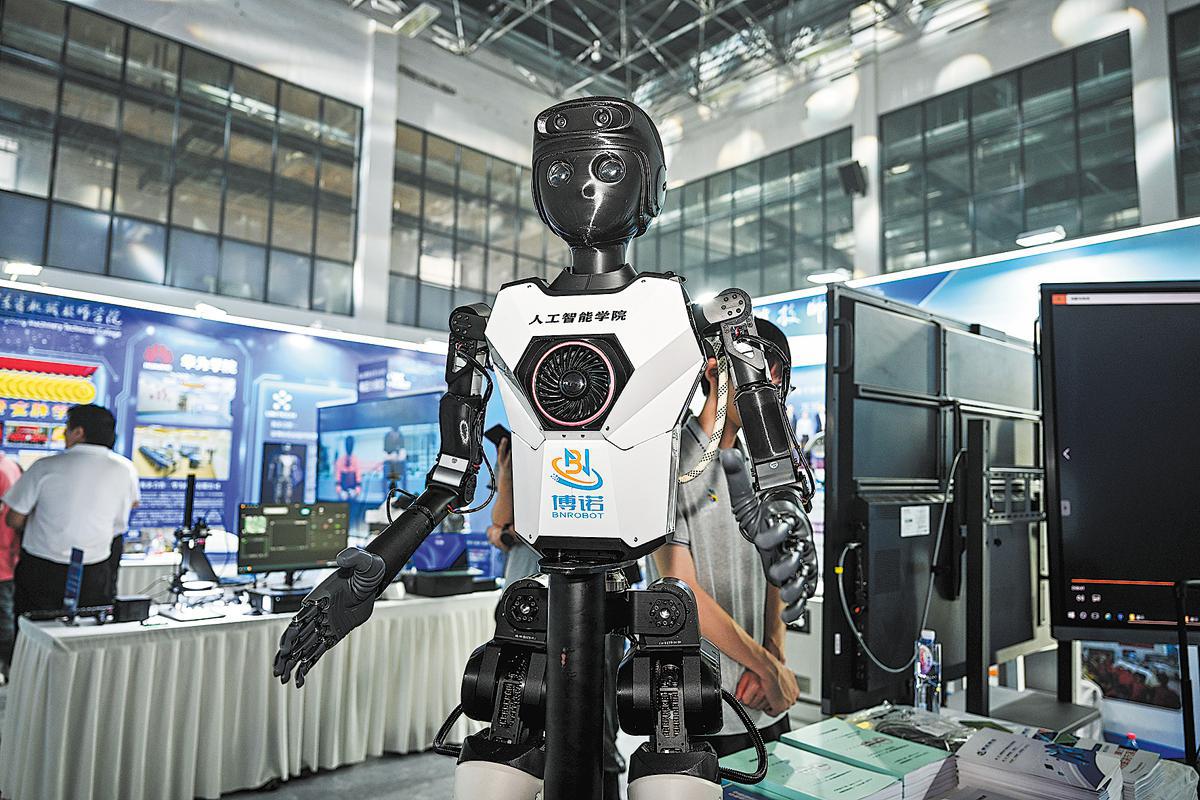
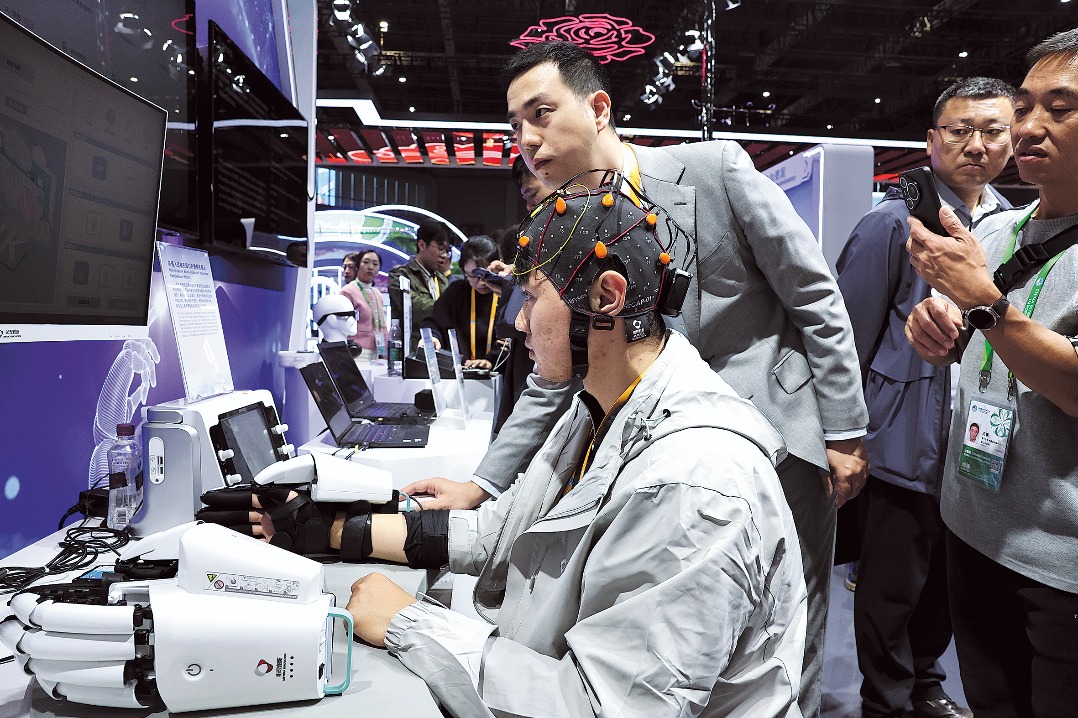
Beijing University of Technology launched its AI undergraduate program in 2020 and introduced an experimental AI class this year. Designed to bridge the needs of academia and industry, the program emphasizes foundational knowledge, technical innovation and interdisciplinary research, according to Yin Baocai, program director and a professor at the university's School of Information Science and Technology.
The inaugural class of 2021 boasted a 55 percent postgraduate advancement rate, with others securing roles at tech firms such as Lenovo and State Grid Beijing, he said.
To address the AI talent gap, the university integrates internships, corporate collaborations and competitions into its training model. For instance, the "engineering master forum" invites industry experts to deliver lectures, while projects in smart transportation and environmental systems simulate real-world problem-solving, he said.
Yin predicts AI will drive breakthroughs in healthcare, robotics and scientific research. Despite the field's popularity, he emphasized that program applicants require strong logical thinking and programming aptitude to avoid "bandwagon" enrollment.
AI majors have become synonymous with "high salaries" and "strong employability".
With computer science and AI-related disciplines dominating the list of the top 10 most popular majors, a severe talent shortage persists, with China's AI workforce gap exceeding 5 million, according to the Ministry of Human Resources and Social Security.
Salaries reflect the competition. Top AI graduates from elite universities command annual packages of 600,000 to 1 million yuan ($84,000 to $140,000), while entry-level AI trainers in Hubei province earn a monthly median salary of 7,800 yuan. Regional disparities exist: Beijing, Shanghai, Shenzhen in Guangdong province and Hangzhou in Zhejiang province lead with average monthly salaries of 18,000 yuan, followed by second-tier cities like Suzhou in Jiangsu province at 14,000 yuan, according to Haibao News, a news portal based in Shandong province.
However, companies still struggle to recruit qualified personnel. A Shandong-based AI firm executive noted that even offers of 30,000 yuan per month often fail to attract ideal candidates. At a Beijing recruitment fair in May last year, 53 companies offered 794 AI-related positions, drawing nearly 600 applicants.
Nationally, China's AI core industry is valued at almost 600 billion yuan, with over 4,500 enterprises spanning chips, algorithms and applications. With generative AI users hitting 230 million by the middle of last year, experts warn that bridging the talent gap remains critical to sustaining China's AI leadership.
Despite the optimism, concerns about program inflation persist. Since 2018, hundreds of universities — including vocational schools — have hastily launched AI programs, often lacking faculty or infrastructure.
Xu Li, a student at a less reputable university in Zhejiang, told China Newsweek how her computer science cohort rushed to switch to AI when the program launched. "I followed the crowd without thinkingit sounded futuristic," she admitted.
Wu Fei, a professor at Zhejiang University, attributes this craze to societal transformation. "Humanity is entering an intelligent era. Without AI, there's no 'intelligence'. Students fear being left behind, especially after breakthroughs like ChatGPT."
Dean Fan from Changsha University of Science and Technology cautioned against "cold employment for hot majors" if institutions prioritize enrollment over quality. "Avoid setting up programs just for admissions," he warned, urging schools to emphasize unique strengths.
Meng Yu earned his bachelor's degree in information engineering from a well-known university in China, later pursuing studies in computer vision in Australia. After completing his PhD, he returned to China and has been teaching computer vision theory at a university in Fujian province.
He told China Newsweek that computer vision is an applied field of artificial intelligence. He said candidly that only top-ranked computer science universities possess the faculty resources and student caliber necessary to support rigorous AI undergraduate programs, urging prospective students to choose carefully.
In his view, the core of AI education lies in computer science and mathematics.
For average students, mastering even one of these disciplines in four years is challenging enough. To excel in AI, however, students need stronger mathematical foundations than typical engineering majors and must undergo repeated training in computer engineering, AI algorithms and application scenarios, he said.
Completing such comprehensive training at the undergraduate level is highly difficult, he noted, as each component risks becoming superficial, resulting in a "jack of all trades, master of none" outcome.
zoushuo@chinadaily.com.cn