Seoul's good-neighborly policy adjustment a boon for regional peace and development: China Daily editorial







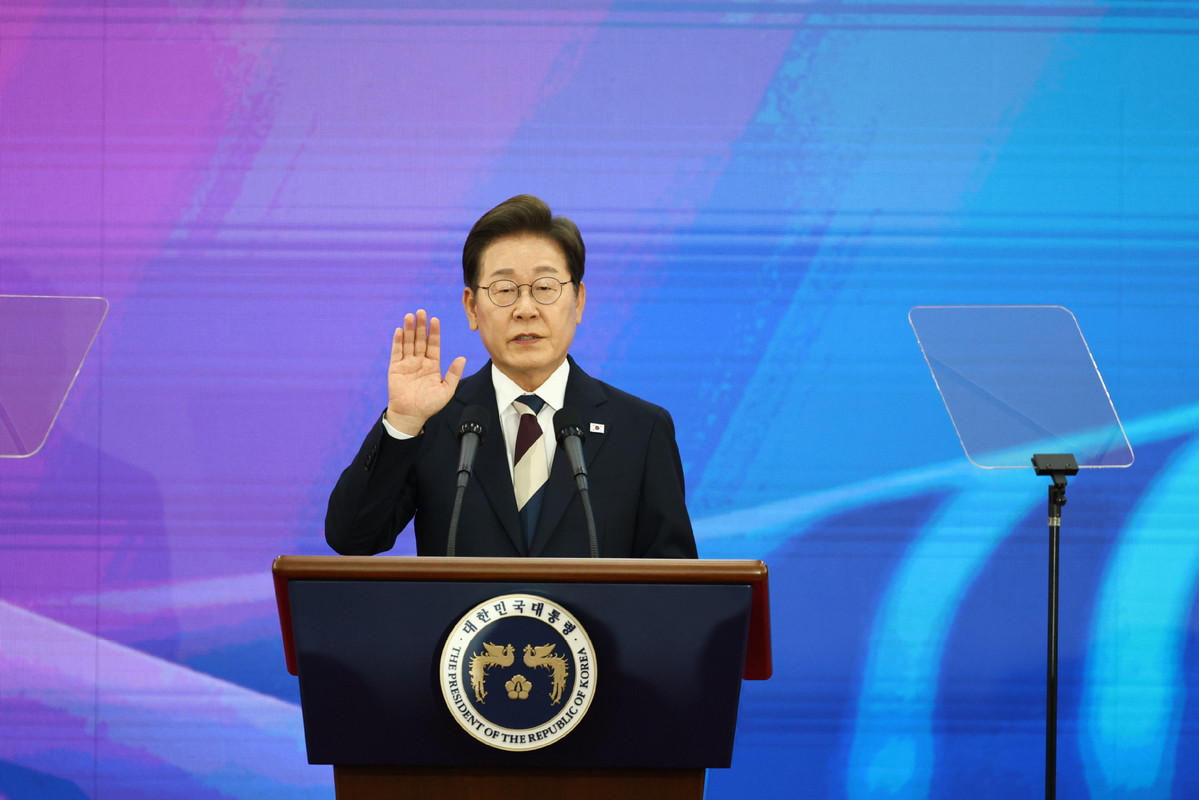
Ending months of political turmoil in the country, Lee Jae-myung's inauguration as the new president of the Republic of Korea marks a significant turning point in the country's political landscape. Taking office immediately following a snap election held to replace ousted former leader Yoon Suk-yeol, Lee enters the presidency with a mandate for change.
Lee, the candidate of the liberal opposition Democratic Party, swept to victory defeating his archrival Kim Moon-soo of the conservative People Power Party. In his victory address at the National Assembly, Lee outlined his administration's priorities, emphasizing the restoration of democracy, economic recovery, ensuring public safety, and a commitment to pursue peaceful dialogue with the Democratic People's Republic of Korea. By vowing to reopen channels of communication with Pyongyang, Lee has signaled his willingness to engage in diplomatic efforts aimed at fostering stability and cooperation in the region.
Although Lee has affirmed the importance of security cooperation with Washington and Tokyo, he has been steadfast in his refusal to be constrained by a binary choice that would jeopardize Seoul's relations with Beijing. Instead, he advocates for a nuanced approach that prioritizes economic interdependence and regional stability.
Lee's call for a recalibration of the ROK's foreign policy so it recognizes the close economic ties and geographical proximity of China represents a welcome departure from the diplomacy of his predecessor. By seeking to foster a more pragmatic and mutually beneficial relationship with China, Lee is acknowledging their longstanding cooperative relations, characterized by continuous growth, have contributed to regional peace and development.
It has to be pointed out that under Lee's predecessor, the ROK's pro-US policy cast a dark shadow on China-ROK ties and created negative perceptions of China in ROK society. It is hoped that Lee will indeed be able to adopt a more balanced approach, which will anchor the ROK's ties with China on more stable terrain.
Beijing has said it hopes that political transition in the ROK is smooth, and the Lee administration seizes the opportunity to do more so that relations between the two countries continue to bring real benefits to the two peoples and contribute to regional peace and development.
Thanks to his favorable remarks on China during his presidential campaign, Lee has already won some hearts in China, and raised hopes that he will indeed endeavor to forge more friendly ties with Beijing. The two countries have everything to gain from building on what has been achieved over the past three decades.
As a close ally of the US, under Lee's predecessor, the ROK drew closer to Washington. For Lee to conduct his pragmatic diplomacy, a balancing act will be needed.
Lee's promise to deepen economic and trade relations with China underscores his recognition of the shared interests of both nations and the importance of strengthening bilateral relations. As Chinese Foreign Ministry spokesman Lin Jian pointed out, the driving force behind the development of China-ROK relations lies in their shared interests, which are not targeted at any third party and should not be influenced by third-party factors.
As neighbors and partners, China and the ROK have much to gain by deepening their relationship. China's stable policy toward the ROK is rooted in the principles of good-neighborliness and friendship, providing a solid foundation for sustained collaboration and shared prosperity.
In the face of rising unilateralism and protectionist tendencies, China and the ROK should stand united in their commitment to resist divisive policies that threaten global supply chains and economic stability.
By jointly opposing isolationist practices and advocating for open and interconnected trade systems, the two countries can work together to safeguard the smooth functioning of the global supply and industry chains.
It is imperative for the ROK to uphold the spirit of friendship and cooperation with China, thereby cementing a strategic and cooperative partnership that advances regional peace and prosperity.