Not a care for the world







The US' refusal to accept any responsibility to provide global public goods creates risks, but also opportunities
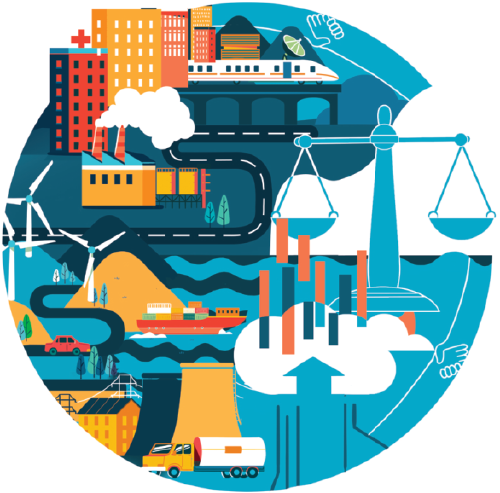
Global public goods (GPGs), such as climate stability, international security and disease control, are critical for the well-being of all nations. Over the past five years, issues such as equity in access to COVID-19 vaccines, insufficient funding for climate mitigation and adaptation, debt relief, interest rates, unilateral Western sanctions, and the perception of double standards in the applicability of the rule of law and other aspects of global governance have significantly undermined collective actions and international cooperation. The series of disruptive administrative initiatives launched by the US administration are further raising concerns about the sustainability of GPG provisions and necessitates exploring alternative mechanisms to fill the gap.
The United States has now exited the Paris Agreement on climate change and the World Health Organization, and is reviewing all international treaties to which the US is a party and international organizations of which it is a member and exploring the possibility of withdrawal. It has dismantled its foreign aid system and suspended most of the projects. The administration's budget for the 2026 fiscal year released in early May proposes to increase defense spending by 13 percent and slash federal funding for international affairs by almost 84 percent through massive cuts to US foreign aid and support for international organizations, and the rescission of previously appropriated funds. It cuts not only voluntary contributions to United Nations programs and agencies but also US legally binding, assessed contributions to the UN's regular and peacekeeping budgets. The US also rejects and denounces the 2030 Agenda for Sustainable Development, an ambitious and universal consensus on development. The administration has also imposed tariffs on imports from countries around the world.
In the meantime, the administration is reducing international sharing of scientific information and technical data. It shuttered the Famine Early Warning System Network, prevented US agencies from sharing atmospheric, climate and other Earth observations data with UN agencies, and requested the Centers for Disease Control and Prevention to stop communicating with the WHO. It has also shown little interest in working with international stakeholders to develop guardrails against potentially catastrophic AI dangers.
These measures show that the US is now trying to avoid multilateralism when possible, relegating issues on the global agenda to the back banner, and refusing any concept or responsibility for the US to maintain world order and provide GPGs. They are not just based on cost-benefit calculations, but also on the belief that international treaties and organizations infringe on US sovereignty. This viewpoint was made clear by the US' UN delegation's declaration in March that it would vote against any resolution referencing the Sustainable Development Goals, on the grounds that they "advance a program of soft global governance that is inconsistent with US sovereignty and adverse to the rights and interests of Americans".
This retreat from multilateralism and the provision of GPGs will have broad and deep impacts. The disruptive measures are eroding credibility, damaging long-standing development partnerships, and creating a whole new level of uncertainty. The financial cuts are highly likely to cripple the ability of UN agencies to address pressing challenges of interdependence. Humanitarian organizations such as the World Food Programme, bearing the brunt of early US cuts, are shedding thousands of employees and struggling to manage large-scale crises in Gaza, Sudan and elsewhere. They will also profoundly impact global health security, reshape scientific cooperation, and undermine the governance of emerging technologies, threatening lives at a time when the SDGs are already heavily delayed.
Nevertheless, no country can thrive in isolation in today's interconnected world. Global risks to humanity such as climate change, biodiversity loss, pandemics, and the spread of infectious diseases are dangers that affect us all. Working together remains the only viable path to shared security and prosperity. With the withdrawal of the US administration from multilateralism, the question now is how the provision of GPGs can be reconstituted. Where will the ideas, mechanisms, human and financial resources come from to support the new world order? Countries and regions will need to leverage existing frameworks, create new institutions, and explore new models to address global challenges.
The first focus should be on tackling global challenges. That will need more pragmatism to overcome differences in thinking and approaches and embrace more flexible approaches to negotiation. Historically, some of the most effective agreements, such as the Montreal Protocol, started with focused but committed coalitions, and then expanded. This kind of phased approach provides meaningful inspirations in the current context. Smaller groups of willing states and institutions can create energy, pool resources, establish proof points, and scale them up from there.
The second focus should be to make global governance more representative, fairer and effective. Global governance reform requires addressing power imbalances, increasing inclusivity, and ensuring that decision-making reflects the needs of all nations, especially those of the Global South. These reforms include adjusting voting shares in the Bretton Woods System to reflect current economic realities, ensuring Global South countries have a say in the governance of artificial intelligence and digital trade rules, and implementing the common but differentiated responsibility principle in climate change adaptation and mitigation. Additionally, global governance reform requires rebuilding trust between institutions and the people they serve, which means continuing to elevate and clearly communicate the tangible results that international cooperation delivers in daily life, in global crises and in laying the groundwork for future resilience.
The third focus should be to innovate financing. There is a huge gap in financing GPGs. With the constraints on public resources in both developed and developing countries, additional resources and mechanisms will be needed. These include the foreign aid playing a catalyst role, increasing the capitalization of multilateral development banks, leveraging the roles of the private sector and philanthropy, mobilizing more domestic resources, and better using remittances. Moreover, innovative partnerships among different parties to use their respective comparative advantages and avoid duplications are also important. In this regard, recent examples, such as the partnerships between the Asian Infrastructure Investment Bank and the Vaccine Alliance, Gavi, to provide sustainable financing for health and immunization systems in low- and lower middle-income countries, and the collaboration between the Export-Import Bank of China and the UN International Children's Emergency Fund on essential services for the well-being of children in Nigeria, the first such partnerships for both sides, are notable. Mechanisms such as carbon pricing, digital taxes or sovereign wealth fund contributions could also generate dedicated funding.
The US retreat from the provision of global public goods creates risks but also opportunities for a more inclusive, stronger and multipolar system. By diversifying partnerships, empowering multilateralism, and strengthening institutional innovation, the world can mitigate the vacuum and prevent the exacerbation of global crises.
The author is vice-president of the Center for International Knowledge on Development. The author contributed this article to China Watch, a think tank powered by China Daily.
Contact the editor at editor@chinawatch.cn.