Vessel marks new era in salmon farming







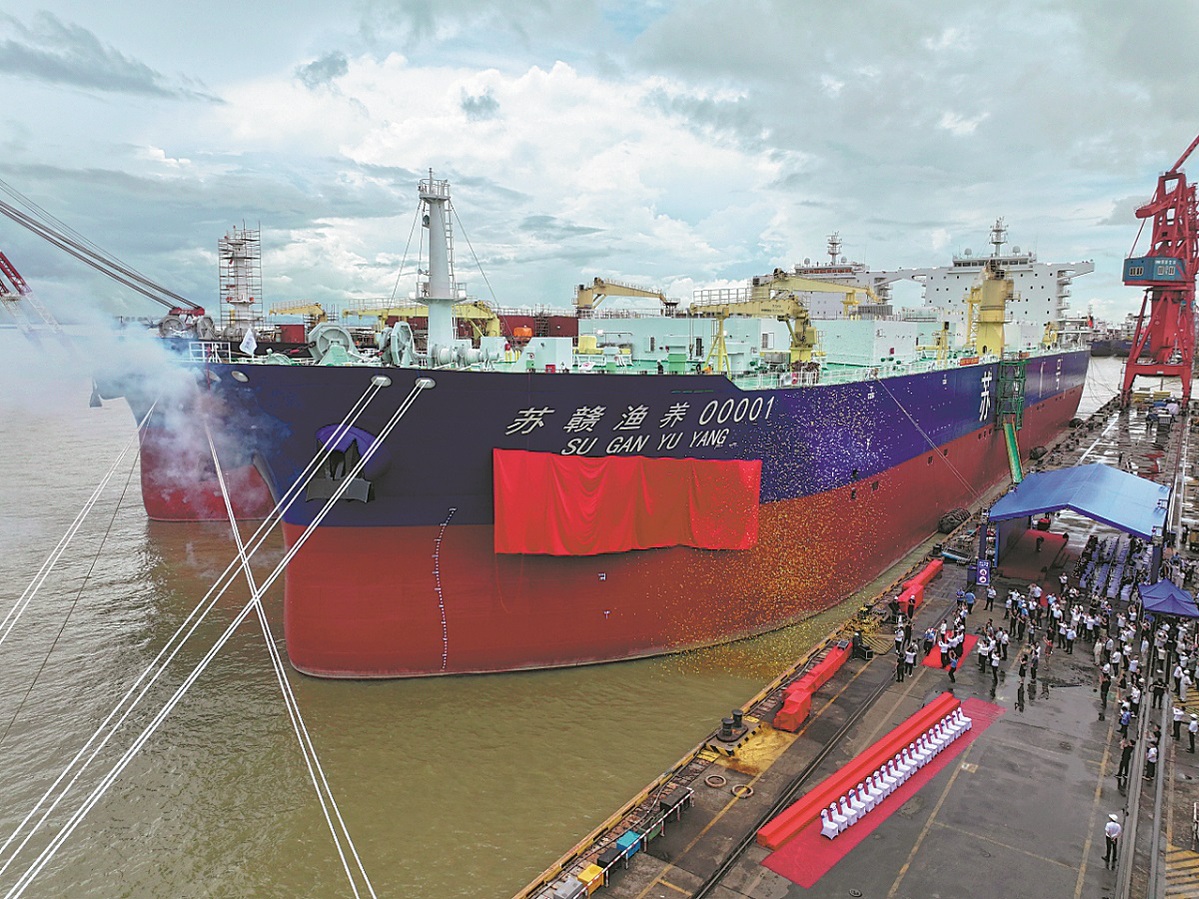
The world's first salmon aquaculture vessel was delivered for use in Nansha district in Guangzhou, Guangdong province, on Thursday, marking a new era in deep-sea salmon farming in China and signaling the country's ambition to reduce its reliance on imported fresh salmon.
The vessel, Su Hai Yi Hao, measures 249.8 meters in length, 45 meters in width and has a displacement of 132,000 metric tons. It was designed by the Fishery Machinery and Instrument Research Institute under the Chinese Academy of Fishery Sciences and built by CSSC Huangpu Wenchong Shipbuilding Co at a cost of nearly 600 million yuan ($83.7 million).
With a holding capacity of 83,000 cubic meters of aquaculture water, the vessel is expected to produce more than 8,000 tons of salmon annually — valued at over 600 million yuan — after it enters operation, said Chen Wei, the vessel's chief designer.
Designed to accommodate more than 50 crew members, the vessel has a range of 20,000 nautical miles and can sustain operations independently for up to 90 days. Its full-load speed exceeds 10.3 knots, or approximately 19 kilometers per hour.
Chen described it as the world's first self-propelled, closed-system salmon aquaculture vessel, requiring complex shipbuilding technologies.
"It is known as a smart marine ranch, integrating industrial breeding technology with marine engineering," he said.
Powered by four 2,800-kilowatt main generator sets, the ship supports both anchored and migratory aquaculture modes. It houses 15 enclosed cabins that enable intelligent control of water, oxygen, feed, lighting and waste management-creating optimal growth conditions for salmon.
A continuous water exchange system allows for a constant inflow of natural seawater, maintaining freshness and cleanliness.
"By adjusting the inlet pressure, we can meet the water flow velocity required for different fish species and their growth stages," Chen said.
The vessel also has equipment for real-time environmental monitoring, centralized automated feeding and integrated ship-to-shore control systems.
Onboard processing facilities allow all salmon to be processed, frozen and packaged at sea before delivery to markets and restaurants on land, Chen added.
Construction of the vessel began in early 2023, and sea trials were completed in April this year.
According to Song Fangmin, project manager at Jiangsu Lianshen Marine Technology Co — the vessel's owner — Su Hai Yi Hao will operate in the Bohai and Yellow seas. Registered in Lianyungang, Jiangsu province, the ship is expected to contribute to the city's efforts to become a strong maritime hub and advance high-quality development.
The first harvest is scheduled for June next year, when each salmon is expected to reach 5 kilograms from 2.5 kg at the start of feeding, Song said.
He highlighted the strong potential for growth in salmon farming in China, which remains largely dependent on imports. Last year, the country imported more than 100,000 tons of salmon.
In the mainland market, salmon sells for about 80 yuan per kg.
"It has become a core marine product favored by consumers worldwide, with demand continuing to grow," Song said.
Industry insiders project that China's demand for salmon will reach 210,000 tons by 2030.
Leveraging its extensive coastline, rich marine resources, and manufacturing capabilities, Guangdong has ramped up the construction of aquaculture vessels in recent years.
In May, the world's first natural waterbody exchange aquaculture vessel, Wan Qu Ling Ding, was launched in Jiangmen, Guangdong, marking another significant step in China's deep-sea aquaculture development.