Smart machines rewriting growth story







Amid the sweltering midsummer heat in July, three consequential gatherings in China sent out a clear message: technology is more than just an add-on to economic growth; it is its very lifeblood. On July 30, the Political Bureau of the Communist Party of China Central Committee underscored the need to create more jobs, stabilize enterprises and markets, and meet people's expectations, saying that scientific and technological innovation must drive the development of "new quality productive forces".
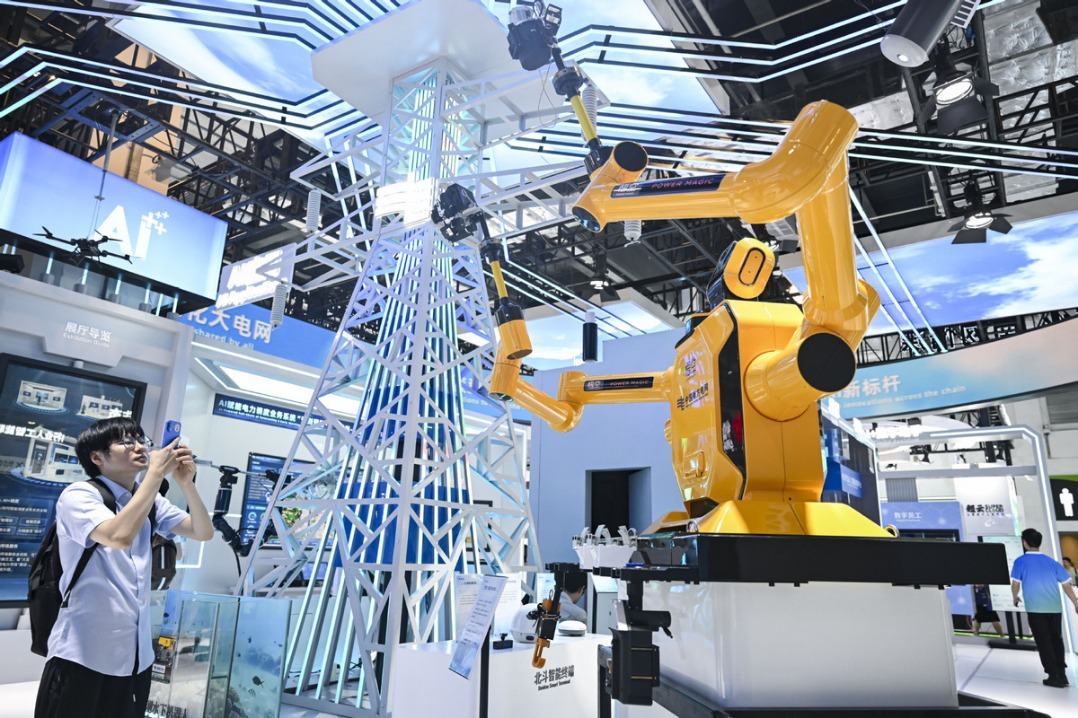
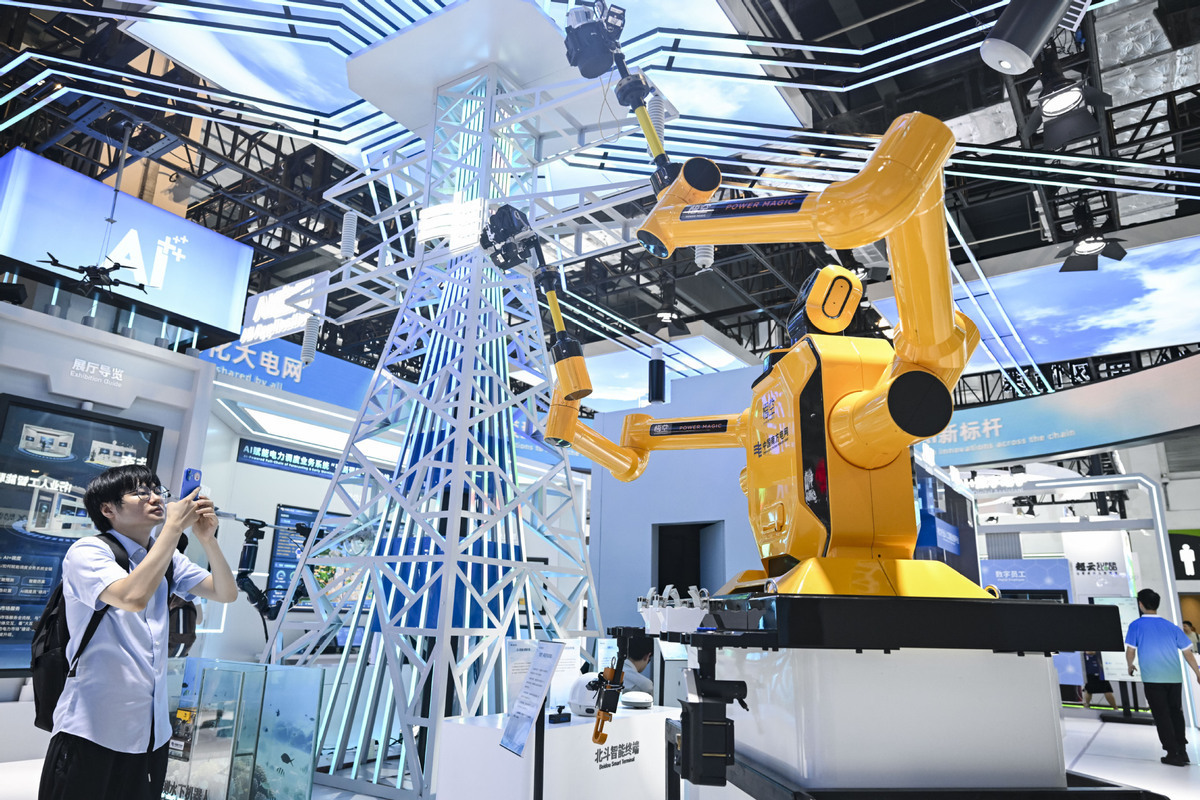
Just days earlier, on July 26-28, the World Artificial Intelligence Conference in Shanghai rolled out its Global AI Governance Action Plan, a blueprint for the healthy development of AI and preventing it from controlling human life. And in mid-July, the third China International Supply Chain Expo in Beijing became an exhibition for smart gizmos — robotic arms that never tire, blockchain trackers that follow a courier package's every move, and digital twins so lifelike they deserve their own passports.
The conference and expo did more than showcase smart gadgets and cutting-edge software. They highlighted a simple truth: China's economic engine is now powered by technology at every stage — from ideation and prototyping to manufacturing and logistics.
Numbers cut through the rhetoric. In the first half of this year, China's GDP grew by 5.3 percent year-on-year despite mounting external pressure and sharp shifts in the international environment since April. More tellingly, the fastest gains were made by sectors steeped in high-end technology. In terms of industrial output, enterprises above a certain size saw their value-added output increase by 6.4 percent, with equipment manufacturing surging by 10.2 percent and high-tech manufacturing by 9.5 percent.
More than marginal increases, these constitute a structural shift, where machinery, robotics and precision instruments, not traditional factors such as coal, steel or low-end assembly lines, are propelling growth.
Since equipment manufacturing is the bedrock of the real economy, many enterprises engaged in the sector have raised their production capacity by pursuing green and intelligent production. For evidence, you need look no further than the growing smart equipment-manufacturing clusters in Guangzhou and Shenzhen, where internet-connected robots collaborate with human workers to weld, pack and inspect products with uncanny precision. On the other hand, the electric vehicles awaiting shipment to Europe and other regions show what the marriage of clean-tech and smart manufacturing can yield.
The service sector, too, has shed its image of a passive recipient of industrial spillovers. Thanks to the breakthroughs in large AI models, quantum communications and humanoid robotics, the service sector has become a hotbed of innovation. In the first half of this year, services value-added increased by 5.5 percent. But more striking was the 11.1 percent growth in information transmission, software and IT services, and the 9.6 percent increase in leasing and business services.
From January to May, high-tech service firms' revenue increased by nearly 10 percent, while strategic emerging services — for example, digital health platforms, smart finance and e-commerce enablers — grew by 9.5 percent, while transactions handled by e-commerce services increased by 13.4 percent.
Much of this surge can be attributed to the deepening integration of technology into everyday business. This means digital-service firms are no longer mere data warehouses. They've become active R&D centers, co-designing products with manufacturers, optimizing supply-chain logistics in real time, and even managing risks through predictive analytics.
All these innovations require capital, and China has been sowing the much-needed financial seeds with gusto.
Also in the first half, manufacturing investment increased by 7.5 percent, outpacing total investment by nearly five percentage points, while high-tech manufacturing attracted heavy investment: aerospace-equipment investment surged by 26.3 percent, and computer and office-equipment manufacturing increased by 21.5 percent. And in the services sector, investment in high-tech services grew by 8.6 percent, with information-service investment alone increasing 37.4 percent.
These are far from ego-boosting figures. They represent capacity — factories, labs and digital platforms that will underpin China's next phase of global competitiveness. Traditionally infrastructure used to be measured in terms of kilometers of railways or megawatts of power. Today, infrastructure is measured by gigaflops, number of data centers and use of AI chips.
With R&D spending at nearly 2.7 percent of GDP — already more than the European Union's average and approaching the OECD mean — China is betting on knowledge, not just bricks and mortar. Patent offices are overloaded with applications: almost 5 million valid patent filings in the first five months of 2025, up 12.8 percent year-on-year. This transforms the narrative from line charts of export volumes to intellectual property portfolios, and trained teams of data scientists.
Yet challenges remain. The global competition in semiconductors and the perennial need for regulatory calibration of data privacy and AI ethics demand special attention. It is a fact that the Chinese economy has entered a new era where technology is driving productivity, the service sector is leading in innovation platforms, and investment is promoting sustainable growth.
In short, the Chinese economy is evolving. The old model of low-cost manufacturing is giving way to one defined by intelligent machines, data-driven services and frontier-pushing research. If the events of July 2025 tell us anything, it is that this transformation is not a footnote to China's economic story but its very headline.
The author is a professor at School of Economics, Renmin University of China.
The views don't necessarily reflect those of China Daily.
If you have a specific expertise, or would like to share your thought about our stories, then send us your writings at opinion@chinadaily.com.cn, and comment@chinadaily.com.cn.