World-leading neutrino detector begins operation in Guangdong







The world's largest transparent spherical neutrino detector has completed liquid filling and begun data taking in Jiangmen, Guangdong province, marking a significant step in frontier studies of particle physics, astrophysics and cosmology.
Located 700 meters underground, the Jiangmen Underground Neutrino Observatory, or JUNO, detects neutrinos produced 53 kilometers away by the Taishan and Yangjiang nuclear power plants and measures their energy spectrum with record precision. The location provides a unique opportunity to determine the neutrino mass ordering, the primary goal of this experiment.
Neutrinos are known as "ghost particles" because of their elusive nature and the role they play in unraveling cosmic mysteries.
"The completion and operation of the JUNO detector mark a historic milestone, as it is the first major scientific facility of its scale and precision dedicated to neutrino research worldwide. JUNO will enable us to answer fundamental questions about the nature of matter and the universe," said Wang Yifang, an academician at the Chinese Academy of Sciences.
JUNO's liquid scintillator volume is 20 times greater than the next best liquid scintillator neutrino detector. Its determination of the mass ordering is independent of matter effects in the Earth and largely free of parameter degeneracies, enabling a threefold increase in photoelectron yield and achieving an unprecedented energy resolution of 3 percent.
Li Yufeng, a researcher at the Institute of High Energy Physics of the academy, said JUNO is designed to determine the mass ordering of the three neutrino types, whose total mass is less than 0.12 electron volt, or about one-millionth of an electron's mass. The nearly massless nature of neutrinos makes them challenging to study, yet understanding them may help explain mysteries of atomic composition and cosmic evolution.
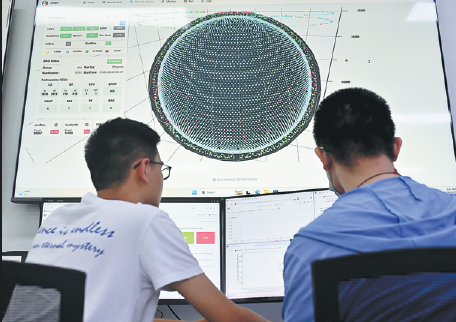
Underground construction began in 2015. JUNO started filling 60,000 metric tons of ultrapure water in December, and over the past six months, 20,000 tons of liquid scintillator have been filled into a 35.4-meter diameter acrylic sphere located at the center of a 44-meter-deep water pool. The sphere is surrounded by 45,000 photomultiplier tubes, and the liquid scintillator displaced the water during filling.
"When neutrinos pass through, they sometimes interact with nuclei or electrons, creating charged particles. These particles excite the scintillator molecules, emitting faint flashes of light called scintillation photons," Li said.
"The high transparency of the liquid allows these photons to reach surrounding photomultiplier tubes, which convert the light into electrical signals. By analyzing the timing, intensity and spatial distribution of these signals, scientists can reconstruct neutrino interactions, measure their energies and identify their types," he said.
JUNO is designed for a scientific lifetime of up to 30 years, with an upgrade path planned for 2030 to enable a world-leading search for neutrinoless double-beta decay and probe the absolute neutrino mass scale, Li said.
Hosted by the Institute of High Energy Physics, JUNO's construction — which cost 2.7 billion yuan ($377 million) — involved more than 700 researchers from 74 institutions across 17 countries and regions. China's investment in the total construction costs is around 80 percent.
"The landmark achievement we announce today is also a result of the fruitful international cooperation ensured by many research groups outside China, bringing to JUNO their expertise from previous liquid scintillator setups," said Gioacchino Ranucci, a professor at the University of Milano and INFN-Milano in Italy who participated in the construction.
"The worldwide liquid scintillator community has pushed the technology to its ultimate frontier, opening the path toward the ambitious physics goals of the experiment," Ranucci said.
Before JUNO, China's first-generation neutrino detector, the Daya Bay Neutrino Experiment in Guangdong, operated from 2011 to 2020. It discovered the third mode of neutrino oscillation, confirming the standard three-neutrino mixing paradigm. The finding was recognized by Science magazine as one of the Top 10 Scientific Breakthroughs of 2012.





Today's Top News
- PLA fully capable of crushing secessionist attempts
- China holds central rural work conference
- President Xi to deliver New Year's message to ring in 2026
- Xi's diplomacy in 2025: Shedding light on a world at crossroads
- FTP has given Sanya a complete makeover
- China to apply lower import tariff rates to unleash market potential